
We read your photo as:
During glycolysis, the oxidation of 3-phosphoglyceraldehyde (PGAL, also known as glyceraldehyde-3-phosphate or G3P) is a key step.
ScanSolve AI Answer
Step-by-step solution
4 stepsDuring glycolysis, the oxidation of 3-phosphoglyceraldehyde (PGAL, also known as glyceraldehyde-3-phosphate or G3P) is a key step.
Analyze the reaction involving PGAL.
The enzyme glyceraldehyde-3-phosphate dehydrogenase catalyzes the oxidation of PGAL. In this reaction, PGAL is oxidized to 1,3-bisphosphoglycerate (BPGA).
Identify the electron acceptor.
During the oxidation of PGAL, hydrogen atoms (and electrons) are removed from PGAL. These are transferred to the coenzyme NAD, which gets reduced to NADH and a proton (H). So, NAD is reduced to NADH + H.
Determine the energy transformation (ATP formation/consumption).
In this specific step, an inorganic phosphate () is added to PGAL to form BPGA. This step does not directly consume or produce ATP. However, in the very next step of glycolysis, 1,3-bisphosphoglycerate (BPGA) is converted to 3-phosphoglycerate (PGA), and during this conversion, a phosphate group is transferred from BPGA to ADP to form ATP via substrate-level phosphorylation.
Evaluate the given options.
-
(A) PGAL is oxidised to BPGA, transferring hydrogen atoms to NAD+, and ATP is consumed in the process.
- The oxidation and NAD reduction are correct. However, ATP is not consumed in this step.
-
(B) PGAL is oxidized to BPGA, NAD+ is reduced to NADH + H, and ATP is directly formed in this step.
- The oxidation and NAD reduction are correct. However, ATP is not directly formed in this specific step.
-
(C) PGAL is oxidized to BPGA, NAD+ is reduced to NADH + H, and ATP is later formed during the conversion of BPGA to 3-phosphoglyceric acid (PGA).
- This statement accurately describes the oxidation of PGAL to BPGA, the reduction of NAD to NADH + H, and correctly states that ATP is formed in the subsequent step when BPGA is converted to PGA.
-
(D) PGAL is directly converted to ATP and CO, releasing energy without involvement of NAD+.
- This statement is incorrect. PGAL is not directly converted to ATP and CO. CO is not produced in glycolysis, and NAD is definitely involved.
Therefore, option (C) provides the most accurate description.
The final answer is
-
Still stuck on this one?
Ask a follow-up, and the answer starts from this question.
More Chemistry Questions
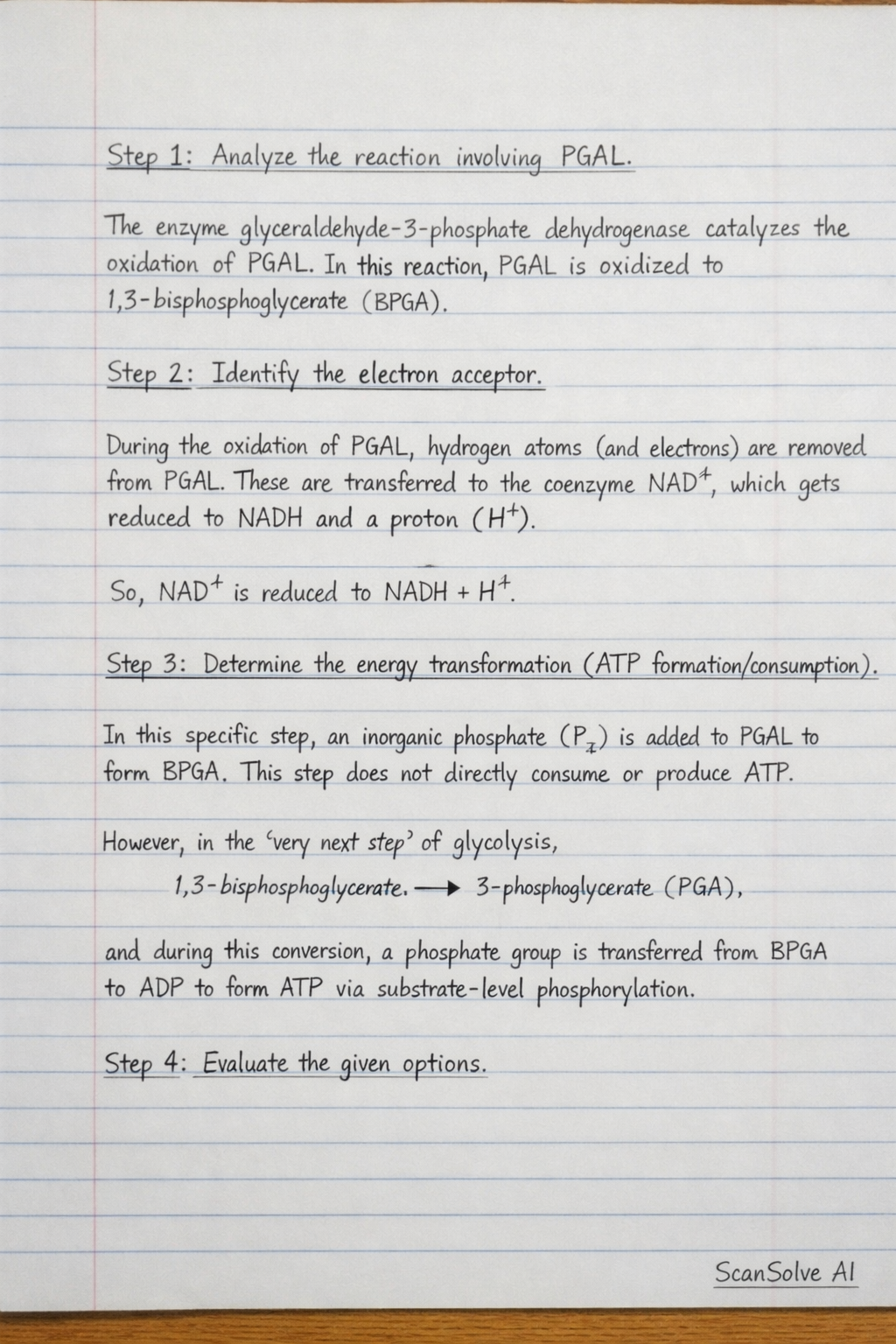
Handwritten Step-by-Step Solution
Get this as a handwritten image on WhatsApp — like a tutor wrote it for you.
Try on WhatsApp