
We read your photo as:
Enthalpy change of combustion of a substance is:
ScanSolve AI Answer
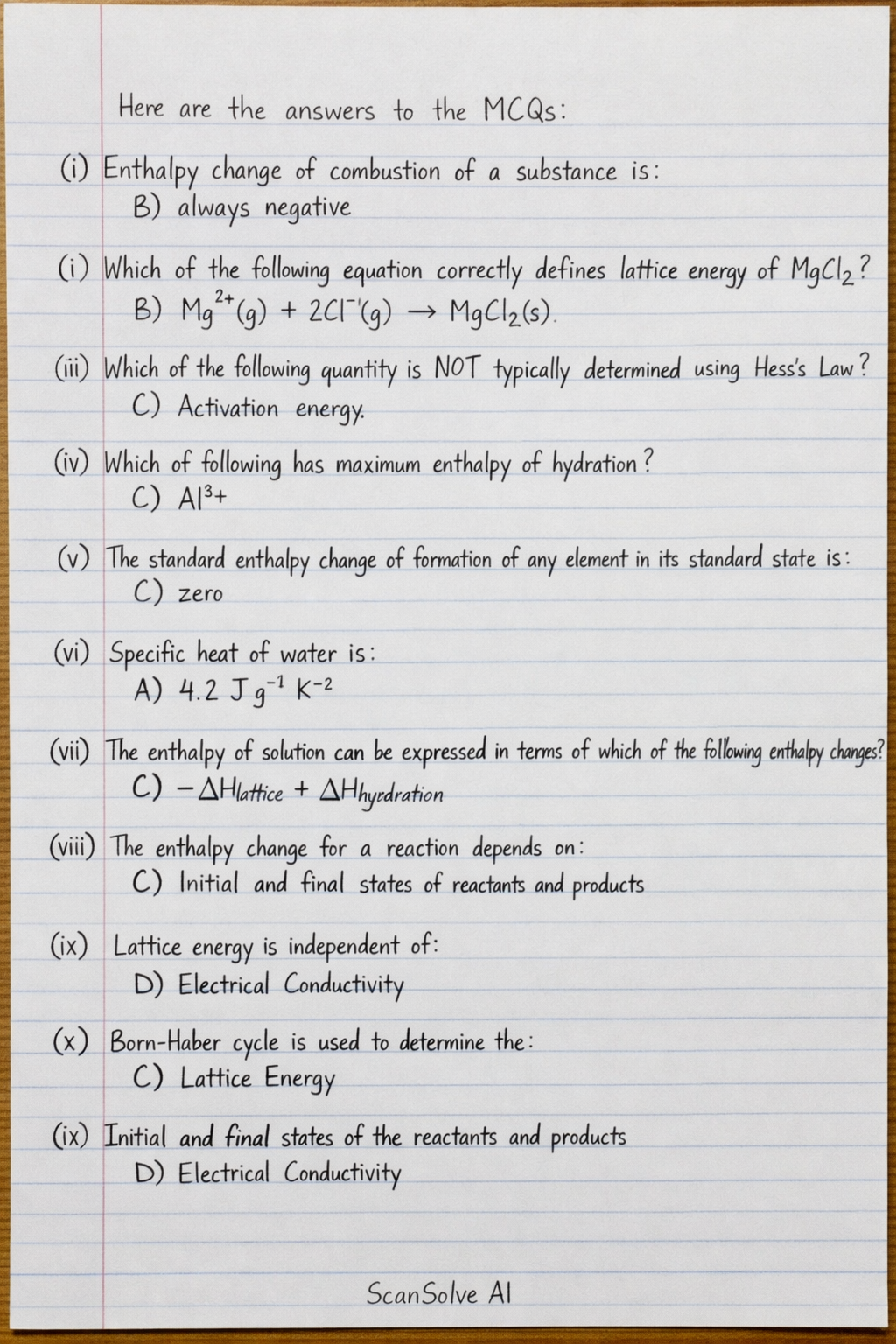
Here are the answers to the MCQs:
(i) Enthalpy change of combustion of a substance is:
B) always negative
(ii) Which of the following equation correctly defines lattice energy of ?
B)
(iii) Which of the following quantity is NOT typically determined using Hess's Law?
C) Activation energy
(iv) Which of following has maximum enthalpy of hydration?
C)
(v) The standard enthalpy change of formation of any element in its standard state is:
C) zero
(vi) Specific heat of water is:
A)
(vii) The enthalpy of solution can be expressed in terms of which of the following enthalpy changes?
C)
(viii) The enthalpy change for a reaction depends on:
C) Initial and final states of the reactants and products
(ix) Lattice energy is independent of:
D) Electrical Conductivity
(x) Born-Haber cycle is used to determine the:
C) Lattice Energy
(xi) An Example of Endothermic process is:
A) Evaporation
(xii) An Example of exothermic process is:
C) Combustion
(xiii) Enthalpy of atomization of Na metal is:
B)
(xiv) For the reaction . The change of enthalpy is called:
D) Heat of Neutralization
(xv) The Born-Haber Cycle is the application of _______ Law:
A) Hess's Law
Still stuck on this one?
Ask a follow-up, and the answer starts from this question.
More Chemistry Questions
Handwritten Step-by-Step Solution
Get this as a handwritten image on WhatsApp — like a tutor wrote it for you.
Try on WhatsApp