

This chemistry question involves key chemical concepts and calculations. The detailed solution below walks through each step, from identifying the reaction type to computing the final answer.
ScanSolve AI Answer
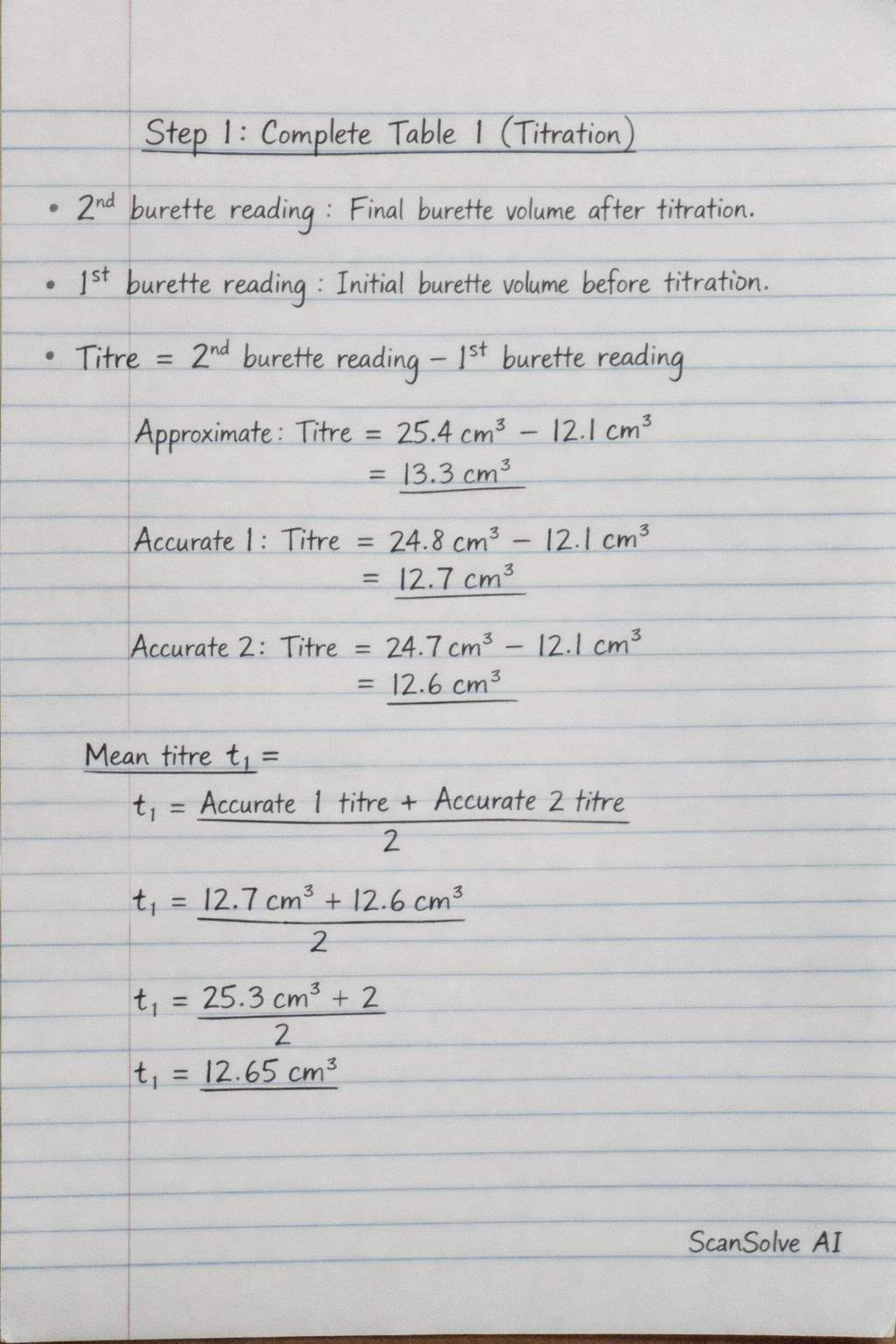
To complete the tables, you would follow the experimental procedures and record your measurements. Since no experimental data is provided, I will explain how to fill each table and calculate the required values. Step 1: Complete Table 1 (Titration) 2nd burette reading/ cm³: Record the final volume reading on the burette after the titration reaches the endpoint. 1st burette reading/ cm³: Record the initial volume reading on the burette before starting the titration. Titre: Calculate the volume of solution R used by subtracting the initial reading from the final reading. Titre = 2^nd burette reading - 1^st burette reading Perform this calculation for the Approximate, Accurate 1, and Accurate 2 trials. Mean titre t_1 =: Calculate the average of the accurate* titre values (usually Accurate 1 and Accurate 2, if they are concordant, meaning they are very close to each other, e.g., within ± 0.1 cm^3). Mean titre t_1 = Accurate 1 titre + Accurate 2 titre2 The final mean titre should be recorded to two decimal places. Step 2: Complete Table 2 (Thermochemistry) Volume of A in cm³: Record the volume of solution R used for each experiment number. Volume of B in cm³: Record the volume of solution S used for each experiment number. Temperature of A in °C: Record the initial temperature of solution R for each experiment. Temperature of B in °C: Record the initial temperature of solution S for each experiment. Highest temperature in °C: Record the maximum temperature reached after mixing solutions R and S for each experiment. Temperature change T/°C: Calculate the change in temperature for each experiment. This is the difference between the highest temperature reached and the average of the initial temperatures of solutions A and B. T = Highest temperature - ( Temperature of A + Temperature of B2 ) Record T to one decimal place. Without the actual experimental readings, the tables cannot be filled with numerical values.