

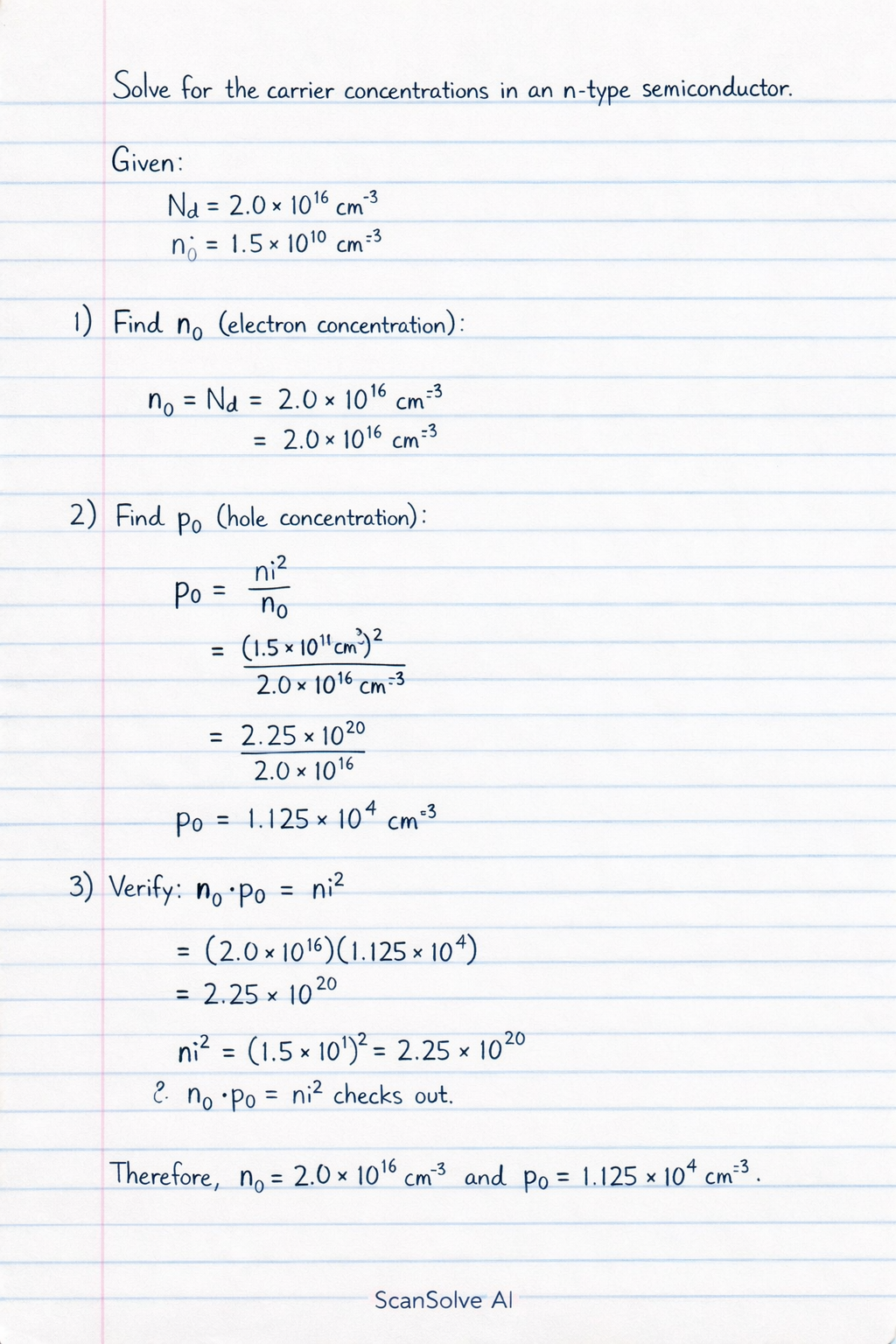
This chemistry question involves key chemical concepts and calculations. The detailed solution below walks through each step, from identifying the reaction type to computing the final answer.
ScanSolve AI Answer
Here's the distinction between intrinsic and extrinsic semiconductors: Intrinsic Semiconductors: These are pure semiconductors, meaning they consist only of a single element (like silicon or germanium) without any added impurities. In an intrinsic semiconductor, the number of free electrons is equal to the number of holes, and their conductivity is relatively low at room temperature. Extrinsic Semiconductors: These are semiconductors that have been intentionally doped with impurities to alter their electrical properties. Doping increases the number of charge carriers (either electrons or holes), significantly enhancing their conductivity. Extrinsic semiconductors are either n-type (doped with donor impurities, resulting in excess electrons) or p-type (doped with acceptor impurities, resulting in excess holes). Drop the next question.