
We read your photo as:
What are the definitions and differences between semiconductors, intrinsic/extrinsic semiconductors, and P-type/N-type semiconductors? Also, what particles make up an atom's nucleus?
ScanSolve AI Answer
Step-by-step solution
7 steps9. (a) (i) Define a semiconductor
A semiconductor is a material with electrical conductivity between that of a conductor and an insulator. Its conductivity can be significantly altered by temperature or by adding impurities (doping).
(ii) Differentiate between intrinsic and extrinsic semiconductors.
- An intrinsic semiconductor is a pure semiconductor material (e.g., pure silicon) whose electrical conductivity is due to thermally generated electron-hole pairs.
- An extrinsic semiconductor is a semiconductor material that has been doped with impurities to increase its conductivity. Doping creates either an excess of free electrons or holes.
(iii) Differentiate between P-type and n-type semiconductors.
- A P-type semiconductor is an extrinsic semiconductor formed by doping a pure semiconductor with trivalent impurities (e.g., boron), creating an excess of positive charge carriers called holes.
- An N-type semiconductor is an extrinsic semiconductor formed by doping a pure semiconductor with pentavalent impurities (e.g., phosphorus), creating an excess of negative charge carriers called free electrons.
9. (b) Magnesium-28, , is unstable and has a half-life of 21 days. It is known to emit beta particles.
(i) Name the particles that constitute the nucleus of an atom.
The nucleus of an atom is constituted by protons and neutrons.
(ii) How many neutrons are in ?
Identify the mass number (A) and atomic number (Z) from the nuclide notation.
For , the mass number and the atomic number .
Calculate the number of neutrons.
Number of neutrons = Mass number (A) - Atomic number (Z)
There are neutrons in .
(iii) If nucleus emits two beta particles, write a balanced decay equation.
Represent the beta particle.
A beta particle is an electron, represented as .
Apply conservation of mass number and atomic number.
When two beta particles are emitted, the atomic number increases by , and the mass number remains unchanged.
Let the resulting nucleus be .Conservation of mass number:
Conservation of atomic number:Identify the element with atomic number 14.
The element with atomic number 14 is Silicon (Si).
The balanced decay equation is:(iv) If initially there are 200 radioactive atoms of , how many radioactive atoms will be left after 42 days?
Determine the number of half-lives.
Given: Initial number of atoms () = 200, Half-life () = 21 days, Total time () = 42 days.
Calculate the number of remaining atoms.
The number of atoms remaining () after half-lives is given by .
After 42 days, radioactive atoms will be left.
9. (c) (i) Sketch the tracks of alpha and beta particles in cloud chambers.
- Alpha particle tracks: These are typically thick, straight, and short lines. They are densely ionizing, causing many ionizations along a short path.
- Beta particle tracks: These are generally thin, irregular, and long lines, often appearing as zig-zag or tortuous paths. They are less ionizing and are easily deflected by collisions with gas molecules.
(ii) Name the three properties responsible for the shape of the alpha tracks.
The three properties are:- Large mass: Alpha particles are relatively heavy (composed of two protons and two neutrons).
- High positive charge: They carry a charge of +2e.
- High kinetic energy: They are emitted with significant kinetic energy. These properties lead to strong and frequent interactions with gas molecules, causing dense ionization and a short, straight path.
(iii) State one use of radioactivity.
One use of radioactivity is in carbon dating for determining the age of archaeological artifacts.
Still stuck on this one?
Ask a follow-up, and the answer starts from this question.
More Physics Questions
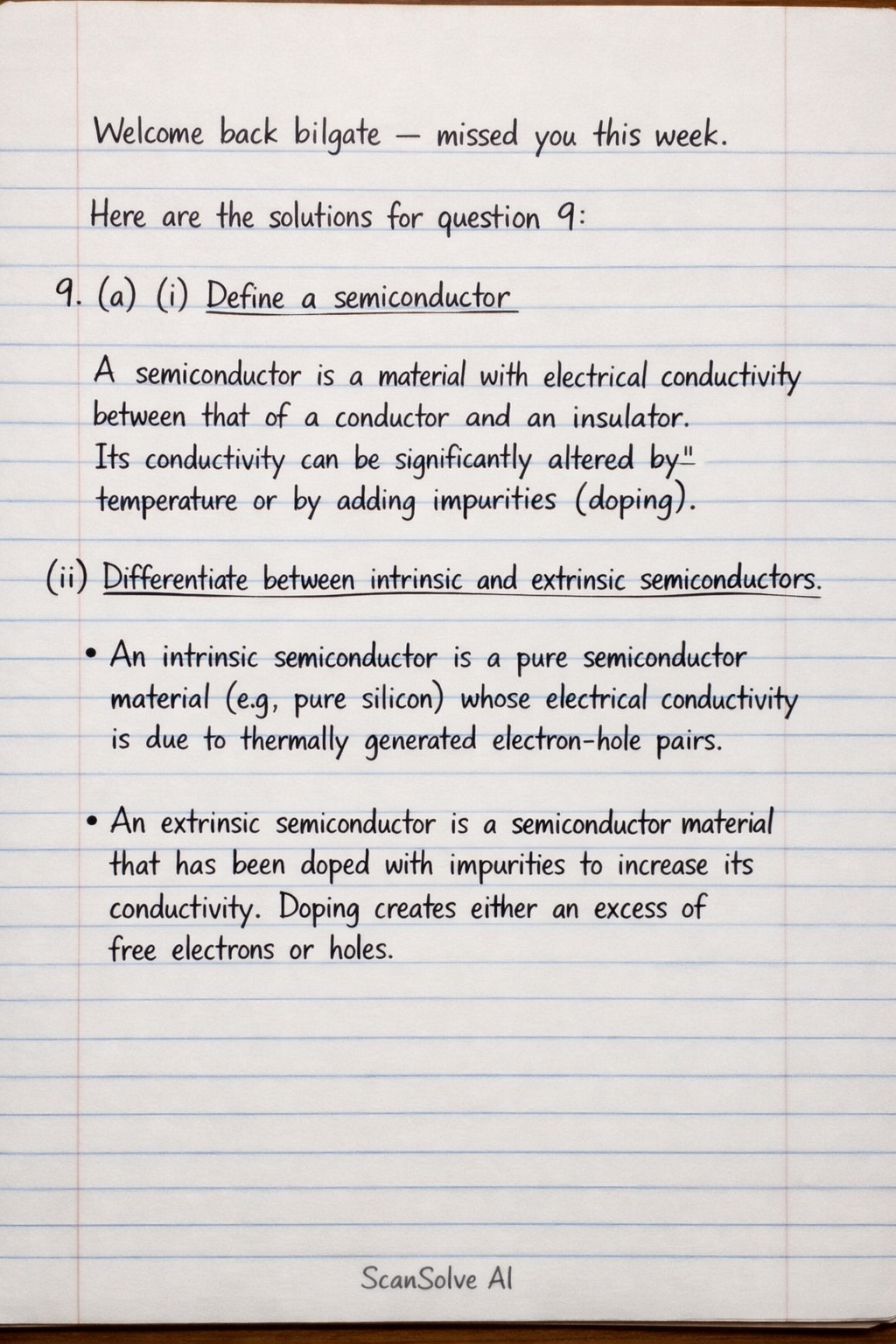
Handwritten Step-by-Step Solution
Get this as a handwritten image on WhatsApp — like a tutor wrote it for you.
Try on WhatsApp