
We read your photo as:
What happens when a pentavalent impurity is added to an intrinsic semiconductor?
ScanSolve AI Answer
Answer
Step-by-step solution
5 stepsThe correct option is (C).
Understand intrinsic semiconductors.
An intrinsic semiconductor is a pure semiconductor material, like silicon or germanium, with four valence electrons. In its crystal lattice, each atom forms four covalent bonds with its neighbors.
Understand pentavalent impurities.
A pentavalent impurity atom (e.g., phosphorus, arsenic) has five valence electrons.
Analyze the doping process.
When a pentavalent impurity atom is added to an intrinsic semiconductor, four of its valence electrons form covalent bonds with the surrounding semiconductor atoms. The fifth valence electron is not needed for bonding and becomes a free electron in the conduction band.
Determine the effect on charge carriers.
Each pentavalent impurity atom donates one free electron to the semiconductor. This significantly increases the concentration of free electrons, making them the majority charge carriers. This type of semiconductor is called an n-type semiconductor. The number of holes (electron vacancies) does not increase; in fact, it slightly decreases due to increased recombination with the abundant free electrons.
Evaluate the given options.
- (A) free electrons double: While free electrons increase, "double" is a specific quantity that depends on the doping concentration and is not universally true.
- (B) holes increased: This is incorrect. Pentavalent impurities increase free electrons, not holes.
- (C) free electrons increased: This is correct, as each pentavalent impurity atom contributes an extra free electron.
- (D) atomic number increases: This is incorrect. Doping adds impurity atoms, but it does not change the atomic number of the primary semiconductor material itself.
Therefore, adding pentavalent impurity atoms to an intrinsic semiconductor material increases the number of free electrons.
The final answer is
Try one yourself
A new problem that tests the same skill.
Still stuck on this one?
Ask a follow-up, and the answer starts from this question.
More Physics Questions
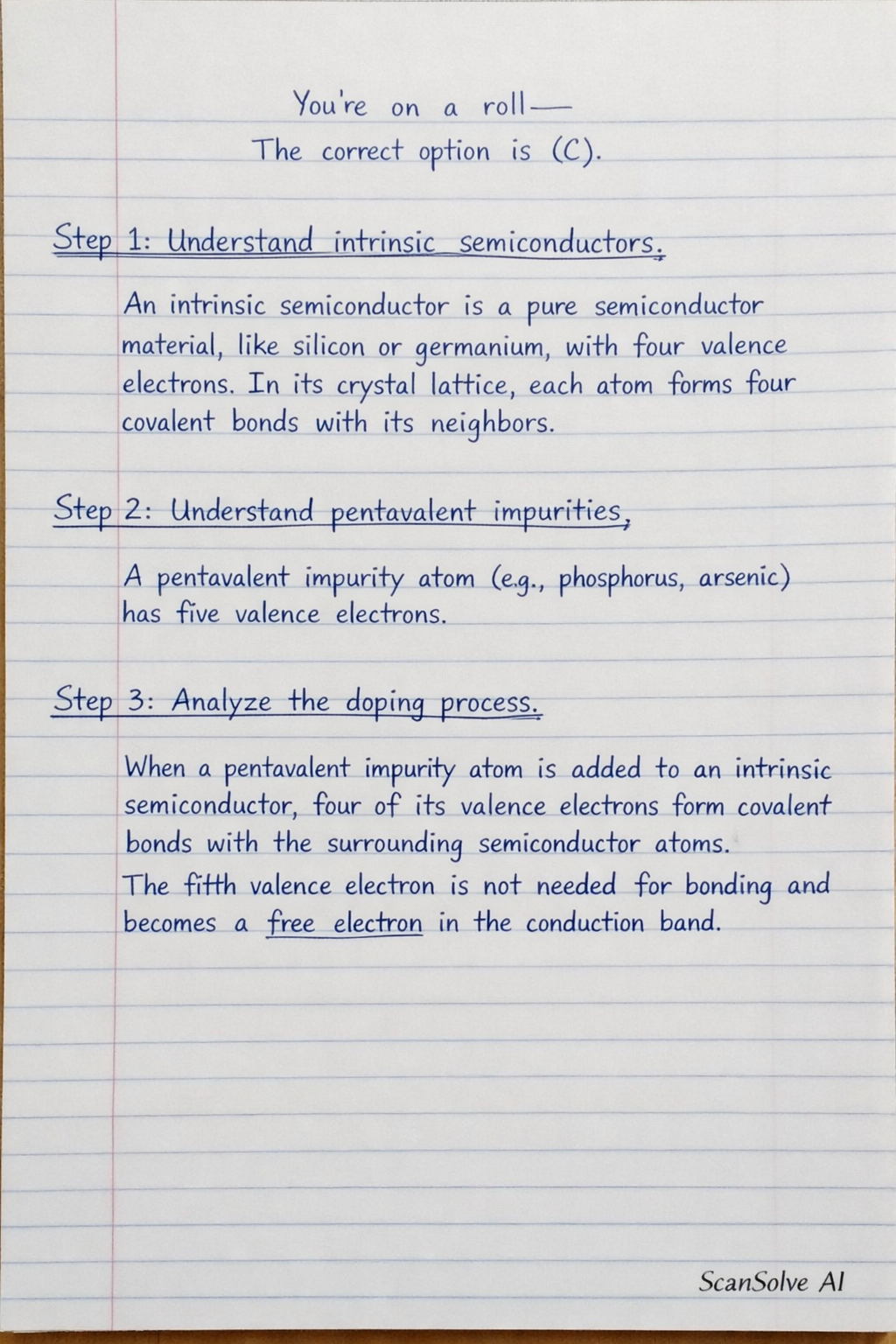
Handwritten Step-by-Step Solution
Get this as a handwritten image on WhatsApp — like a tutor wrote it for you.
Try on WhatsApp