
We read your photo as:
When a pure semiconductor is heated, its resistance decreases.
Physics
ScanSolve AI Answer
Answer
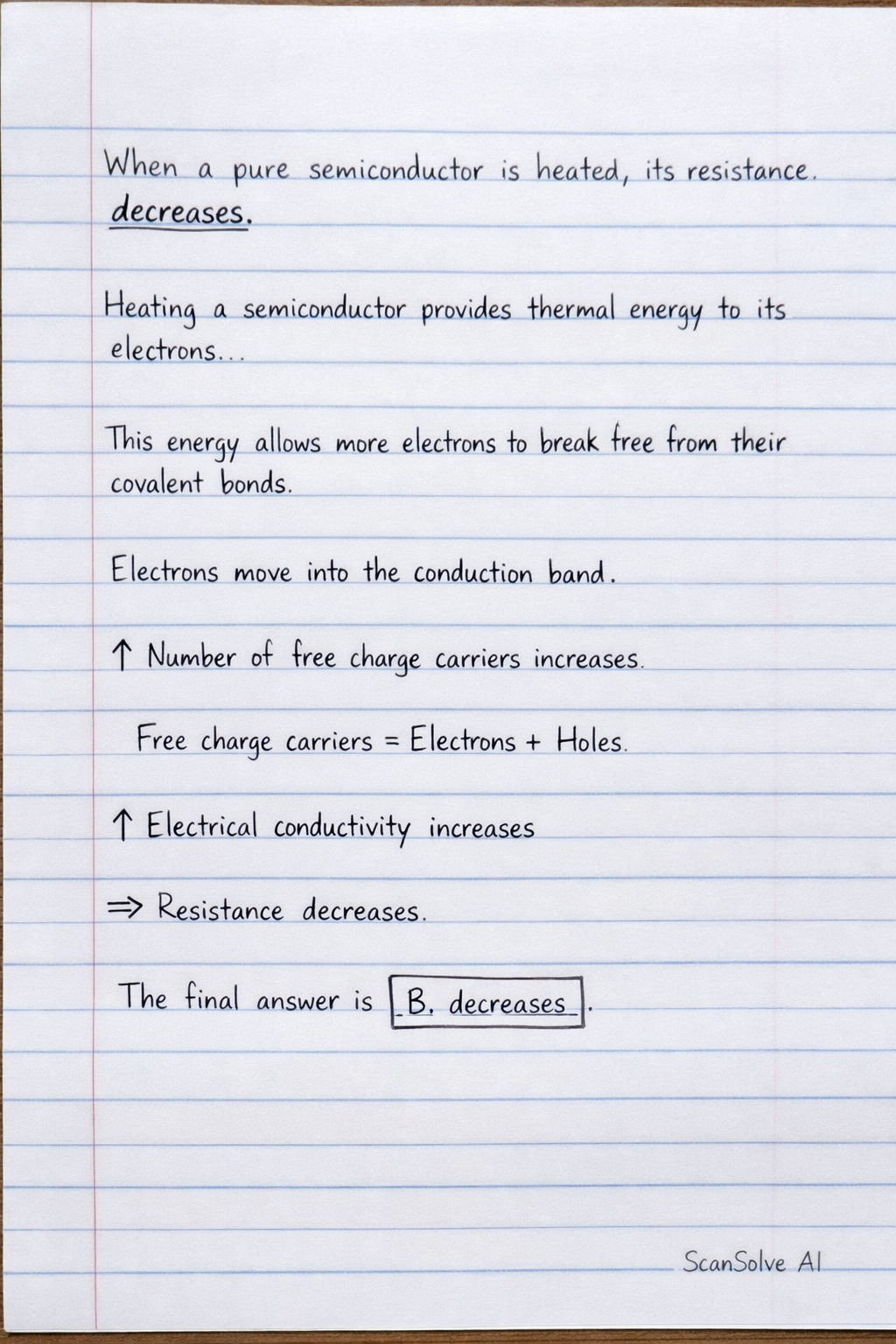
When a pure semiconductor is heated, its resistance decreases.
This is because heating a semiconductor provides thermal energy to its electrons, allowing more electrons to break free from their covalent bonds and move into the conduction band. This increases the number of free charge carriers (electrons and holes), which in turn increases the material's electrical conductivity and thus decreases its resistance.
The final answer is .
Was this helpful?
Try one yourself
A new problem that tests the same skill.
Still stuck on this one?
Ask a follow-up, and the answer starts from this question.
Got a different question?Ask your own question
More Physics Questions
QExplain how temperature affects semiconductor conductivity and the role of dopants in creating…QWhat happens when a pentavalent impurity is added to an intrinsic semiconductor?QWhat is a semiconductor? Distinguish between a p-type semiconductor and an n-type semiconductor.QWhat are the correct answers and explanations for questions 5, 6, and 7 regarding semiconductor…QWhat is a semiconductor, distinguish between p-type and n-type semiconductors, and calculate…
Browse by topic:Electrical Engineering
Handwritten Step-by-Step Solution
Get this as a handwritten image on WhatsApp — like a tutor wrote it for you.
Try on WhatsApp