
We read your photo as:
Calculate the enthalpy change of the reaction C3H8(g) + 5O2(g) -> 3CO2(g) + 4H2O(l) using the given standard enthalpies of formation.
Chemistry
ScanSolve AI Answer
Answer
Step-by-step solution
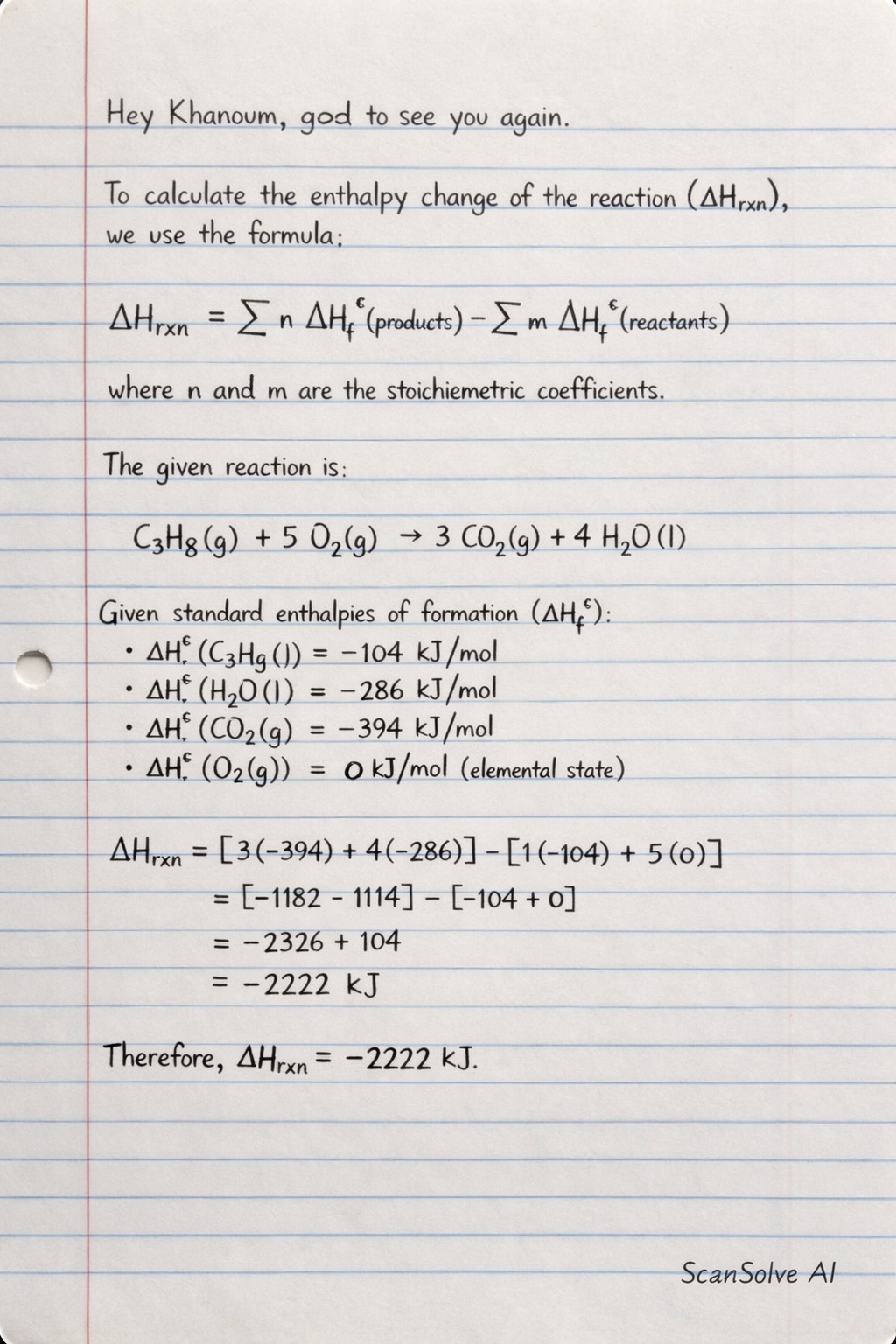
3 stepsTo calculate the enthalpy change of the reaction (), we use the formula:
where and are the stoichiometric coefficients for the products and reactants, respectively.
The given reaction is:
Given standard enthalpies of formation ():
- (since it is an element in its standard state)
Calculate the sum of the enthalpies of formation for the products.
Calculate the sum of the enthalpies of formation for the reactants.
Calculate .
The calculated value matches option B.
The final answer is .
Was this helpful?
Try one yourself
A new problem that tests the same skill.
Still stuck on this one?
Ask a follow-up, and the answer starts from this question.
Got a different question?Ask your own question
More Chemistry Questions
QTo calculate the enthalpy change ( H) for the reaction C + O2 -> CO2 using bond energies, we use the…QCalculate the enthalpy change for the reaction C2H4 + H2 -> C2H6 using the provided bond energies.QCalculate the enthalpy change for the reaction SO3(g) + H2O(l) -> H2SO4(l) using standard heats of…QUsing Hess's Law, calculate the heat of formation of propane given the following reactions: 1. C(s)…QCalculate the enthalpy change for the following reaction: C2H4(g) + Br2(g) -> C2H4Br2(g)
Handwritten Step-by-Step Solution
Get this as a handwritten image on WhatsApp — like a tutor wrote it for you.
Try on WhatsApp