
We read your photo as:
Write the equilibrium constant expression for the reaction C(s) + CO2(g) + 2Cl2(g) <=> 2COCl2(g). Calculate Kc for this reaction using the given values.
Chemistry
ScanSolve AI Answer
Answers
3 partsStep-by-step solution
8 stepsHere are the solutions to the problems.
Part 1· 3 steps
-
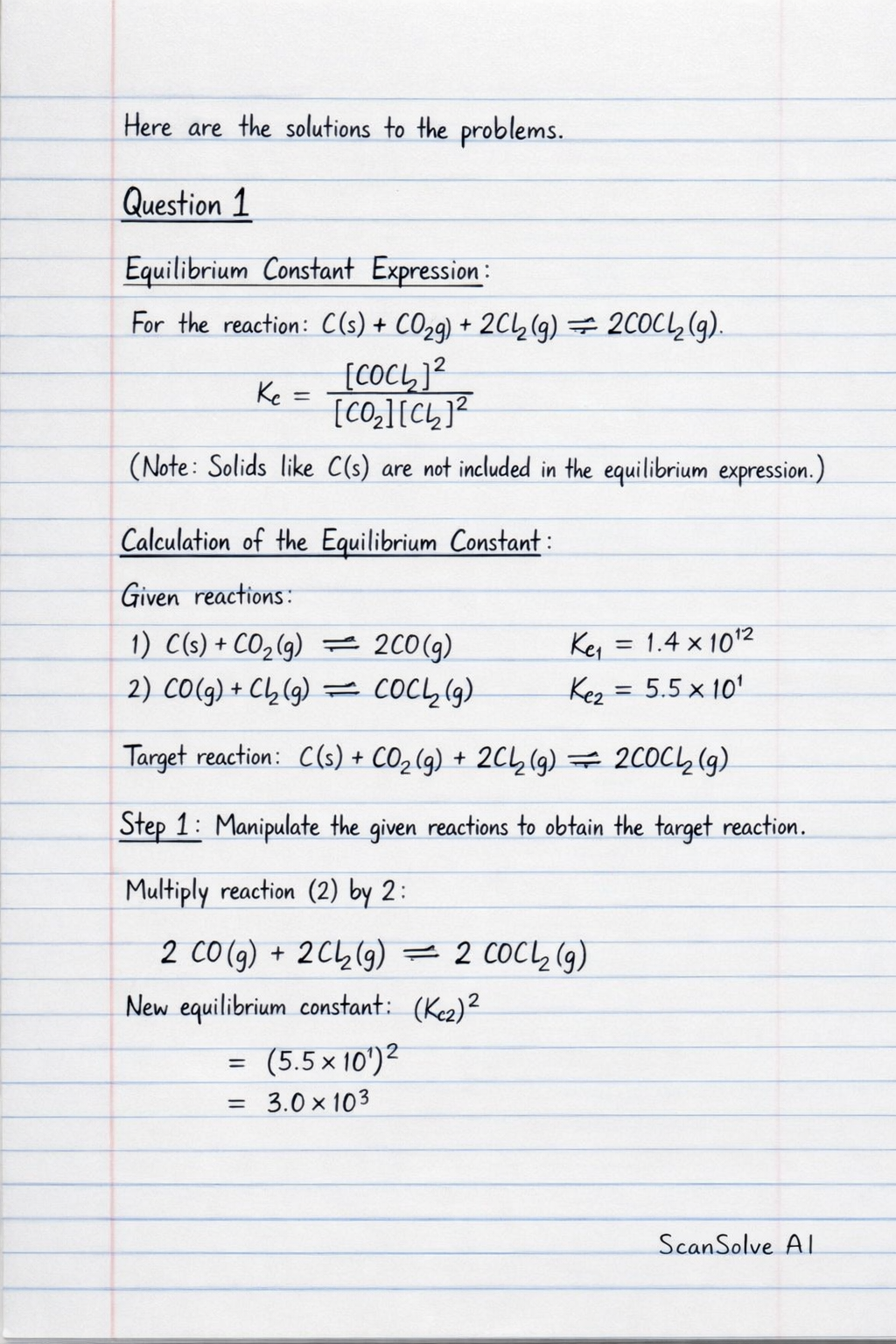
Equilibrium constant expression: For the reaction , the equilibrium constant expression is:
(Note: Solids like are not included in the equilibrium constant expression.)
-
Calculation of the equilibrium constant: Given reactions:
- with
- with
Target reaction:
Manipulate the given reactions to obtain the target reaction.
Multiply reaction (2) by 2: $2CO(g) + 2Cl_2(g) \rightleftharpoons 2COCl_2(g)$ The new equilibrium constant for this reaction is $(K_{c2})^2$.Add reaction (1) and the modified reaction (2).
$(C(s) + CO_2(g) \rightleftharpoons 2CO(g))$ $+$ $(2CO(g) + 2Cl_2(g) \rightleftharpoons 2COCl_2(g))$ Summing these gives: $C(s) + CO_2(g) + 2CO(g) + 2Cl_2(g) \rightleftharpoons 2CO(g) + 2COCl_2(g)$ Canceling $2CO(g)$ from both sides yields the target reaction: $C(s) + CO_2(g) + 2Cl_2(g) \rightleftharpoons 2COCl_2(g)$Calculate the overall equilibrium constant.
When reactions are added, their equilibrium constants are multiplied.
$$
K_c = K_{c1} \times (K_{c2})^2
$$
$$
K_c = (1.4 \times 10^{12}) \times (5.5 \times 10^1)^2
$$
$$
K_c = (1.4 \times 10^{12}) \times (30.25 \times 10^2)
$$
$$
K_c = (1.4 \times 10^{12}) \times (3.025 \times 10^3)
$$
$$
K_c = (1.4 \times 3.025) \times 10^{12+3}
$$
$$
K_c = 4.235 \times 10^{15}
$$
The equilibrium constant for the reaction is $\boxed{\mathbf{4.235 \times 10^{15}}}$.
Part 2
Given reaction: with at 700 K.
Part a
For the reaction
Identify the relationship between the given reaction and the target reaction.
This reaction is the reverse of the original reaction.Calculate the new .
When a reaction is reversed, the new equilibrium constant is the reciprocal of the original.
$$
K_p' = \frac{1}{K_p}
$$
$$
K_p' = \frac{1}{7.1 \times 10^4}
$$
$$
K_p' \approx 1.408 \times 10^{-5}
$$
The value of $K_p$ is $\boxed{\mathbf{1.408 \times 10^{-5}}}$.
Part b
For the reaction
Identify the relationship between the given reaction and the target reaction.
This reaction is the original reaction multiplied by a factor of $\frac{1}{2}$.Calculate the new .
When a reaction is multiplied by a factor 'n', the new equilibrium constant is the original constant raised to the power 'n'. Here, $n = \frac{1}{2}$.
$$
K_p'' = (K_p)^{1/2} = \sqrt{K_p}
$$
$$
K_p'' = \sqrt{7.1 \times 10^4}
$$
$$
K_p'' = \sqrt{71000}
$$
$$
K_p'' \approx 266.458
$$
The value of $K_p$ is $\boxed{\mathbf{266.458}}$.
Part 3· 1 step
Calculate a value for the equilibrium constant for the reaction:
Given information:
- with
- with
Target reaction:
Manipulate the given reactions
Was this helpful?
Try one yourself
A new problem that tests the same skill.
Still stuck on this one?
Ask a follow-up, and the answer starts from this question.
Got a different question?Ask your own question
More Chemistry Questions
QWrite the equilibrium constant expression (K_c) for the reaction.QWrite the balanced chemical equation and the equilibrium constant expression (K_c).QExplain Le Chatelier's principle and write the equilibrium constant expression for the reaction C(s)…QA mixture of CO(g) and H2O(g) at equilibrium contains 0.6 mol CO, 0.6 mol H2O, 0.1 mol CO2, and 0.1…QCalculate the equilibrium constant (K_c) for the reaction.
Handwritten Step-by-Step Solution
Get this as a handwritten image on WhatsApp — like a tutor wrote it for you.
Try on WhatsApp