

This chemistry question involves key chemical concepts and calculations. The detailed solution below walks through each step, from identifying the reaction type to computing the final answer.
ScanSolve AI Answer
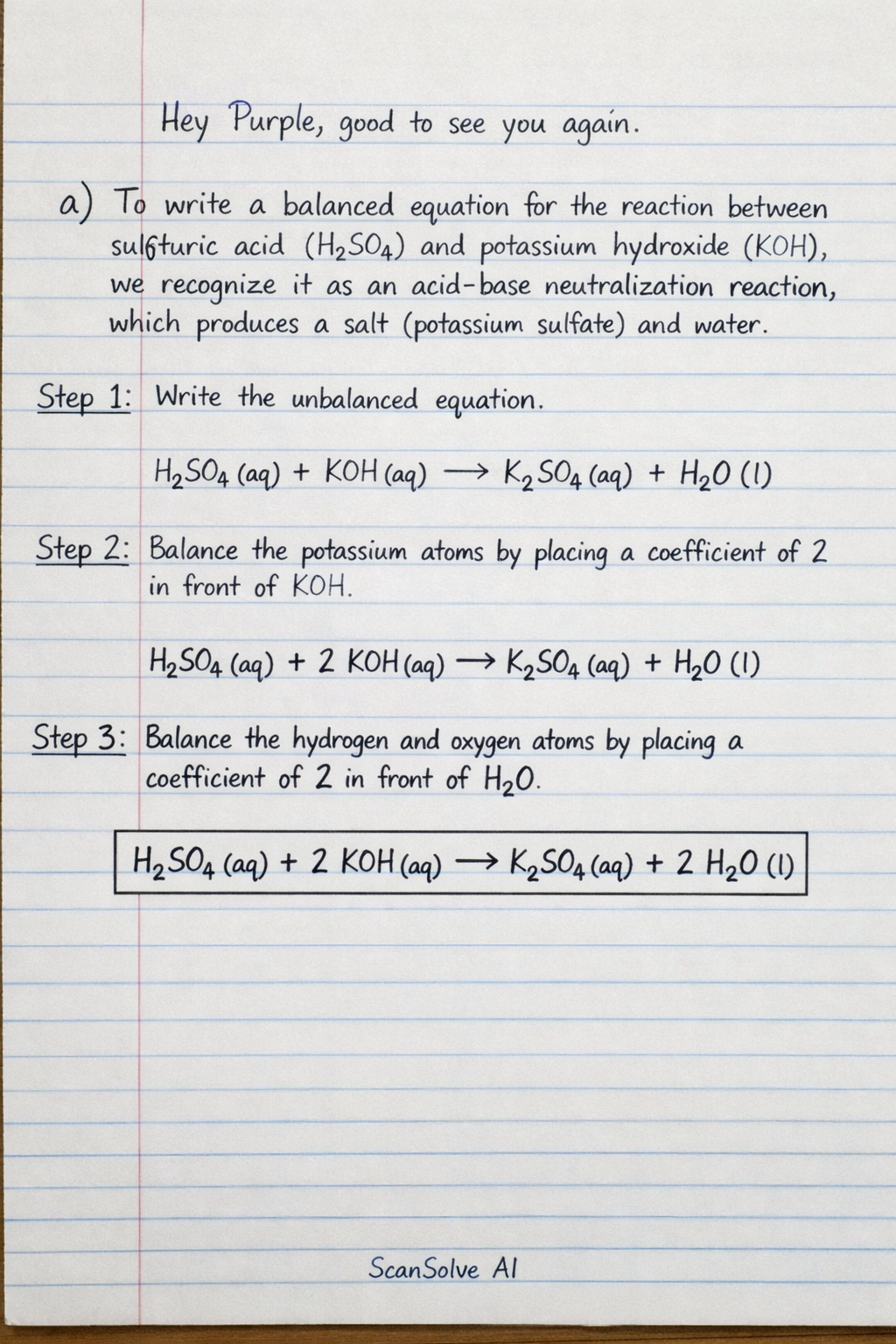
a) To write a balanced equation for the reaction between sulphuric acid (H_2SO_4) and potassium hydroxide (KOH), we recognize it as an acid-base neutralization reaction, which produces a salt (potassium sulfate) and water. Step 1: Write the unbalanced equation. H_2SO_4(aq) + KOH(aq) → K_2SO_4(aq) + H_2O(l) Step 2: Balance the potassium atoms by placing a coefficient of 2 in front of KOH. H_2SO_4(aq) + 2KOH(aq) → K_2SO_4(aq) + H_2O(l) Step 3: Balance the hydrogen and oxygen atoms by placing a coefficient of 2 in front of H_2O. H_2SO_4(aq) + 2KOH(aq) → K_2SO_4(aq) + 2H_2O(l) b) For a strong acid-strong base titration, the equivalence point is at pH 7. A suitable indicator should have a color change range that includes pH 7. A suitable indicator for this reaction is phenolphthalein. c) To calculate the concentration of the acid solution, we use the titration formula based on the mole ratio from the balanced equation. Step 1: Identify the given values and the mole ratio. Given: Volume of acid, V_a = 32.5 cm^3 Volume of base, V_b = 25 cm^3 Concentration of base, C_b = 0.6 mol.dm^-3 From the balanced equation, the mole ratio of acid to base (n_a : n_b) is 1:2. Step 2: Use the titration formula (C_a V_a)/(n_a) = (C_b V_b)/(n_b) to find the concentration of the acid (C_a). C_a = (n_a)/(n_b) × (C_b V_b)/(V_a) Step 3: Substitute the values into the formula. C_a = (1)/(2) × 0.6 mol.dm^-3 × 25 cm^332.5 cm^3 Step 4: Calculate the concentration. C_a = (1)/(2) × (15)/(32.5) mol.dm^-3 C_a = (1)/(2) × 0.461538... mol.dm^-3 C_a = 0.230769... mol.dm^-3 Rounding to three significant figures: C_a = 0.231 mol.dm^-3