
We read your photo as:
Describe the extraction of lead from its chief ore, Galena, including relevant chemical equations and the reasons for phasing out tetraethyl lead.
ScanSolve AI Answer
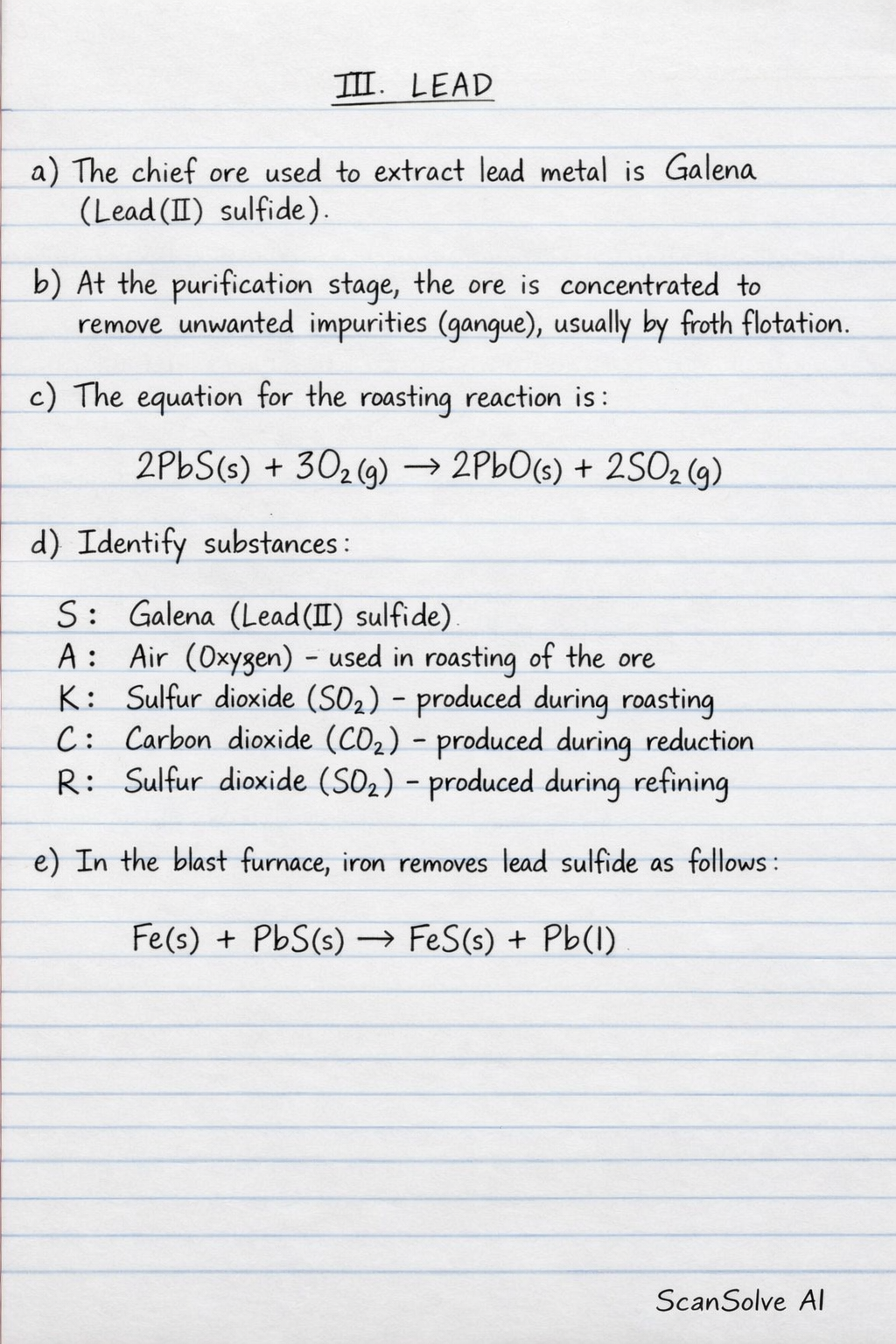
III. LEAD
a) The chief ore used to extract lead metal is Galena (Lead(II) sulfide).
b) At the purification stage, the ore is concentrated to remove unwanted impurities (gangue), typically through a process like froth flotation.
c) The equation for the reaction when the ore (Lead(II) sulfide) is roasted in air is:
d) Identify substances: * S: Galena (Lead(II) sulfide) * A: Air (or Oxygen, used for oxidative refining of crude lead) * K: Sulfur dioxide () (produced during roasting) * C: Carbon dioxide () (produced during reduction in the blast furnace) * R: Sulfur dioxide () (produced during refining if sulfur impurities are oxidized)
e) The role of iron in the blast furnace is to remove any remaining lead sulfide impurities by reacting with them to form iron(II) sulfide and lead.
f) Tetraethyl lead has been phased out because lead is a toxic heavy metal. When burnt in petrol, it releases lead compounds into the atmosphere, causing environmental pollution and severe health hazards, particularly neurological damage in humans.
IV. COPPER
a) The method used to purify the ore (concentrate it) is froth flotation.
b) One equation in stage (ii) (roasting and reduction) that forms blister copper is the self-reduction of copper(I) oxide by copper(I) sulfide:
Still stuck on this one?
Ask a follow-up, and the answer starts from this question.
More Chemistry Questions
Handwritten Step-by-Step Solution
Get this as a handwritten image on WhatsApp — like a tutor wrote it for you.
Try on WhatsApp