
We read your photo as:
For the atom 166X, find: a) atomic number b) number of neutrons c) number of electrons d) mass number. If another atom is 188X, how is it related to 168X? Find the difference in particles and calculat
ScanSolve AI Answer
Answers
4 partsStep-by-step solution
4 stepsFor the atom :
Part a
The atomic number of X is the subscript value.
The atomic number is .
Part b
The number of neutrons is the mass number minus the atomic number.
The number of neutrons is .
Part c
For a neutral atom, the number of electrons equals the atomic number.
The number of electrons is .
Part d
The mass number of X is the superscript value.
The mass number is .
If another atom is represented as , its relation to is that they are isotopes.
Difference between and in terms of particles:
- Both atoms have an atomic number of 8, meaning they both have 8 protons and 8 electrons.
- They differ in their mass numbers: has a mass number of 16, while has a mass number of 18.
- This difference in mass number is due to a difference in the number of neutrons.
- For : Number of neutrons .
- For : Number of neutrons .
- Therefore, has 8 neutrons, and has 10 neutrons.
To show that the relative atomic mass of X would be 16.2, given 90% of and 10% of :
Use the formula for relative atomic mass.
Substitute the given values.
Calculate the products.
Sum the products and divide by 100.
The relative atomic mass of X is 16.2.
Try one yourself
A new problem that tests the same skill.
Still stuck on this one?
Ask a follow-up, and the answer starts from this question.
More Chemistry Questions
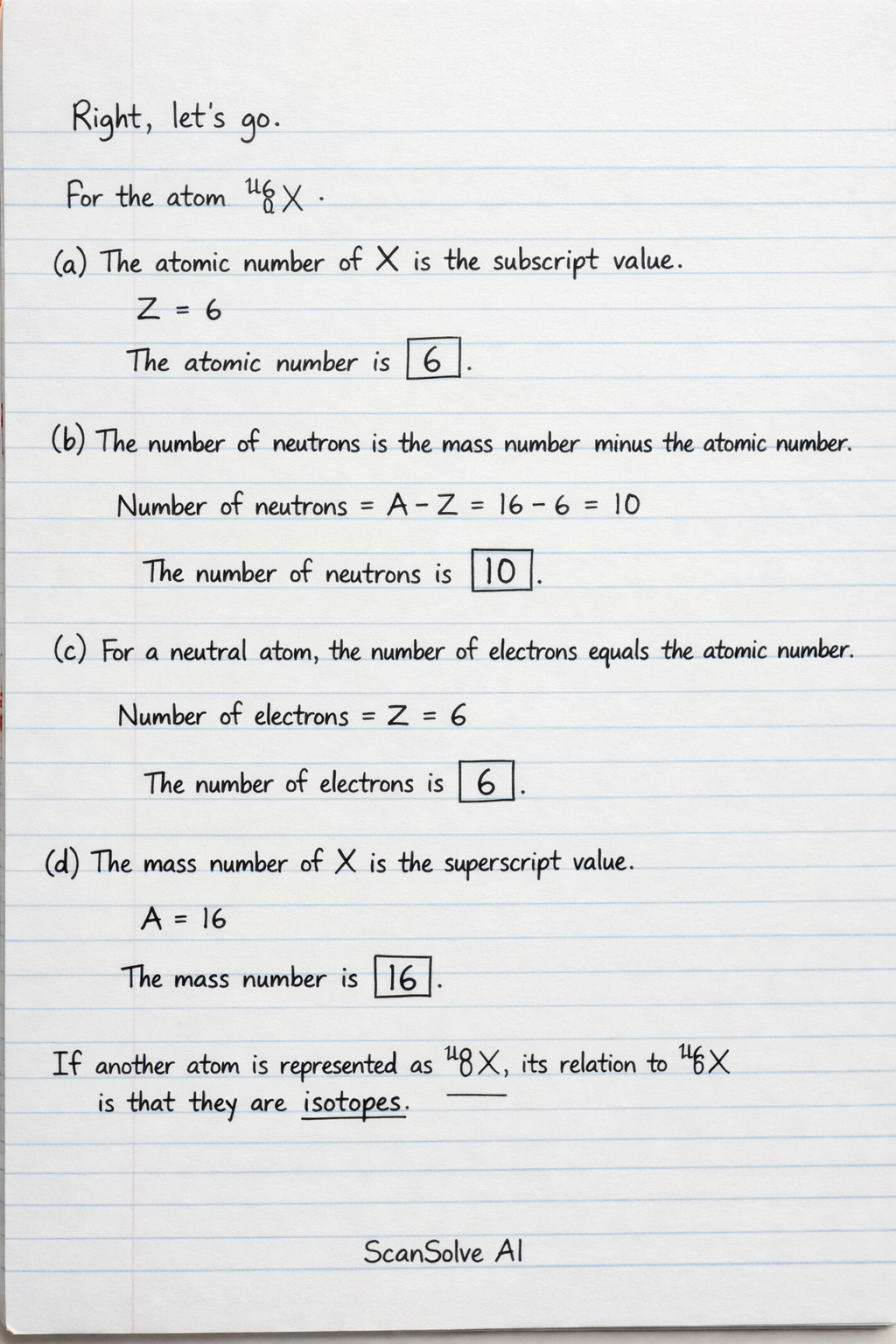
Handwritten Step-by-Step Solution
Get this as a handwritten image on WhatsApp — like a tutor wrote it for you.
Try on WhatsApp