
We read your photo as:
Determine the formula and charge of the complex ion formed from Fe3+ and SCN- in equimolar solutions, given maximum color intensity at a 1:1 mole ratio.
ScanSolve AI Answer
Answer
Step-by-step solution
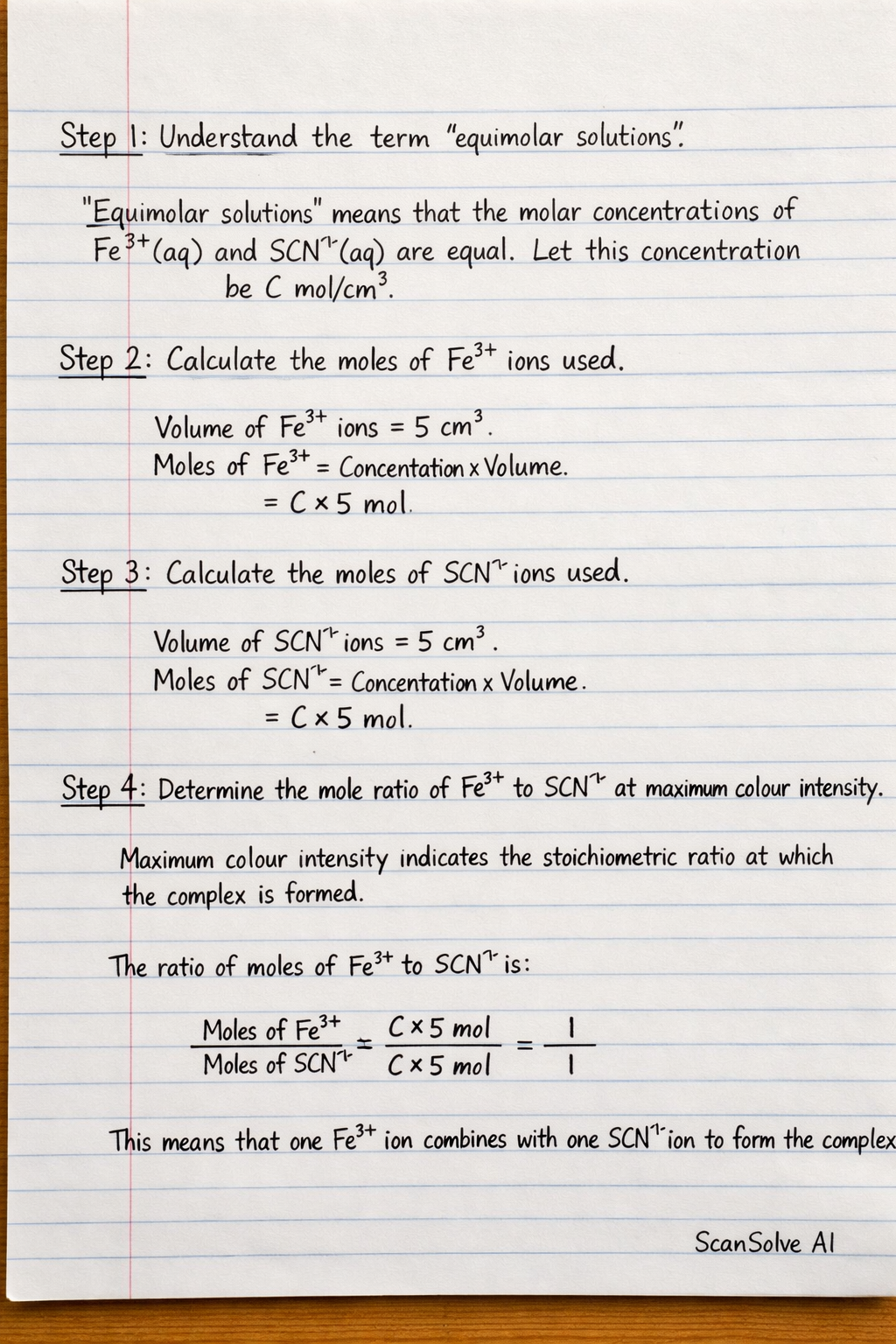
5 stepsUnderstand the term "equimolar solutions".
"Equimolar solutions" means that the molar concentrations of and are equal. Let this concentration be .
Calculate the moles of ions used.
Volume of ions =
Moles ofCalculate the moles of ions used.
Volume of ions =
Moles ofDetermine the mole ratio of to at maximum colour intensity.
Maximum colour intensity indicates the stoichiometric ratio at which the complex is formed.
The ratio of moles of to is:This means that one ion combines with one ion to form the complex.
Determine the formula and charge of the complex ion.
The central metal ion is .
The ligand is .
Since the ratio is 1:1, the complex will contain one and one .
The charge of the complex is the sum of the charges of the metal ion and the ligand:Therefore, the formula of the complex ion is .
Try one yourself
A new problem that tests the same skill.
Still stuck on this one?
Ask a follow-up, and the answer starts from this question.
More Chemistry Questions
Handwritten Step-by-Step Solution
Get this as a handwritten image on WhatsApp — like a tutor wrote it for you.
Try on WhatsApp