
We read your photo as:
Determine the formula of the hydrated salt and calculate the concentration of the resulting salt solution.
ScanSolve AI Answer
Step-by-step solution
8 stepslet's solve these questions.
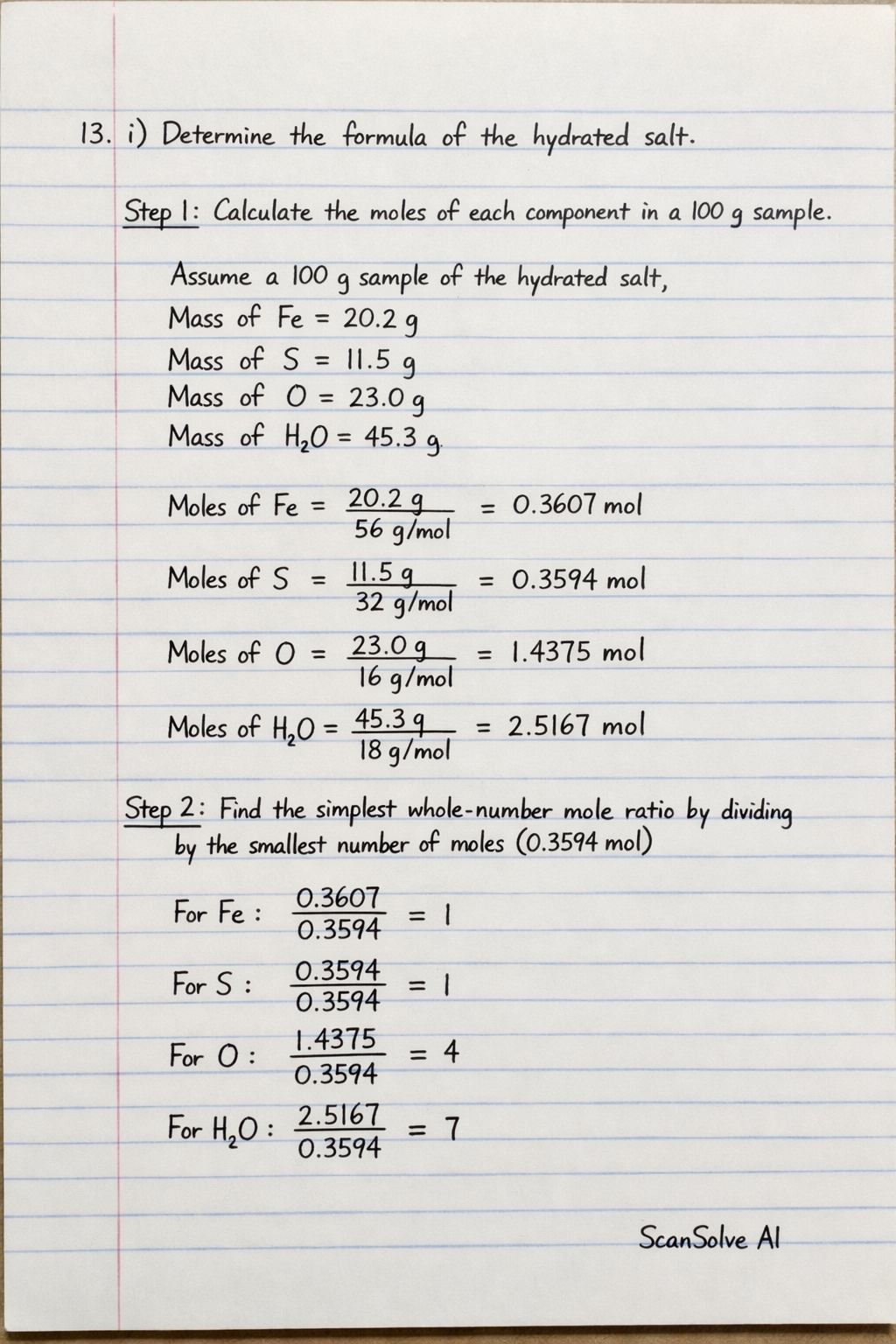
13. i) Determine the formula of the hydrated salt.
Calculate the moles of each component in a 100 g sample.
Assume a 100 g sample of the hydrated salt.
Mass of Iron () = 20.2 g
Mass of Sulphur () = 11.5 g
Mass of Oxygen () = 23.0 g
Mass of Water () = 45.3 gMoles of
Moles of
Moles of
Moles ofFind the simplest whole-number mole ratio by dividing by the smallest number of moles (0.3594 mol).
For
For
For
ForThe ratio of is .
This indicates the anhydrous part is and there are 7 molecules of water of crystallization.The formula of the hydrated salt is .
13. ii) Calculate the concentration of the resulting salt solution in moles per litre.
Calculate the moles of the hydrated salt.
Given mass of hydrated salt = 6.95 g
Given molecular mass of the salt = 278 g/molCalculate the concentration in moles per litre.
Given total volume = 250
The concentration of the resulting salt solution is .
14. (i) Calculate the mass in grams of lead (II) iodide formed.
Calculate the moles of iodide ions ().
Given volume of iodide ions = 300
Given molarity of iodide ions = 0.1 MUse stoichiometry to find the moles of lead (II) iodide () formed.
The balanced equation is:
From the equation, 2 moles of react to produce 1 mole of .Calculate the molar mass of lead (II) iodide.
Atomic mass of = 207
Atomic mass of = 127Calculate the mass of lead (II) iodide formed.
The mass of lead (II) iodide formed is .
14. (ii) Identify the colour of the product formed in (i).
The product formed is lead (II) iodide ().
The colour of lead (II) iodide is .
Still stuck on this one?
Ask a follow-up, and the answer starts from this question.
More Chemistry Questions
Handwritten Step-by-Step Solution
Get this as a handwritten image on WhatsApp — like a tutor wrote it for you.
Try on WhatsApp