

This chemistry question involves key chemical concepts and calculations. The detailed solution below walks through each step, from identifying the reaction type to computing the final answer.
ScanSolve AI Answer
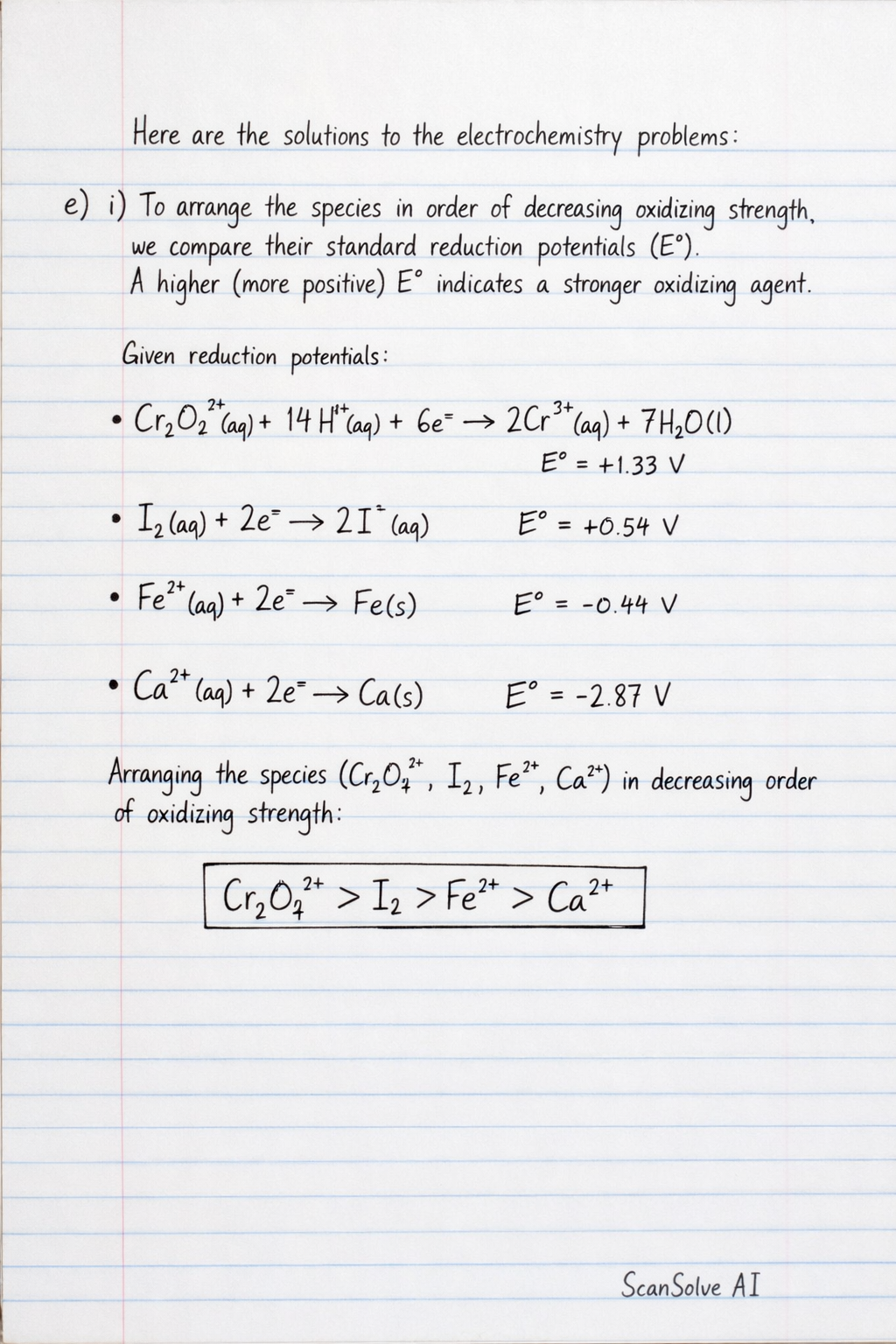
Here are the solutions to the electrochemistry problems: e) i) To arrange the species in order of decreasing oxidizing strength, we compare their standard reduction potentials (E^). A higher (more positive) E^ indicates a stronger oxidizing agent. Given reduction potentials: Cr_2O_7^2-(aq) + 14H^+(aq) + 6e^- 2Cr^3+(aq) + 7H_2O(l) E^ = +1.33 V I_2(aq) + 2e^- 2I^-(aq) E^ = +0.54 V Fe^2+(aq) + 2e^- Fe(s) E^ = -0.44 V Ca^2+(aq) + 2e^- Ca(s) E^ = -2.87 V Arranging the species (Cr_2O_7^2-, I_2, Fe^2+, Ca^2+) in decreasing order of oxidizing strength: Cr_2O_7^2- > I_2 > Fe^2+ > Ca^2+ ii) When granules of calcium are added to a solution of potassium dichromate, a redox reaction will occur. Calcium metal (Ca) is a strong reducing agent (has a very negative reduction potential, meaning it is easily oxidized), while dichromate ions (Cr_2O_7^2-) are strong oxidizing agents (have a very positive reduction potential, meaning they are easily reduced). The relevant half-reactions are: Oxidation: Ca(s) Ca^2+(aq) + 2e^- (E^_oxidation = +2.87 V) Reduction: Cr_2O_7^2-(aq) + 14H^+(aq) + 6e^- 2Cr^3+(aq) + 7H_2O(l) (E^_reduction = +1.33 V) Since the overall cell potential would be positive (2.87 V + 1.33 V = 4.20 V), the reaction is spontaneous. Observations: The calcium granules will disappear/dissolve as they are oxidized to Ca^2+ ions. The orange solution of potassium dichromate will turn green as the Cr_2O_7^2- ions (orange) are reduced to Cr^3+ ions (green). iii) When the calcium and iron half-cells are coupled: Calcium half-cell: Ca^2+(aq) + 2e^- Ca(s), E^ = -2.87 V Iron half-cell: Fe^2+(aq) + 2e^- Fe(s), E^ = -0.44 V The half-cell with the more negative reduction potential will undergo oxidation (anode), and the half-cell with the more positive reduction potential will undergo reduction (cathode). Since -2.87 V < -0.44 V: Calcium will be oxidized (anode): Ca(s) Ca^2+(aq) + 2e^- Iron(II) ions will be reduced (cathode): Fe^2+(aq) + 2e^- Fe(s) Cell diagram: The cell diagram represents the anode on the left and the cathode on the right, separated by a salt bridge (||). Ca(s) | Ca^2+(aq) || Fe^2+(aq) | Fe(s) Calculation of the EMF of the cell (E^_cell): E^_cell = E^_cathode - E^_anode E^_cell = E^(Fe^2+/Fe) - E^(Ca^2+/Ca) E^_cell = (-0.44 V) - (-2.87 V) E^_cell = -0.44 V + 2.87 V E^_cell = +2.43 V