
Given: Square base ABCD with AD = DC = 6 cm.
ScanSolve AI Answer
Answers
3 partsHere are the solutions for the remaining parts of question 2.
2. Square-based pyramid ABCD V
Given: Square base ABCD with AD = DC = 6 cm.
Height of pyramid OV = 10 cm, where O is the center of the base.
b) Find:
ii) The angle between VA and ABCD.
The angle between the line VA and the base plane ABCD is the angle between VA and its projection onto the base, which is OA. So, we need to find .
Consider the right-angled triangle VOA.
We have:
VO = 10 cm (height of the pyramid)
OA = cm (calculated in part b.i)
We can use the tangent function:
To rationalize the denominator:
Now, calculate the angle:
The angle between VA and ABCD is (to 2 decimal places).
iii) The angle between VDC and ABCD.
The angle between two planes (VDC and ABCD) is the angle between two lines, one in each plane, that are perpendicular to their line of intersection. The line of intersection is DC.
Let M be the midpoint of DC. Then OM is perpendicular to DC, and VM is perpendicular to DC.
So, the angle between the planes VDC and ABCD is .
Consider the right-angled triangle VOM.
We have:
VO = 10 cm (height of the pyramid)
OM = cm.
We can use the tangent function:
Now, calculate the angle:
The angle between VDC and ABCD is (to 2 decimal places).
iv) Volume of the pyramid.
The formula for the volume of a pyramid is:
The base ABCD is a square with side length 6 cm.
Base Area .
The height of the pyramid VO is 10 cm.
Substitute these values into the formula:
The volume of the pyramid is .
Try one yourself
A new problem that tests the same skill.
Still stuck on this one?
Ask a follow-up, and the answer starts from this question.
More Chemistry Questions
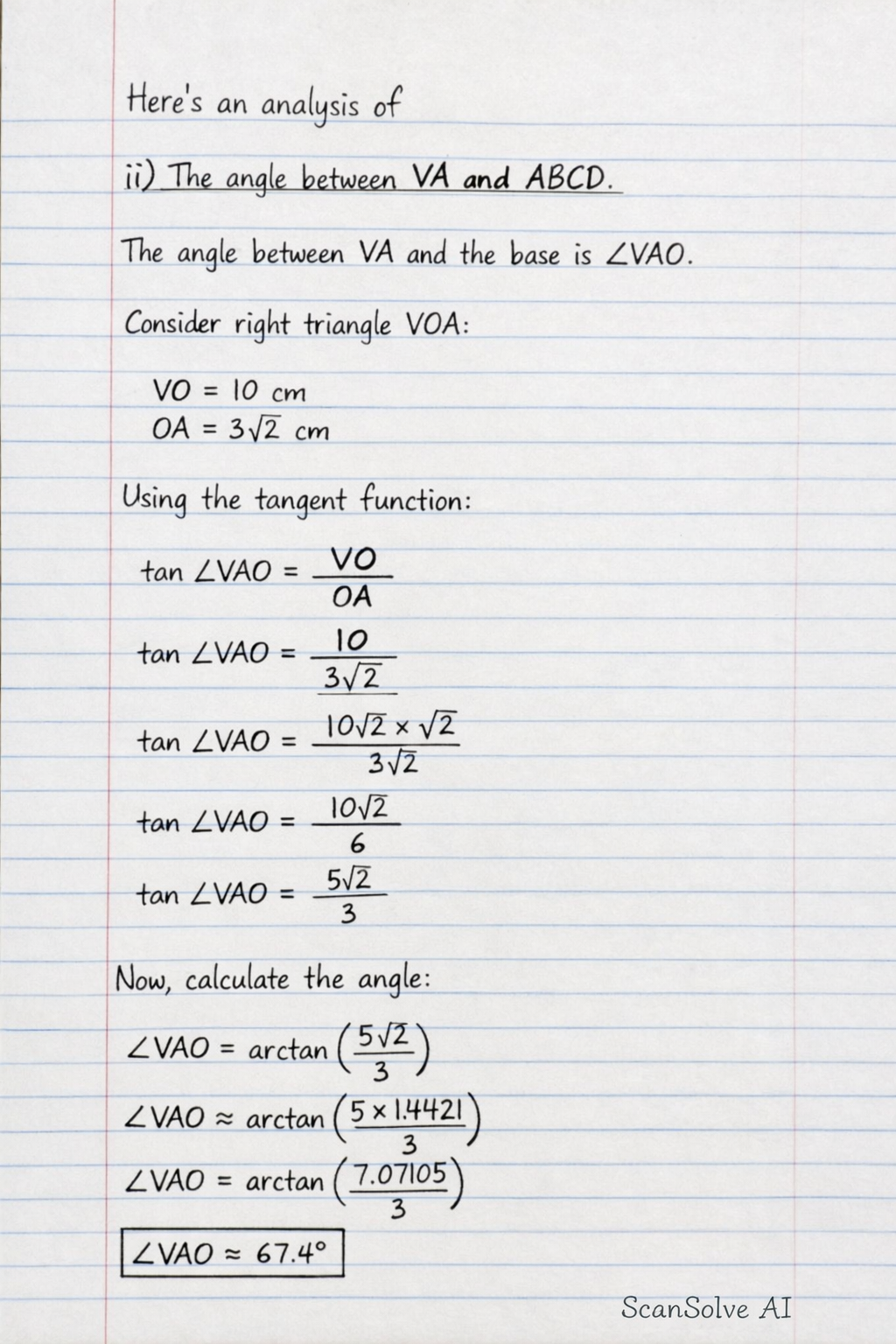
Handwritten Step-by-Step Solution
Get this as a handwritten image on WhatsApp — like a tutor wrote it for you.
Try on WhatsApp