
We read your photo as:
State Hess's Law of constant heat summation. ii. From the H enthalpy values, determine the amount of energy liberated when 1 mol of ethanol is completely burnt under standard conditions. iii. Balance the following chemical equations.
ScanSolve AI Answer
Step-by-step solution
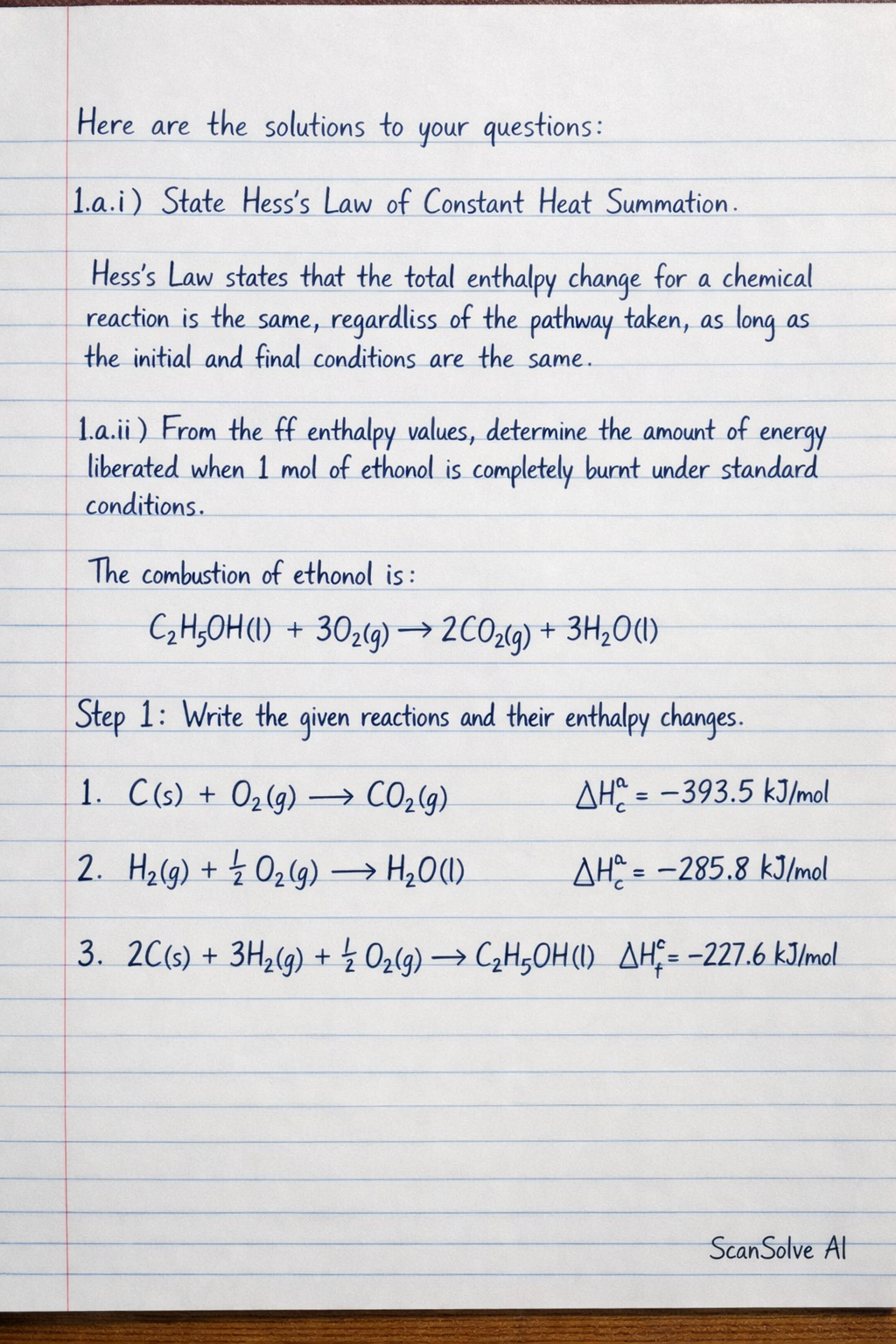
6 stepsHere are the solutions to your questions:
1.a.i) State Hess's Law of Constant Heat Summation.
Hess's Law states that the total enthalpy change for a chemical reaction is the same, regardless of the pathway taken, as long as the initial and final conditions are the same.
1.a.ii) From the ff enthalpy values, determine the amount of energy liberated when 1 mol of ethanol is completely burnt under standard conditions.
The combustion of ethanol is represented by the equation:
Write the given reactions and their enthalpy changes.
Manipulate the given equations to match the target combustion reaction for ethanol.
- Reverse equation (3):
- Multiply equation (1) by 2:
- Multiply equation (2) by 3:
Sum the manipulated equations and their enthalpy changes.
Adding the modified equations gives:
After canceling common species, we get the target reaction:
Calculate the total enthalpy change.
The amount of energy liberated is the absolute value of the enthalpy change.
The energy liberated is .2.a. Balance the ff chemical equations.
- i)
- ii) This reaction is typically balanced with oxygen () as an additional reactant. Assuming the presence of from the environment, the balanced equation is:
2.b) List two essential parts of the mass spectrometer.
- Ionization chamber
- Detector
2.c) Why are gamma rays more injurious to health than alpha particles?
Gamma rays are more injurious to health than alpha particles primarily due to their high penetrating power. Gamma rays are high-energy electromagnetic radiation that can pass through significant amounts of matter, including the human body, causing damage to internal organs and DNA throughout the body. Alpha particles, while having high ionizing power, have very low penetrating power and are easily stopped by the skin, limiting their damage to superficial tissues unless ingested or inhaled.2.d) The atomic mass of Carbon 12 is . If the mass of an atom is , determine the relative atomic mass.
Identify the given values.
The mass of one Carbon-12 atom is . This value is equivalent to 1 atomic mass unit (amu).
Mass of the unknown atom = .Calculate the relative atomic mass.
Relative atomic mass is defined as the ratio of the mass of an atom to the mass of a carbon-12 atom (which is 1 amu).
Rounding to four significant figures:
The relative atomic mass is .2.e.i) Give 2 physical properties of metals.
- Good conductors of electricity
- Malleable
2.e.ii) Indicate how each of the properties given in (i) contribute to their characteristics/uses.
- Good conductors of electricity: Metals have delocalized electrons that are free to move throughout the metallic lattice, allowing them to efficiently carry electrical current. This property makes them ideal for electrical wiring and electronic components.
- Malleable: Metals can be hammered or pressed into thin sheets without breaking because the metallic bonds allow layers of atoms to slide past each other without fracturing the overall structure. This makes metals suitable for shaping into various forms, such as car bodies or aluminum foil.
Still stuck on this one?
Ask a follow-up, and the answer starts from this question.
More Chemistry Questions
Handwritten Step-by-Step Solution
Get this as a handwritten image on WhatsApp — like a tutor wrote it for you.
Try on WhatsApp