
We read your photo as:
I) State how burning can be used to distinguish between ethane and ethyne. Explain. ii) Draw and name the structural formula of the third member of the homologous series of ethyne.
ScanSolve AI Answer
19.
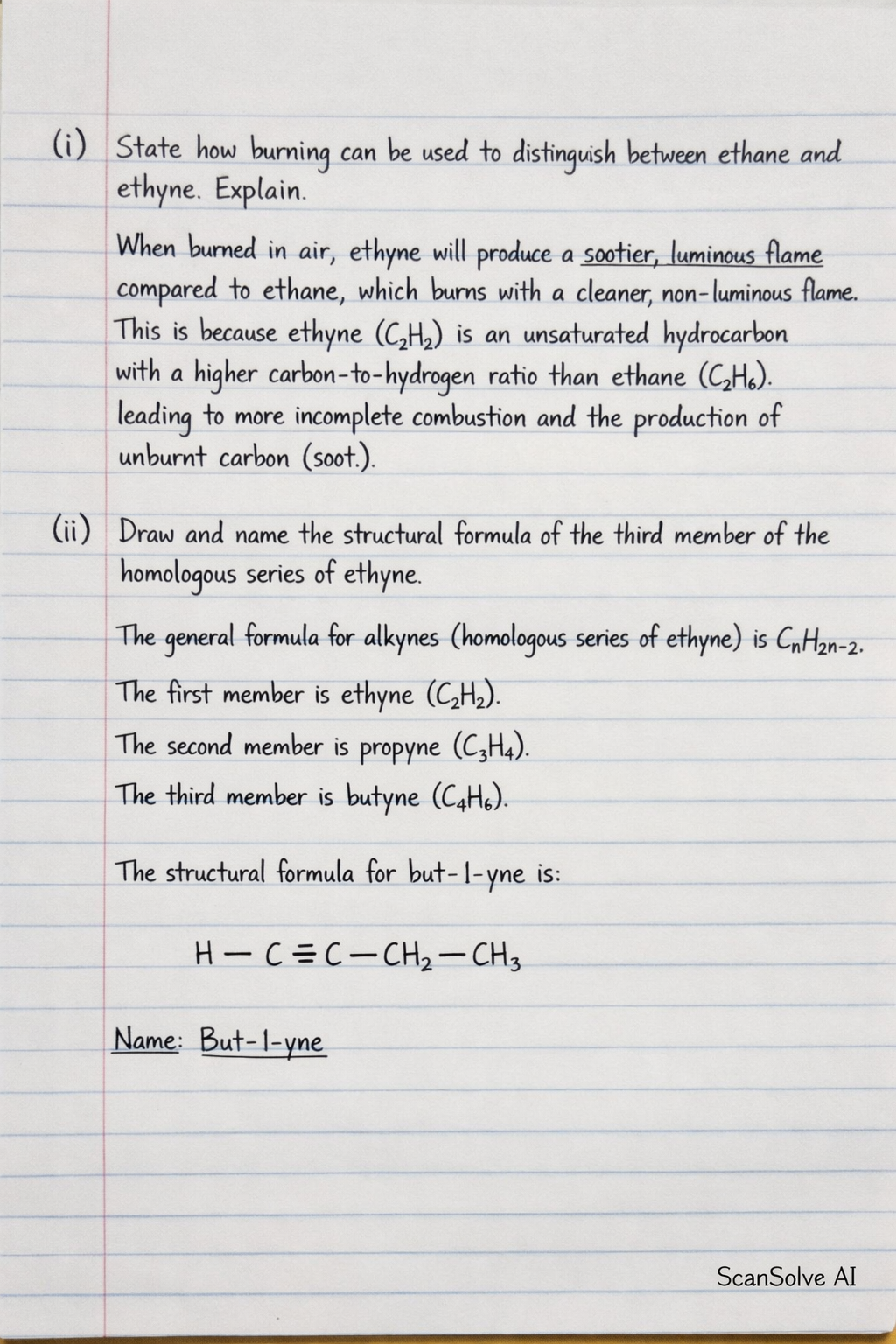
i) State how burning can be used to distinguish between ethane and ethyne. Explain.
When burned in air, ethyne will produce a sootier, luminous flame compared to ethane, which burns with a cleaner, non-luminous flame. This is because ethyne () is an unsaturated hydrocarbon with a higher carbon-to-hydrogen ratio than ethane (), leading to more incomplete combustion and the production of unburnt carbon (soot).
ii) Draw and name the structural formula of the third member of the homologous series of ethyne.
The general formula for alkynes (homologous series of ethyne) is .
The first member is ethyne ().
The second member is propyne ().
The third member is butyne ().
The structural formula for but-1-yne is:
Name: But-1-yne
20.
a) Name the type of reaction between solution X and sodium sulphate solution.
The reaction is a precipitation reaction (or double decomposition reaction).
b) Write the ionic equation for the reaction in (a) above.
c) Explain why it is not possible to prepare residue Q using lead metal and sodium sulphate solution.
Lead metal is less reactive than sodium, so it cannot displace sodium from sodium sulphate solution. Lead metal does not directly react with sulphate ions to form lead sulphate. To form lead sulphate, lead metal must first be converted into a soluble lead salt (e.g., lead nitrate) which then reacts with sodium sulphate.
21.
*a) State and explain the observations made when burning magnesium is lowered into a glass jar of carbon (
Still stuck on this one?
Ask a follow-up, and the answer starts from this question.
More Chemistry Questions
Handwritten Step-by-Step Solution
Get this as a handwritten image on WhatsApp — like a tutor wrote it for you.
Try on WhatsApp