

This chemistry question involves key chemical concepts and calculations. The detailed solution below walks through each step, from identifying the reaction type to computing the final answer.
ScanSolve AI Answer
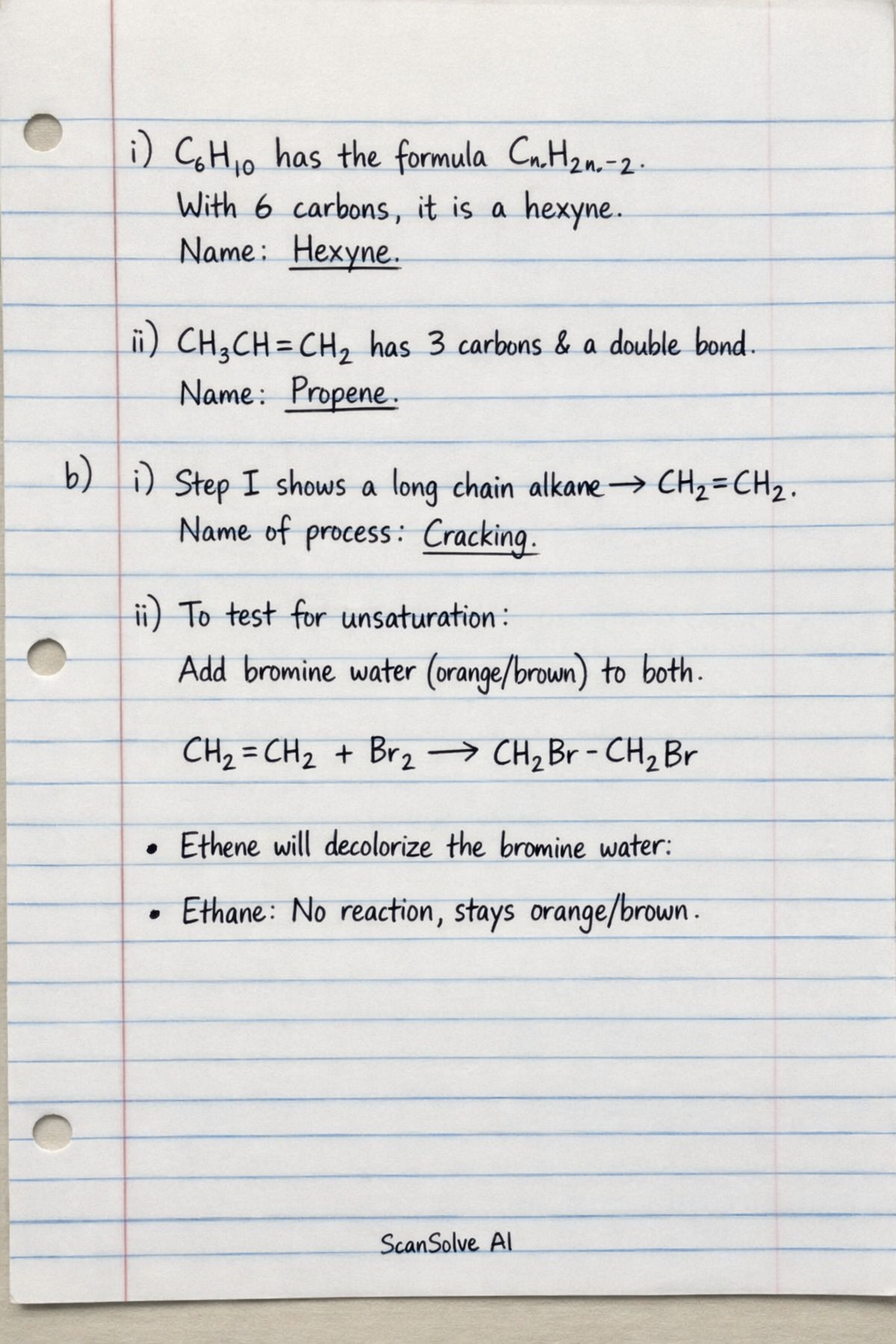
a) i) The compound C₆H₁₀ has the general formula CₙH₂ₙ₋₂, which corresponds to an alkyne. With 6 carbon atoms, it is a hexyne. Name: Hexyne ii) The compound CH₃CHCH₂ has three carbon atoms and a double bond, making it an alkene. Name: Propene b) i) Step I shows a long chain alkane being converted into ethene (CH₂=CH₂), which is a smaller alkene. This process involves breaking down larger hydrocarbon molecules into smaller, more useful ones. Name of process: Cracking ii) To distinguish between ethene (CH₂=CH₂) and ethane (CH₃CH₃), a chemical test for unsaturation can be used. • Add bromine water (orange/brown) to both compounds. • Ethene, being an alkene, will undergo an addition reaction with bromine, causing the bromine water to decolorize (turn colorless). CH_2=CH_2 + Br_2 → CH_2Br-CH_2Br • Ethane, being an alkane, will not react with bromine water under normal conditions, and the orange/brown color will persist. That's 2 down. 3 left today — send the next one.