

This chemistry question involves key chemical concepts and calculations. The detailed solution below walks through each step, from identifying the reaction type to computing the final answer.
ScanSolve AI Answer
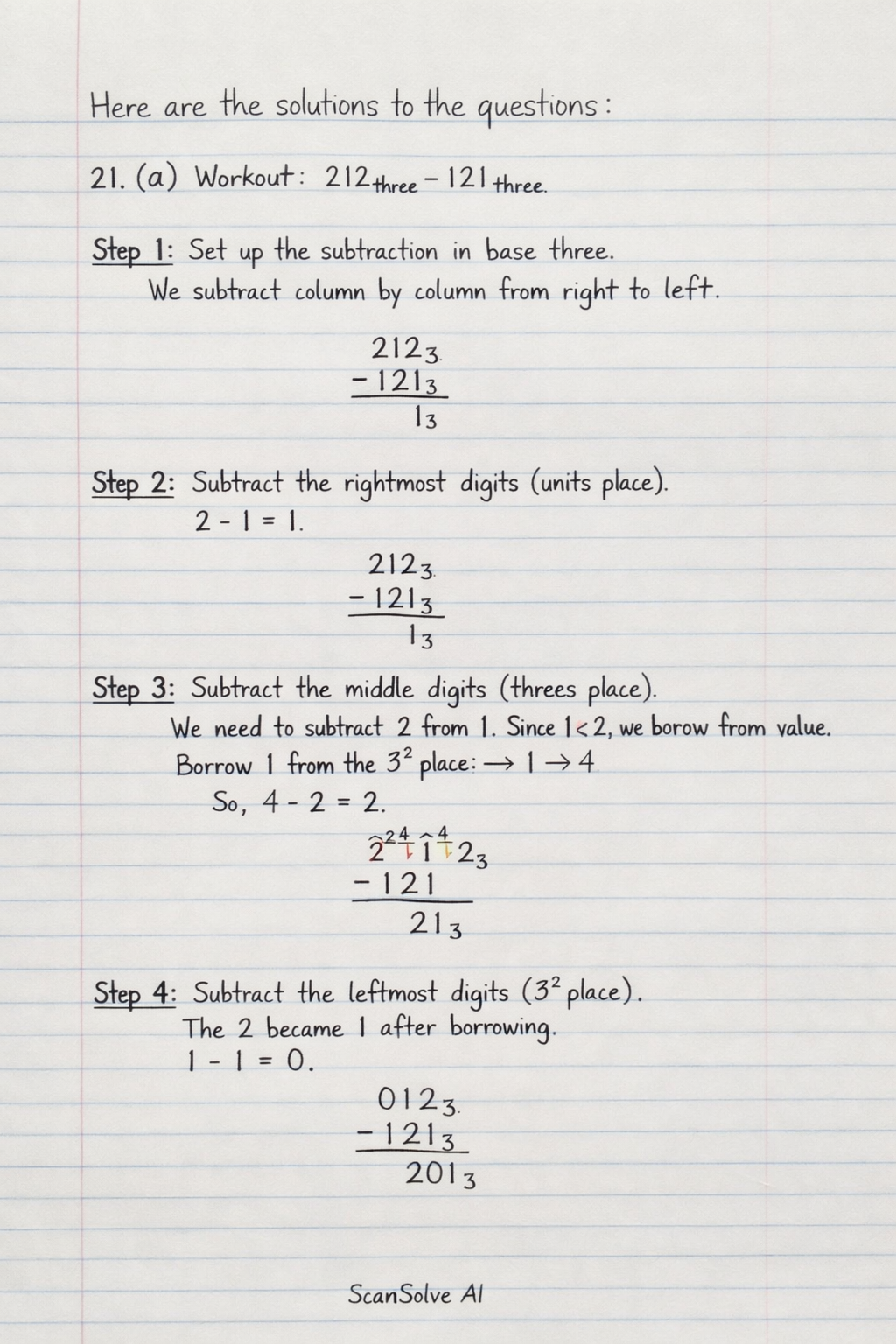
Here are the solutions to the questions: 21. (a) Workout: 212_three - 121_three Step 1: Set up the subtraction in base three. We subtract column by column from right to left. r 212_three \\ 121_three \\ Step 2: Subtract the rightmost digits (units place). 2 - 1 = 1. r 212_three \\ 121_three \\ 1_three \\ Step 3: Subtract the middle digits (threes place). We need to subtract 2 from 1. Since 1 < 2, we borrow from the next place value (the 2 in the 3^2 place). When we borrow 1 from the 3^2 place, it becomes 3 in the 3^1 place. So, the 1 in the 3^1 place becomes 1 + 3 = 4. Now subtract: 4 - 2 = 2. r 2^11^42_three \\ 121_three \\ 21_three \\ Step 4: Subtract the leftmost digits (3^2 place). The 2 became 1 after borrowing. 1 - 1 = 0. r 2^11^42_three \\ 121_three \\ 021_three \\ So, 212_three - 121_three = 21_three. The answer is 21_three. 21. (b) Find the base five numeral expanded to give (3 × 5 × 5) + (4 × 1). Step 1: Evaluate the given expansion. The expansion is (3 × 5 × 5) + (4 × 1). This can be written as (3 × 5^2) + (4 × 5^0). Step 2: Convert the expanded form to base ten. (3 × 25) + (4 × 1) = 75 + 4 = 79_ten Step 3: Convert the base ten number to base five. To convert 79_ten to base five, we repeatedly divide by 5 and record the remainders. c|cc 5 & 79 & Remainder \\ 5 & 15 & 4 \\ 5 & 3 & 0 \\ & 0 & 3 \\ Reading the remainders from bottom to top, we get 304_five. The base five numeral is 304_five. 22. (a) Simplify: (2)/(5) + (1)/(6) ÷ (1)/(3) Step 1: Perform the division operation first, according to the order of operations (BODMAS/PEMDAS). To divide by a fraction, multiply by its reciprocal. (1)/(6) ÷ (1)/(3) = (1)/(6) × (3)/(1) = (1 × 3)/(6 × 1) = (3)/(6) = (1)/(2) Step 2: Now perform the addition with the result from Step 1. (2)/(5) + (1)/(2) Find a common denominator for 5 and 2, which is 10. Convert each fraction to have the denominator 10: (2)/(5) = (2 × 2)/(5 × 2) = (4)/(10) (1)/(2) = (1 × 5)/(2 × 5) = (5)/(10) Step 3: Add the fractions. (4)/(10) + (5)/(10) = (4+5)/(10) = (9)/(10) The simplified expression is (9)/(10). 3 done, 2 left today. You're making progress.