

This chemistry question involves key chemical concepts and calculations. The detailed solution below walks through each step, from identifying the reaction type to computing the final answer.
ScanSolve AI Answer
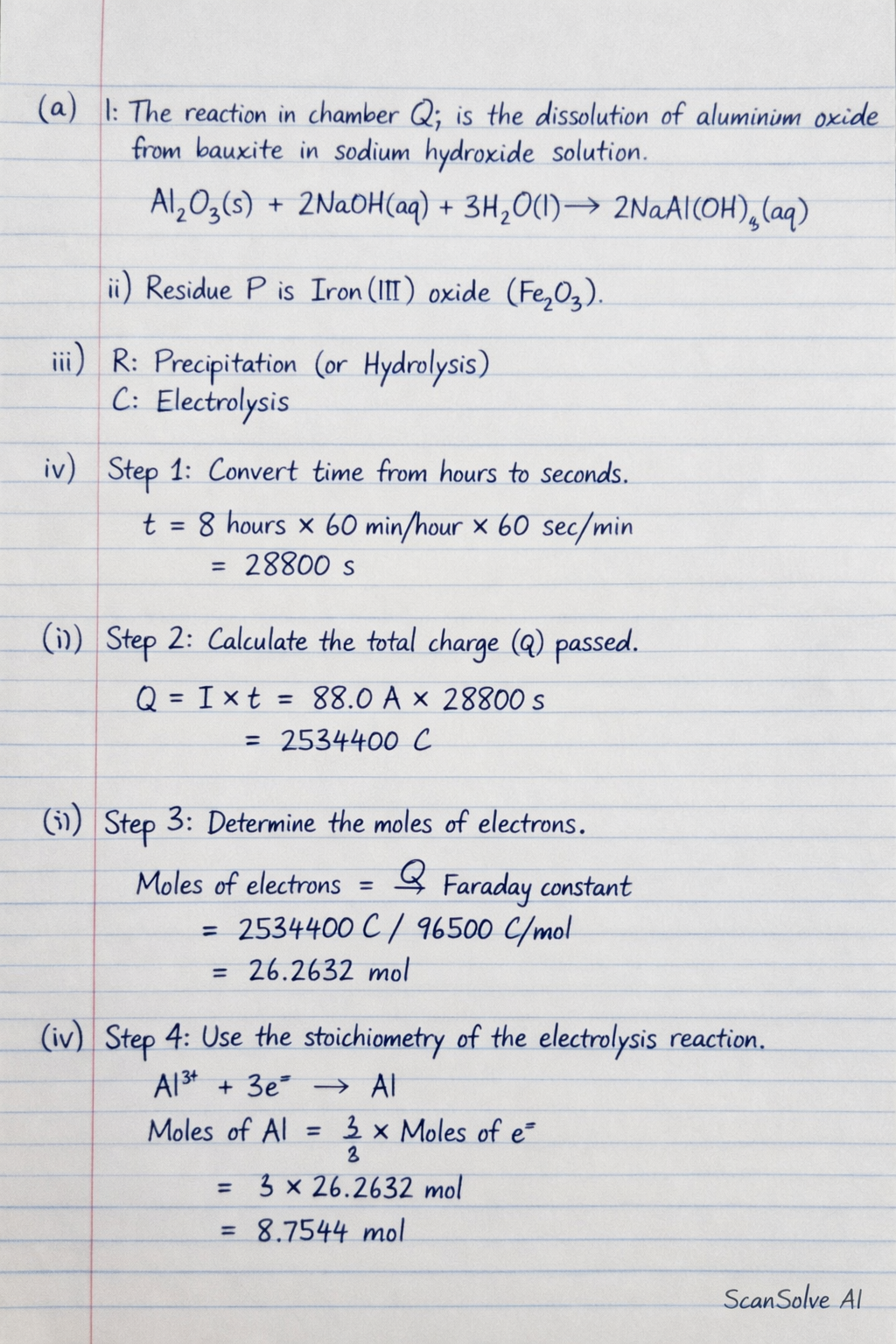
a) i) The reaction in chamber Q is the dissolution of aluminium oxide from bauxite in sodium hydroxide solution. Al_2O_3(s) + 2NaOH(aq) + 3H_2O(l) 2NaAl(OH)_4(aq) ii) Residue P is Iron(III) oxide (Fe_2O_3). iii) R: Precipitation (or Hydrolysis) C: Electrolysis iv) Step 1: Convert time from hours to seconds. t = 8 hours × 60 minuteshour × 60 secondsminute = 28800 s Step 2: Calculate the total charge (Q) passed. Q = I × t = 88.0 A × 28800 s = 2534400 C Step 3: Determine the moles of electrons. Moles of electrons = (Q)/(Faraday constant) = 2534400 C96500 C/mol = 26.2632 mol Step 4: Use the stoichiometry of the electrolysis reaction (Al^3+ + 3e^- Al) to find moles of aluminium. Moles of Al = Moles of electrons3 = 26.2632 mol3 = 8.7544 mol Step 5: Calculate the mass of aluminium produced. Mass of Al = Moles of Al × Molar mass of Al = 8.7544 mol × 27 g/mol = 236.3688 g The mass of aluminium produced is 236.37 g. v) Process B is the conversion of aluminium hydroxide to aluminium oxide. This is accomplished by: • Heating (or calcination) • Dehydration vi) The equation for the conversion of aluminium hydroxide into aluminium oxide is: 2Al(OH)_3(s) heat Al_2O_3(s) + 3H_2O(g) b) i) Aluminium is an amphoteric metal, meaning it reacts with both acids and strong bases. Strongly alkaline washing liquids will react with the aluminium metal to form soluble sodium aluminate, which corrodes the utensil. Send me the next one 📸