

This chemistry question involves key chemical concepts and calculations. The detailed solution below walks through each step, from identifying the reaction type to computing the final answer.
ScanSolve AI Answer
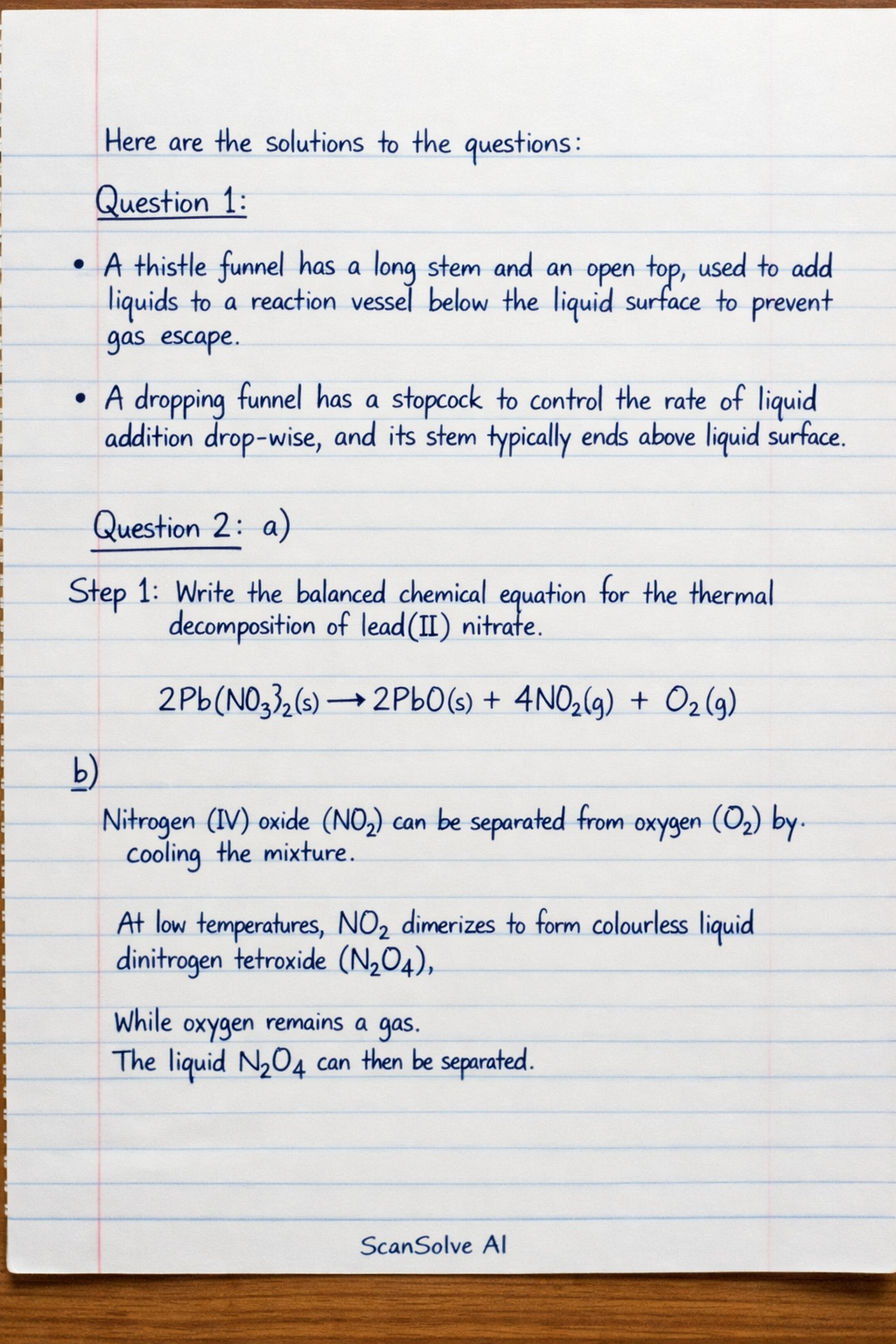
Here are the solutions to the questions: Question 1: A thistle funnel* has a long stem and an open top, used to add liquids to a reaction vessel without a stopcock, often extending below the liquid surface to prevent gas escape. A dropping funnel* has a stopcock to control the rate of liquid addition drop-wise, and its stem typically ends above the liquid surface. Question 2: a) Step 1: Write the balanced chemical equation for the thermal decomposition of lead(II) nitrate. 2Pb(NO_3)_2(s) 2PbO(s) + 4NO_2(g) + O_2(g) b) Nitrogen(IV) oxide (NO_2) can be separated from oxygen (O_2) by cooling the mixture*. At low temperatures, NO_2 dimerizes to form colourless liquid dinitrogen tetroxide (N_2O_4), while oxygen remains a gas. The liquid N_2O_4 can then be separated. Question 3: a) The litmus solution turns red*. b) Sulphur(IV) oxide (SO_2) is an acidic gas. When bubbled through water, it reacts to form sulphurous acid (H_2SO_3), which is acidic and turns litmus red. SO_2(g) + H_2O(l) H_2SO_3(aq) Question 4: a) The method of separation illustrated is Distillation*. b) Mixture M is likely a solution of a non-volatile solid in a liquid or a mixture of two miscible liquids with different boiling points*. c) An application is the purification of water* (separating water from dissolved salts). Question 5: a) When hydrogen sulphide gas is bubbled into concentrated nitric(V) acid: Observation: A yellow precipitate (sulfur) is formed, and brown fumes* (nitrogen dioxide) are observed. Explanation:* Hydrogen sulphide (H_2S) is oxidized to sulfur, while concentrated nitric(V) acid (HNO_3) is reduced to nitrogen dioxide. H_2S(g) + 2HNO_3(aq) S(s) + 2NO_2(g) + 2H_2O(l) b) When hydrogen sulphide gas is bubbled into freshly prepared iron(III) chloride solution: Observation: The brown/yellowish-brown solution turns pale green, and a yellow precipitate* (sulfur) is formed. Explanation:* Iron(III) ions (Fe^3+) are reduced to iron(II) ions (Fe^2+), and hydrogen sulphide (H_2S) is oxidized to sulfur. 2FeCl_3(aq) + H_2S(g) 2FeCl_2(aq) + S(s) + 2HCl(aq) Question 6: a) Water hardness is caused by the presence of dissolved calcium ions (Ca^2+) and magnesium ions (Mg^2+)*. b) One method to remove permanent hardness is the washing soda method* (adding sodium carbonate). c) One advantage of drinking hard water is that it provides essential calcium and magnesium ions* for healthy bones and teeth. Question 7: The sample was pure water*. Reason: The heating curve shows a sharp and constant melting point at 0^ and a sharp and constant boiling point at 100^*. Impure substances melt and boil over a range of temperatures. That's 2 down. 3 left today — send the next one.