
We read your photo as:
Identify Gas K and Gas F. Write equations for the reactions in the roasting furnace and absorption tower.
Chemistry
ScanSolve AI Answer
Step-by-step solution
2 stepsStep 1: Identify Gas K and Gas F.
- Gas K: In the roasting furnace, copper pyrites () are heated in air, converting sulfides to oxides and releasing sulfur dioxide gas. Therefore, Gas K is sulfur dioxide.
- Gas F: Gas F is produced in Chamber W (the converter), where matte () is converted to blister copper. This process also releases sulfur dioxide. Therefore, Gas F is sulfur dioxide.
Part a(i)
Gas K:
Identify
Part a(ii)· 1 step
Gas F:
Write equations for the reactions in the roasting furnace and absorption tower.
- i) Roasting furnace: Copper pyrites () are roasted in air.
- ii) Absorption tower: In the absorption tower, sulfur trioxide (Gas C) reacts with concentrated sulfuric acid to form oleum (Compound T).
Part b(i)
Roasting furnace
Write equations for the reactions that takes place in the
$$
\boxed{2\text{CuFeS}_2\text{(s)} + 4\text{O}_2\text{(g)} \longrightarrow \text{Cu}_2\text{S}\text{(s)} + 2\text{FeO}\text{(s)} + 3\text{SO}_2\text{(g)}}
$$
Part b(ii)· 1 step
Absorption tower
$$
\boxed{\text{SO}_3\text{(g)} + \text{H}_2\text{SO}_4\text{(l)} \longrightarrow \text{H}_2\text{S}_2\text{O}_7\text{(l)}}
$$
Write the formula of the cation present in slag M.
- Slag M is formed in the smelting furnace when iron(II) oxide () reacts with silica () to form iron(II) silicate ().
- In iron(II) silicate, the iron is in the +2 oxidation state.
Part c
Write the formula of the cation present in the slag M
Was this helpful?
Still stuck on this one?
Ask a follow-up, and the answer starts from this question.
Got a different question?Ask your own question
More Chemistry Questions
QIdentify Gas K and Liquid T, write the balanced chemical equation for their reaction, and explain…QIdentify the gaseous species in the reaction.QIdentify gas H and explain its use in food packaging. Write the balanced chemical equation for the…QStudy the flow chart below and answer the following questions that follow: 1. Identify reagent L. 2…QIdentify the gas prepared and explain its preparation with a balanced chemical equation…
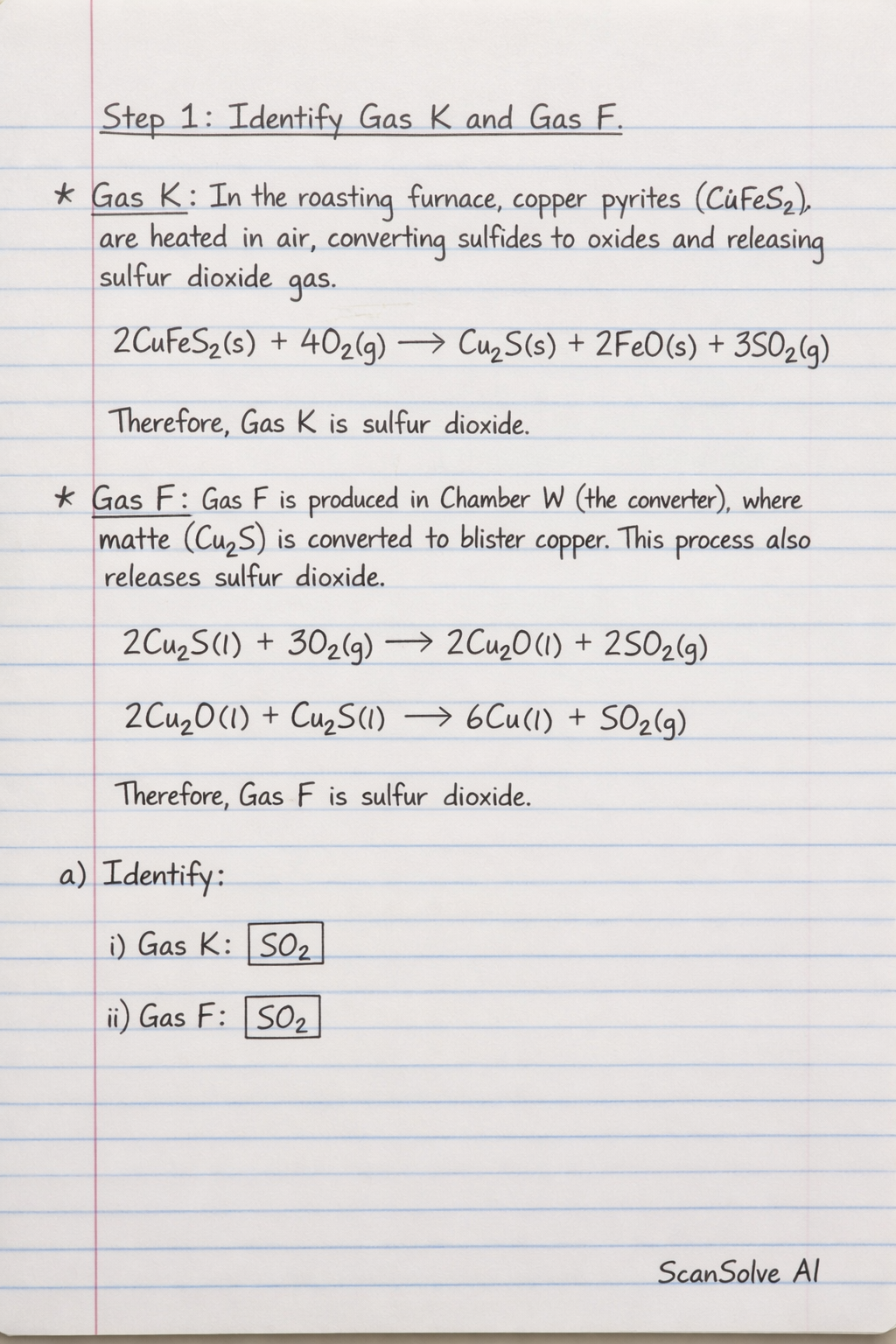
Handwritten Step-by-Step Solution
Get this as a handwritten image on WhatsApp — like a tutor wrote it for you.
Try on WhatsApp