
We read your photo as:
Identify liquid P, write the equation for the reaction, and state one industrial use of carbon(IV) oxide apart from making fire extinguishers.
ScanSolve AI Answer
10.
i) Identify liquid P.
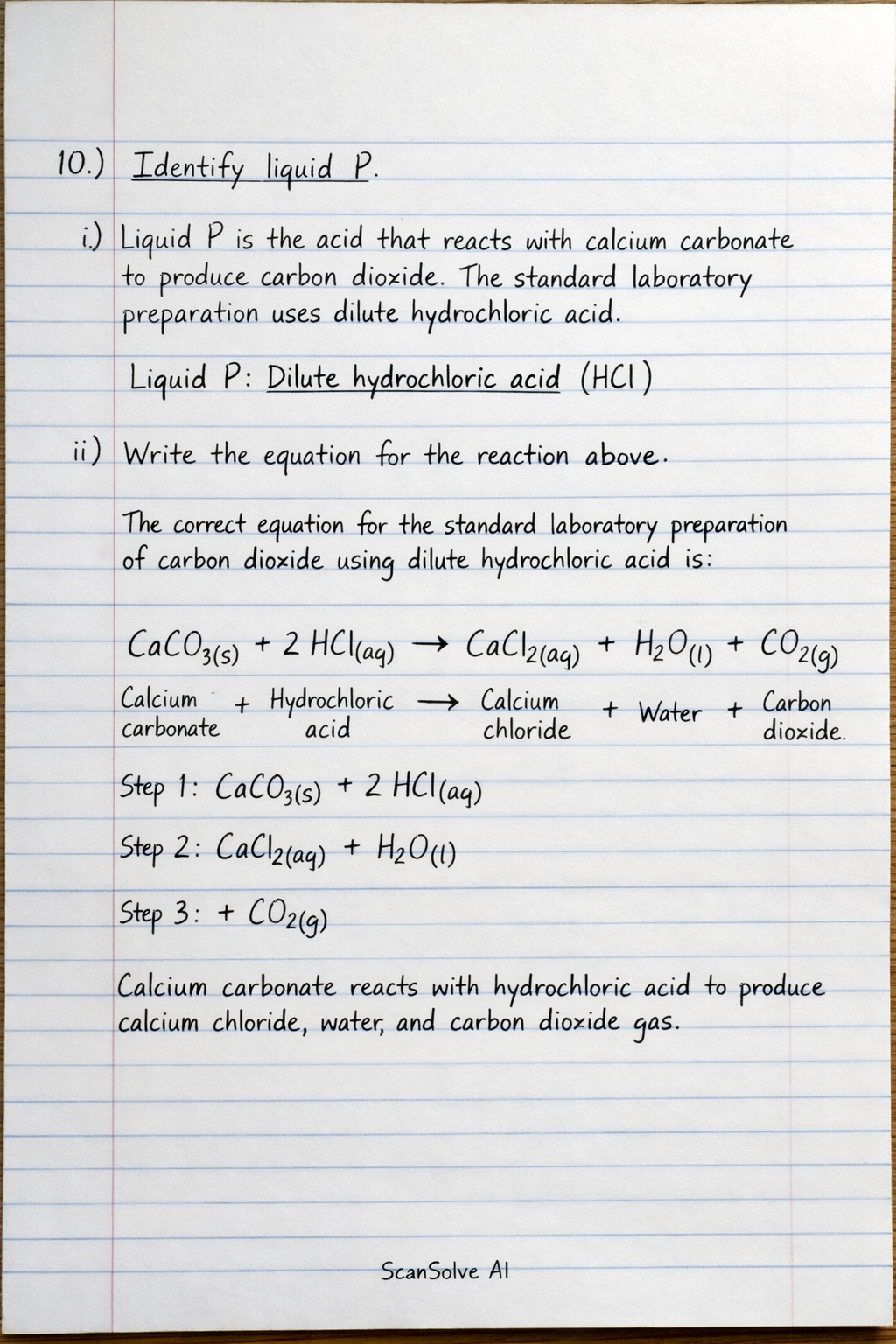
Liquid P is the acid that reacts with calcium carbonate to produce carbon dioxide. The standard laboratory preparation uses dilute hydrochloric acid.
Liquid P: Dilute hydrochloric acid ()
ii) Write the equation for the reaction above.
The student's equation uses sulfuric acid. While sulfuric acid reacts with calcium carbonate, it is not typically used for laboratory preparation of because the calcium sulfate () formed is sparingly soluble and coats the calcium carbonate, stopping the reaction. The state symbol for should be in this context.
The correct equation for the standard laboratory preparation of carbon dioxide using dilute hydrochloric acid is:
iii) State one industrial use of carbon(IV) oxide apart from making fire extinguishers.
The student's answer is incorrect. Carbon dioxide is not used to manufacture calcium carbonate for fixing broken bones.
One industrial use of carbon(IV) oxide is in the carbonation of soft drinks.
Still stuck on this one?
Ask a follow-up, and the answer starts from this question.
More Chemistry Questions
Handwritten Step-by-Step Solution
Get this as a handwritten image on WhatsApp — like a tutor wrote it for you.
Try on WhatsApp