

This chemistry question involves key chemical concepts and calculations. The detailed solution below walks through each step, from identifying the reaction type to computing the final answer.
ScanSolve AI Answer
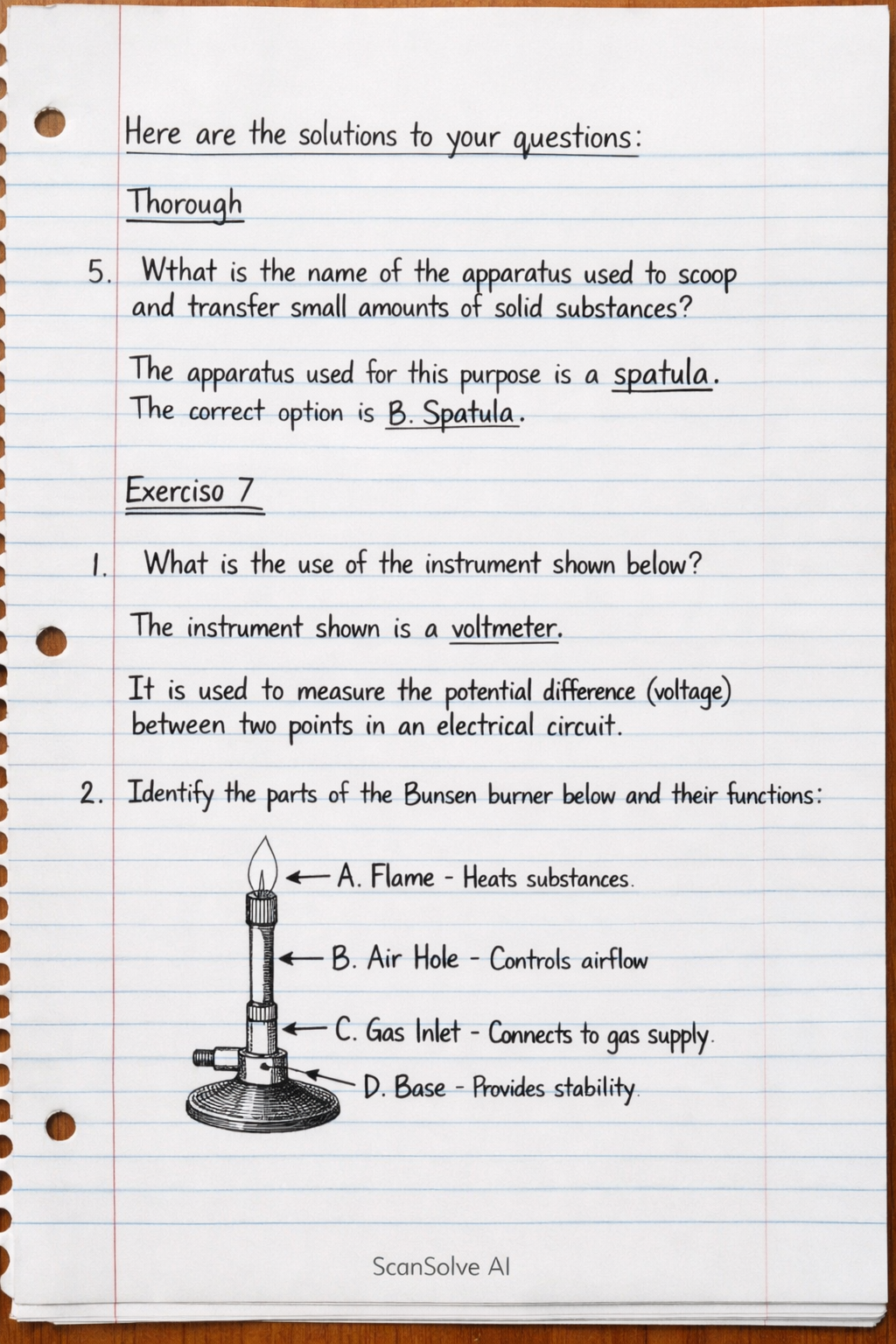
Here are the solutions to your questions: Thorough 5. What is the name of the apparatus used to scoop and transfer small amounts of solid substances? The apparatus used for this purpose is a spatula. The correct option is B. Spatula. Exercise 7 1. What is the use of the instrument shown below? The instrument shown is a voltmeter. It is used to measure the potential difference (voltage) between two points in an electrical circuit. 2. Identify the parts of the Bunsen burner below and their functions. | Part | Name | Function | | :--- | :------------- | :---------------------------------------------------------------------- | | P | Chimney/Barrel | Where the gas burns and the flame is produced. | | Q | Collar | Used to adjust the size of the air hole, controlling the air supply. | | R | Rubber tubing | Connects the Bunsen burner to the gas supply. | | S | Base | Provides stability and support for the Bunsen burner. | 3. Which one of the following laboratory apparatus is used for measuring [volume]? Assuming the question is about measuring volume, especially accurately. A burette is used for accurate measurement and dispensing of variable volumes of liquid, typically in titrations. The correct option is D. Burette. 4. Which one of the following apparatus is used to hold and dispense water especially into vessels with narrow necks? A wash bottle is specifically designed for this purpose. The correct option is C. Wash bottle. 5. The part of the Bunsen burner that is used to open or close the air [hole/supply]? The collar is rotated to adjust the air hole, thereby controlling the air supply to the flame. The correct option is B. Collar.