
We read your photo as:
Identify the functional group, list the first three members of the homologous series and draw the structure of but-1-yne. Explain the distinction between an alkene and alcohol using bromine water. Des
Chemistry
ScanSolve AI Answer
a)
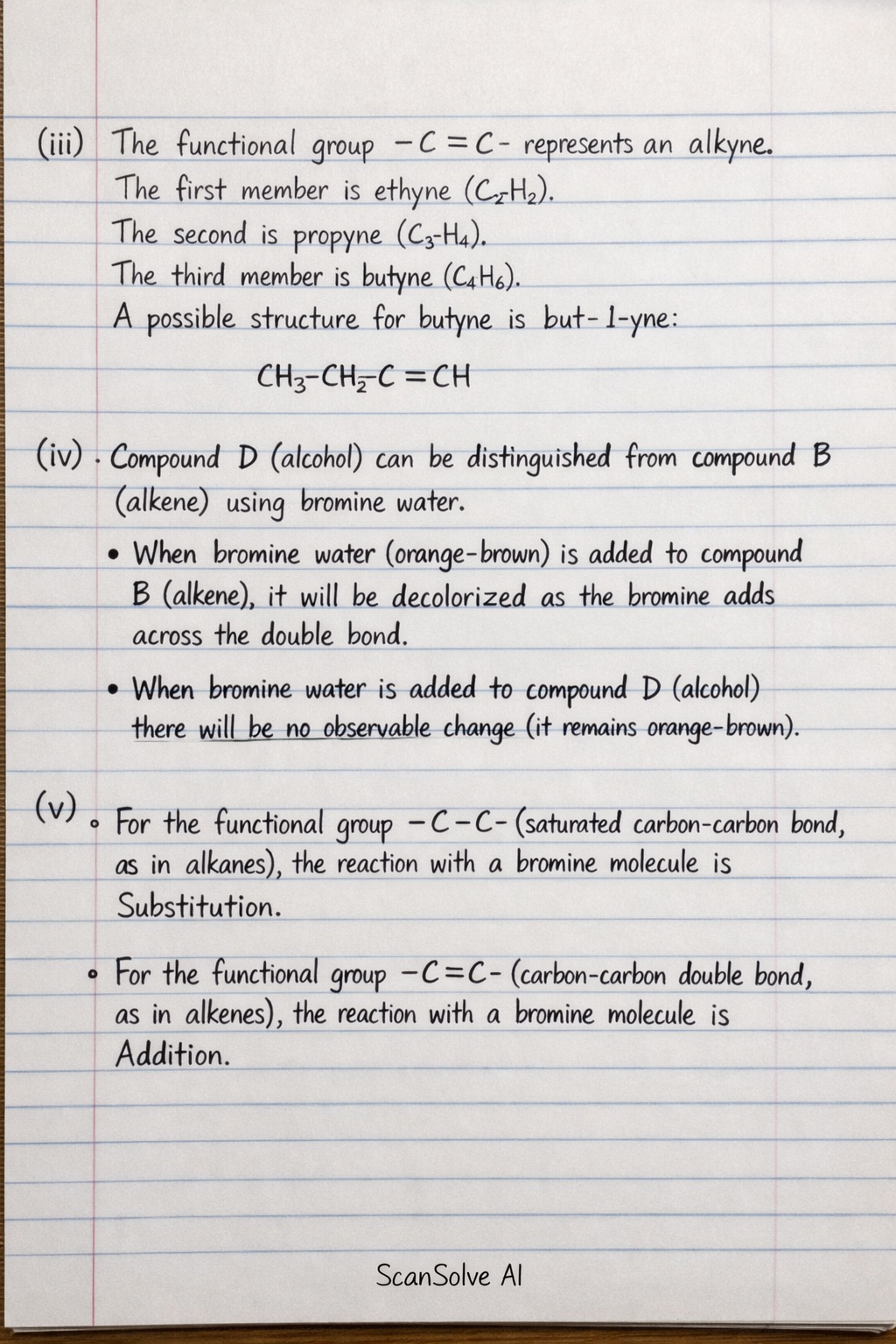
(iii) The functional group represents an alkyne. The first member is ethyne (), the second is propyne (). The third member is butyne (). A possible structure for butyne is but-1-yne:
(iv) Compound D (alcohol) can be distinguished from compound B (alkene) using bromine water.
- When bromine water (orange-brown) is added to compound B (alkene), it will be decolorized as the bromine adds across the double bond.
- When bromine water is added to compound D (alcohol), there will be no observable change (it remains orange-brown).
(v)
- For the functional group (saturated carbon-carbon bond, as in alkanes), the reaction with a bromine molecule is Substitution.
- For the functional group (carbon-carbon double bond, as in alkenes), the reaction with a bromine molecule is Addition.
Was this helpful?
Still stuck on this one?
Ask a follow-up, and the answer starts from this question.
Got a different question?Ask your own question
More Chemistry Questions
QGive the name of the 3rd member of the alkene homologous series. (b) Draw and name all isomers of…QDefine acyclic compounds and alkyl halides. Draw the structure of (E)−1-bromobut-1-ene.QDraw the expanded structural formula for each of the following organic compounds: a) Propene, b)…QWrite in the boxes, the names of the species in the following reaction of alkyne with bromine. Also…QI) State how burning can be used to distinguish between ethane and ethyne. Explain. ii) Draw and…
Browse by topic:Organic Chemistry
Handwritten Step-by-Step Solution
Get this as a handwritten image on WhatsApp — like a tutor wrote it for you.
Try on WhatsApp