
We read your photo as:
Define the identity element.
ScanSolve AI Answer
Answers
2 partsStep-by-step solution
5 stepsHere are the solutions to your problems.
1. Find the identity for the binary operation on the set , given that .
Step 1: Define the identity element.
An element is the identity element for the operation if for all , and .
Step 2: Apply the definition to the given operation.
Given the operation , we set :
Step 3: Solve for .
To solve for , we rearrange the equation:
For this equation to hold true for all (specifically for ), the term must be zero.
We can verify this with : , which is correct.
The identity element is .
2. A binary operation is defined as .
Part i· 3 steps
Find the inverse element under the operation .
Find the identity element for the operation .
An element is the identity element if for all , and .
Using :Subtract from both sides:
Factor out :
For this equation to hold for all , must be 0. (If , then , which means would only work for a specific , not all .)
We can verify with : , which is correct.
So, the identity element is .Define the inverse element.
An element is the inverse of if and .
We found the identity element .
So, we need to solve .Apply the definition and solve for .
Using the operation , we set it equal to 0:
Rearrange the terms to isolate :
Factor out from the left side:
Divide by to solve for :
The inverse element exists for all such that , i.e., .
The inverse element is .
Part ii
The inverse of H.
Use the formula for the inverse found in part i).
The inverse of an element is given by .
Substitute for .
To find the inverse of , we replace with in the formula:
This inverse exists for such that .
The inverse of H is .
Try one yourself
A new problem that tests the same skill.
Still stuck on this one?
Ask a follow-up, and the answer starts from this question.
More Chemistry Questions
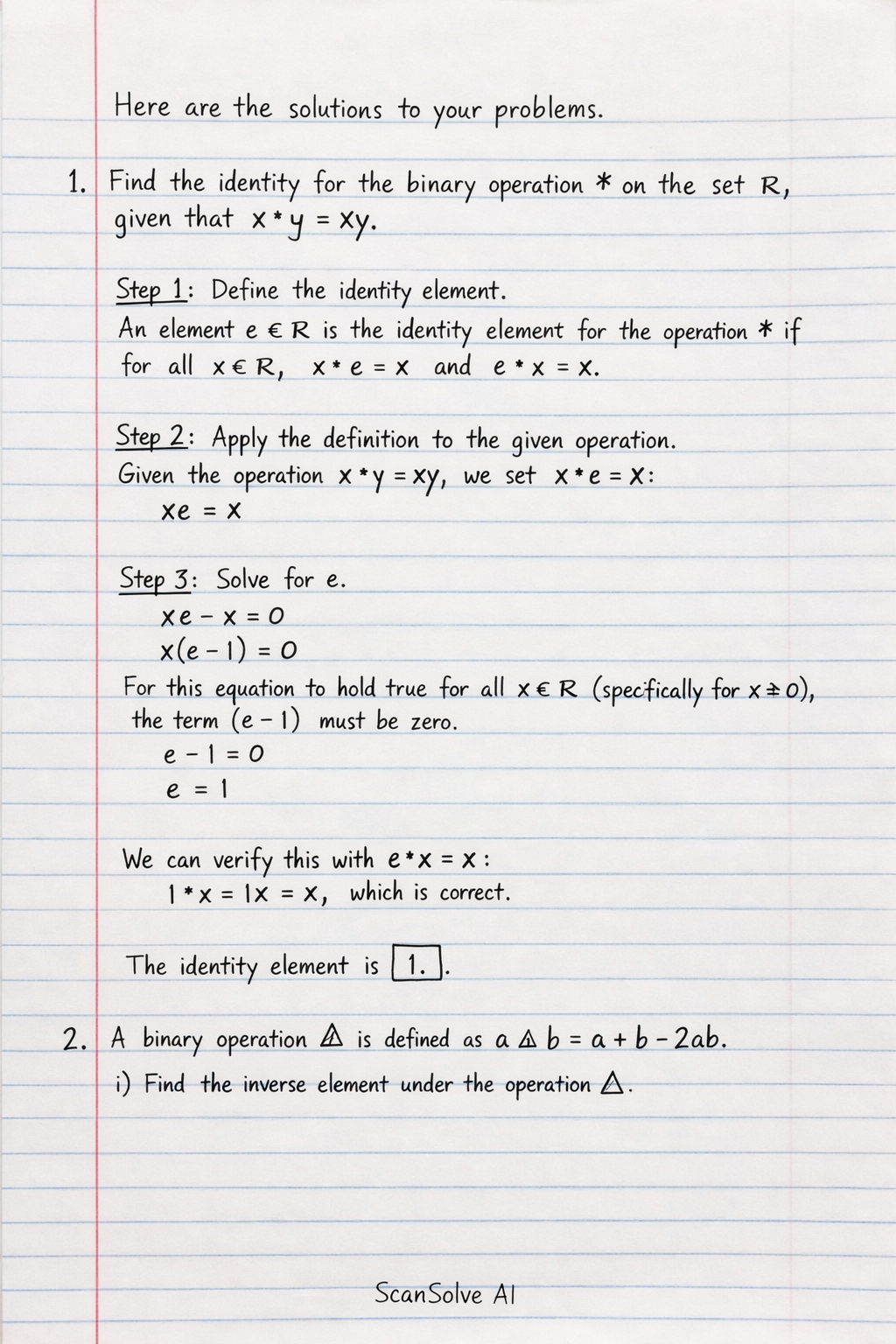
Handwritten Step-by-Step Solution
Get this as a handwritten image on WhatsApp — like a tutor wrote it for you.
Try on WhatsApp