
We read your photo as:
If iron (Fe(s)/Fe2+(aq)) is used as a reference electrode, what are the new standard reduction potentials for Al(s)/Al3+(aq), Zn(s)/Zn2+(aq), and Ni(s)/Ni2+(aq)?
Chemistry
ScanSolve AI Answer
Step-by-step solution
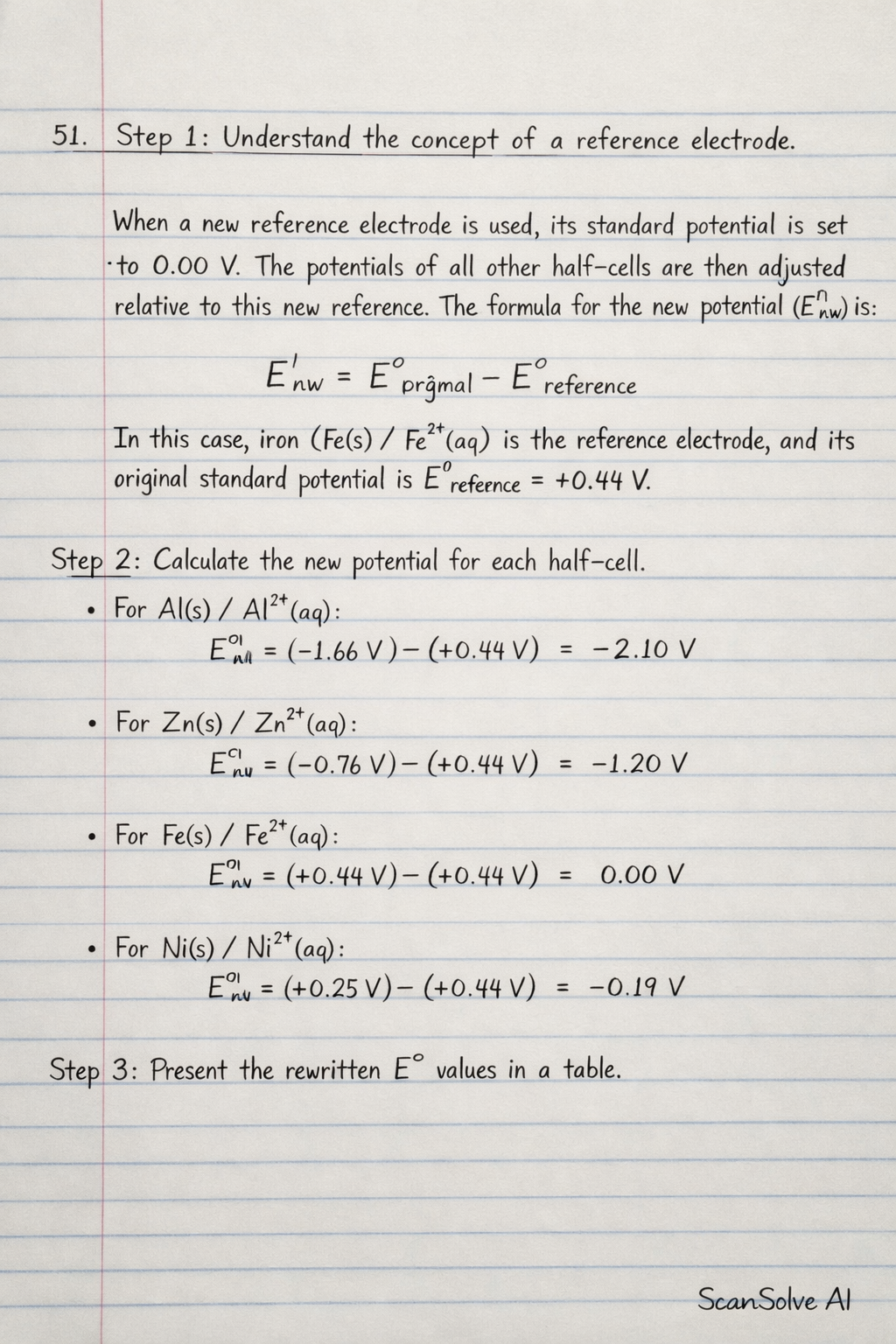
3 stepshere are the answers for question 51:
Understand the concept of a reference electrode.
When a new reference electrode is used, its standard potential is set to 0.00 V. The potentials of all other half-cells are then adjusted relative to this new reference. The formula for the new potential () is:
In this case, iron () is the reference electrode, and its original standard potential is V (from the given table).
Calculate the new potential for each half-cell.
-
For :
-
For :
-
For :
-
For :
-
Present the rewritten values in a table.
The rewritten values using iron as a reference electrode are:
Was this helpful?
Still stuck on this one?
Ask a follow-up, and the answer starts from this question.
Got a different question?Ask your own question
More Chemistry Questions
QThe standard reduction potentials are:QConsider the reduction potentials below: Pb2+(aq) + 2e^- <=> Pb(s) E° = −0.13 V and Mg2+(aq) + 2e^…QWhich half equation is used as the standard for the electrode potentials? From the table identify…QThe table gives the standard redox potentials for a number of half reactions. Use it to answer the…QThe table gives the standard redox potentials for a number of half-reactions. (i) Relative to which…
Handwritten Step-by-Step Solution
Get this as a handwritten image on WhatsApp — like a tutor wrote it for you.
Try on WhatsApp