
We read your photo as:
If the rate law for a reaction is Rate = k[B]^(3/2), by what factor does the reaction rate increase if the concentration of B is doubled?
Chemistry
ScanSolve AI Answer
Answer
Step-by-step solution
5 stepsHere's how to determine the increase in reaction rate:
Write down the initial rate law.
The given experimental rate law is:
where is the initial concentration of B.
Write down the new rate law when the concentration of B is doubled.
If the concentration of B is doubled, the new concentration is . The new rate, , will be:
Simplify the new rate expression.
Calculate the ratio of the new rate to the initial rate to find the factor of increase.
Cancel out and :
Evaluate the numerical value.
The reaction rate will increase by a factor of .
Was this helpful?
Try one yourself
A new problem that tests the same skill.
Still stuck on this one?
Ask a follow-up, and the answer starts from this question.
Got a different question?Ask your own question
More Chemistry Questions
QA reaction rate depends on the concentration of reactant B according to the rate law: Rate…QDetermine the units of the specific rate constant k given the rate law d[x]/dt = k[B]^(3/4).QFor 2NO2 + O3 -> N2O5 + O2: Doubling [NO2] doubles the rate, doubling [O3] doubles the rate. What is…QDetermine the reaction order and rate constant from the given experimental data. Rate law: rate…QGiven A = k(B2/C2), solve for A and percentage change in A under specified conditions.
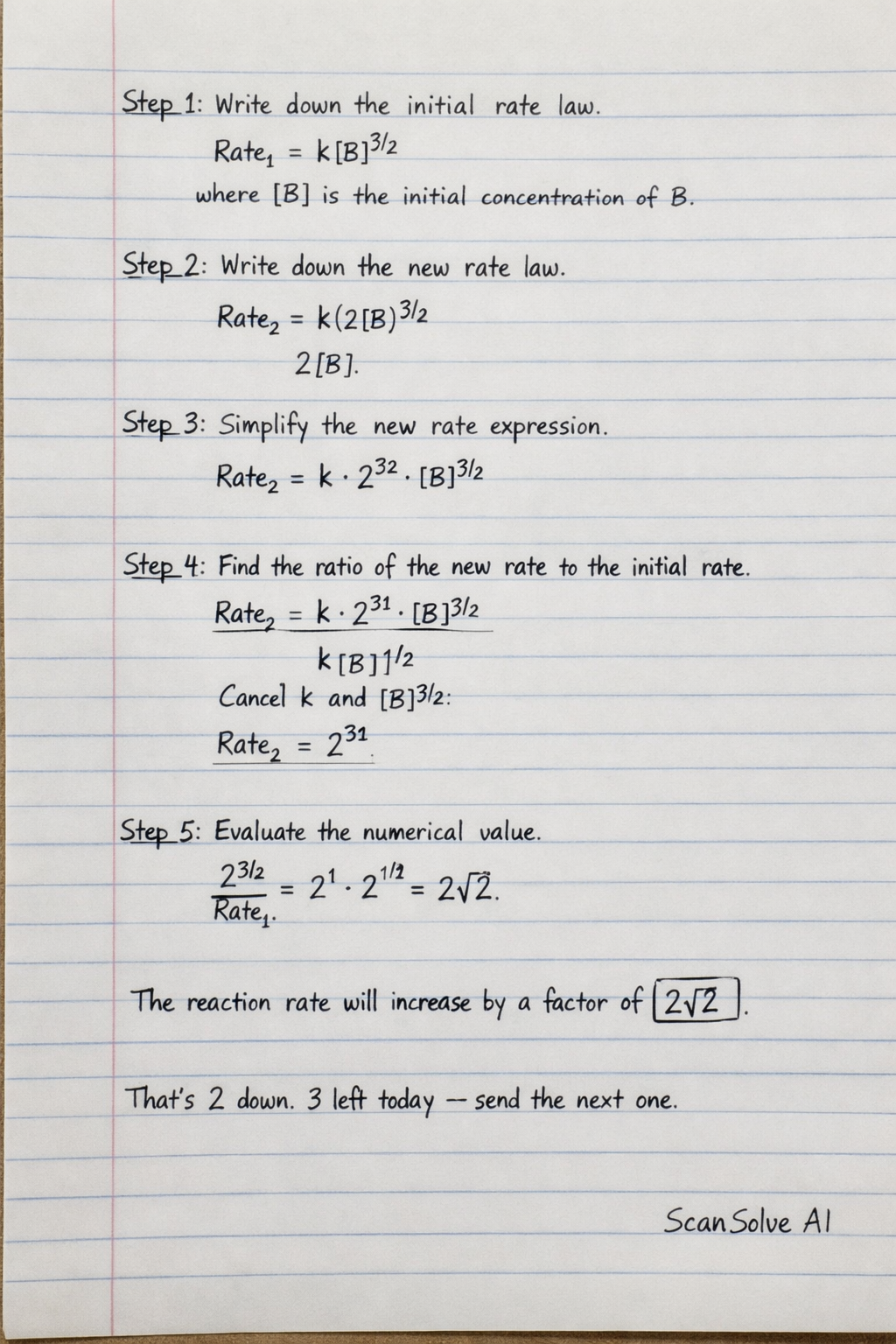
Handwritten Step-by-Step Solution
Get this as a handwritten image on WhatsApp — like a tutor wrote it for you.
Try on WhatsApp