
We read your photo as:
Illustrate the formation of the following as covalent compounds: Group 1 - CO2, Group 2 - H2O
ScanSolve AI Answer
Step-by-step solution
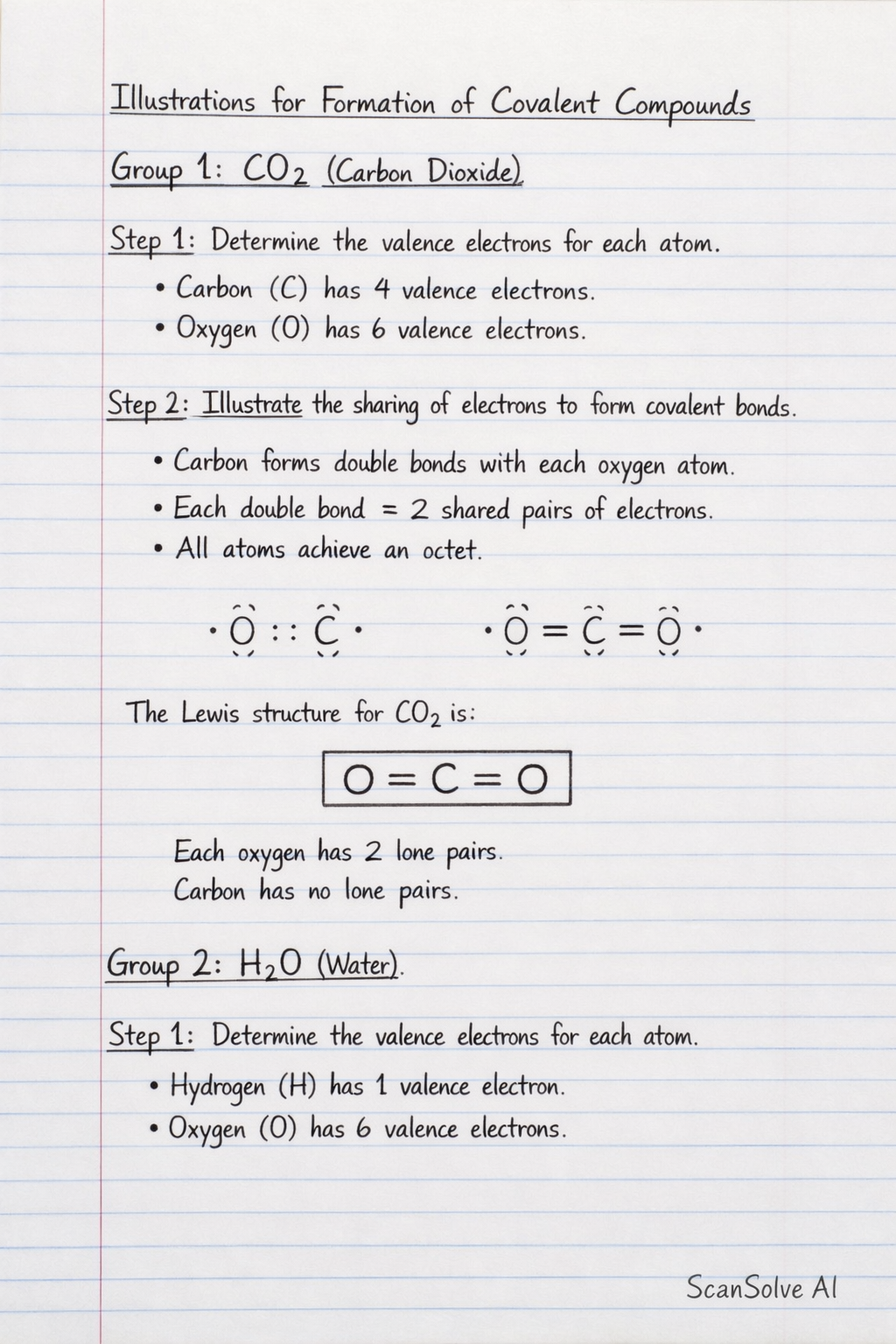
4 stepsHere are the illustrations for the formation of the covalent compounds:
Group 1: (Carbon Dioxide)
Determine the valence electrons for each atom.
Carbon (C) has 4 valence electrons. Each Oxygen (O) atom has 6 valence electrons.
Illustrate the sharing of electrons to form covalent bonds.
Carbon forms double covalent bonds with each oxygen atom. Each double bond consists of two shared pairs of electrons. This allows all atoms to achieve a stable octet configuration.
The Lewis structure for is:
Each oxygen atom has two lone pairs of electrons, and carbon has no lone pairs.
Group 2: (Water)
Determine the valence electrons for each atom.
Each Hydrogen (H) atom has 1 valence electron. Oxygen (O) has 6 valence electrons.
Illustrate the sharing of electrons to form covalent bonds.
Oxygen forms a single covalent bond with each hydrogen atom. Each single bond consists of one shared pair of electrons. This allows hydrogen atoms to achieve a stable duet and the oxygen atom to achieve a stable octet.
The Lewis structure for is:
The oxygen atom has two lone pairs of electrons.
Still stuck on this one?
Ask a follow-up, and the answer starts from this question.
More Chemistry Questions
Handwritten Step-by-Step Solution
Get this as a handwritten image on WhatsApp — like a tutor wrote it for you.
Try on WhatsApp