
We read your photo as:
Define air pollution, air pollutant, and smog. Discuss the causes of air pollution and their corresponding mitigation strategies.
Chemistry
ScanSolve AI Answer
Here is an article addressing the challenge of air pollution:
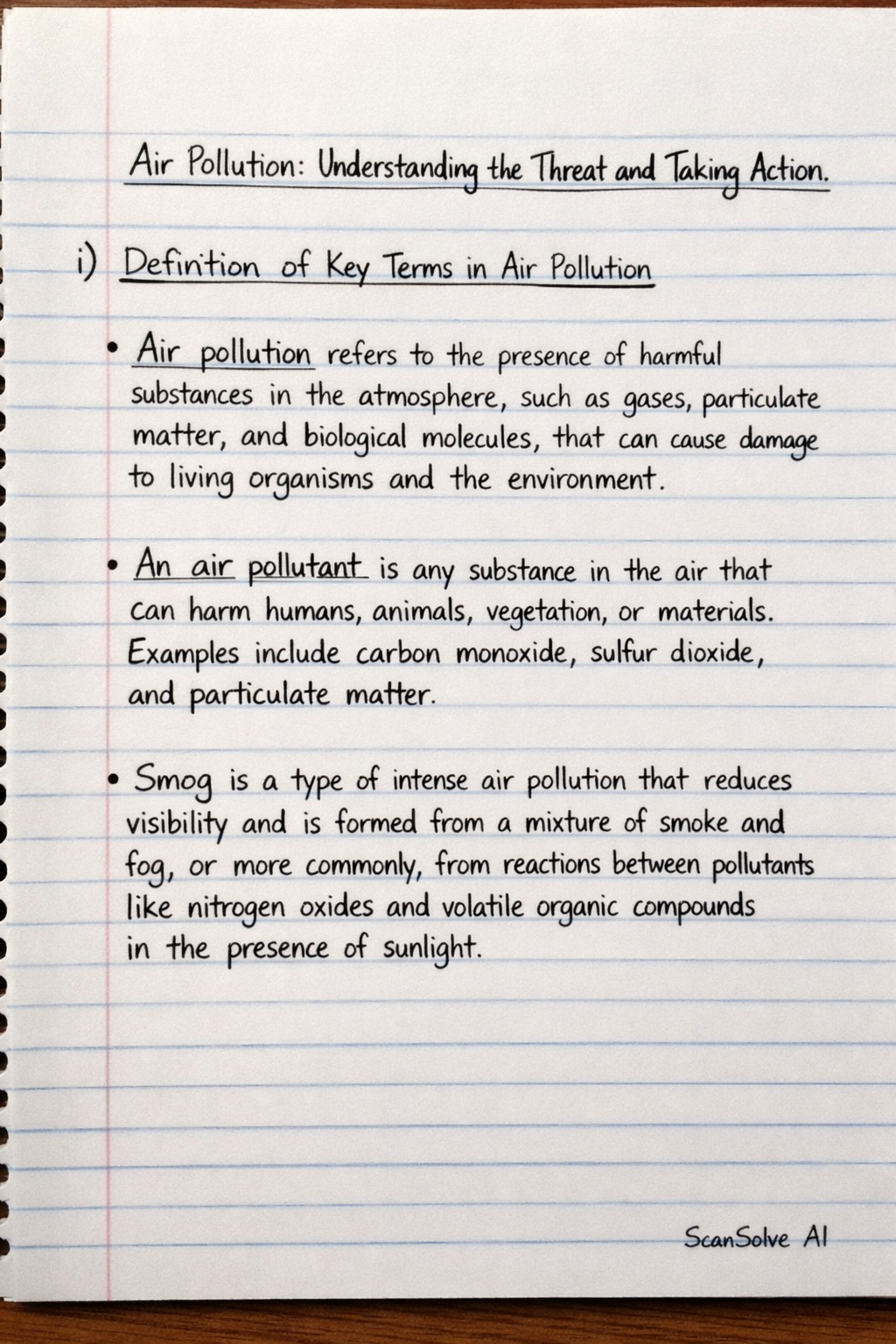
Air Pollution: Understanding the Threat and Taking Action
Air pollution has become a critical global issue, with significant impacts on health and the environment. As a chemistry learner, understanding its complexities is crucial for effective mitigation.
i) Definition of Key Terms in Air Pollution
- Air pollution refers to the presence of harmful substances in the atmosphere, such as gases, particulate matter, and biological molecules, that can cause damage to living organisms and the environment.
- An air pollutant is any substance in the air that can harm humans, animals, vegetation, or materials. Examples include carbon monoxide, sulfur dioxide, and particulate matter.
- Smog is a type of intense air pollution that reduces visibility and is formed from a mixture of smoke and fog, or more commonly, from reactions between pollutants like nitrogen oxides and volatile organic compounds in the presence of sunlight.
ii) Causes of Air Pollution and Corresponding Mitigation
- Cause: Emissions from industrial activities and factories. Mitigation: Implementing stricter emission standards, using scrubbers and electrostatic precipitators to filter pollutants, and transitioning to cleaner production technologies.
- Cause: Vehicle exhaust from cars, trucks, and buses. Mitigation: Promoting public transportation, encouraging the use of electric vehicles, improving fuel efficiency, and enforcing regular vehicle maintenance checks.
- Cause: Burning of fossil fuels for energy generation (e.g., coal power plants). Mitigation: Investing in renewable energy sources like solar, wind, and hydroelectric power, and improving energy efficiency in homes and industries.
- Cause: Agricultural activities, such as ammonia emissions from livestock and pesticide spraying. Mitigation: Adopting sustainable farming practices, optimizing fertilizer use, and improving waste management in livestock operations.
- Cause: Domestic burning of solid fuels (wood, charcoal) for cooking and heating. Mitigation: Promoting cleaner cooking fuels and technologies (e.g., LPG, electric stoves), and improving ventilation in homes.
iii) Effects of Air Pollution
Air pollution has severe effects on human health, the environment, and infrastructure.
- Health Effects: It can lead to respiratory diseases like asthma and bronchitis, cardiovascular problems, lung cancer, and other chronic illnesses. Vulnerable populations, such as children and the elderly, are particularly at risk.
- Environmental Effects: It contributes to acid rain, which damages forests, lakes, and soil. It also causes smog, reduces visibility, and contributes to climate change through the emission of greenhouse gases.
- Effects on Infrastructure: Pollutants can corrode buildings, monuments, and other structures, leading to significant maintenance costs and damage to cultural heritage.
Was this helpful?
Still stuck on this one?
Ask a follow-up, and the answer starts from this question.
Got a different question?Ask your own question
More Chemistry Questions
QDiscuss the causes, effects, and mitigation of air pollution, and define key terms related to it.QBased on the image, create a report outline about air pollution, including causes, other factors…QComplete the sentences about pollution, focusing on its definition, causes, and types. Use the…QExplain the main ways human activities contribute to air pollution.QWrite a geographical essay on this three as follows " Pollution, Air Transport , and Migration…
Handwritten Step-by-Step Solution
Get this as a handwritten image on WhatsApp — like a tutor wrote it for you.
Try on WhatsApp