
We read your photo as:
Explain allotropy, name the allotropes of carbon shown, give their uses, and compare their electrical conductivity.
ScanSolve AI Answer
Here are the solutions to the questions:
-
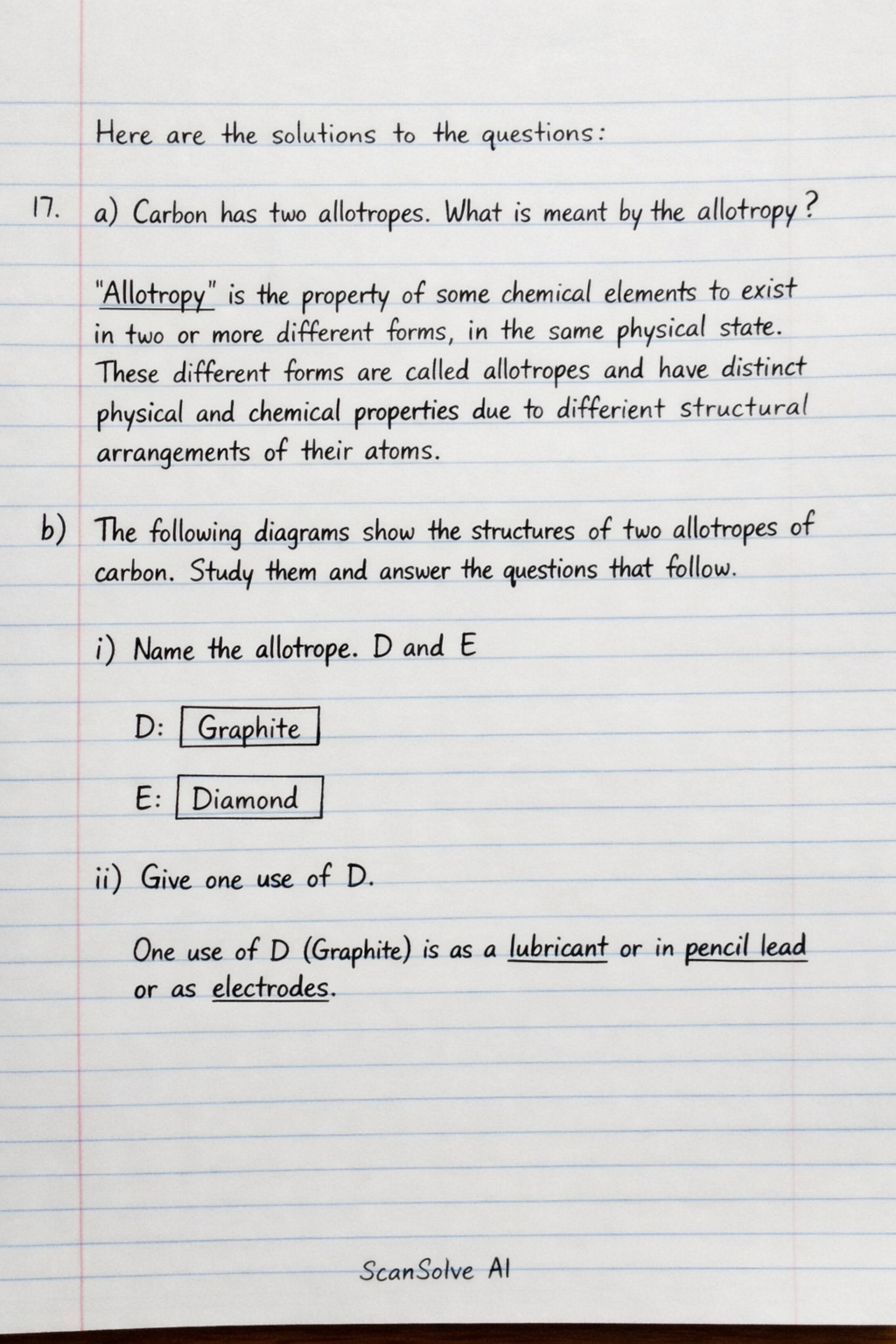
a) Carbon has two allotropes. What is meant by the allotropy? Allotropy is the property of some chemical elements to exist in two or more different forms, in the same physical state. These different forms are called allotropes and have distinct physical and chemical properties due to different structural arrangements of their atoms.
b) The following diagrams show the structures of two allotropes of carbon. Study them and answer the questions that follow.
i) Name the allotrope. D and E
D:
E:ii) Give one use of D.
One use of D (Graphite) is as a lubricant or in pencil lead or as electrodes.iii) The following set ups were used by Form Two students. Study and use them to answer the questions that follow.
State and explain the difference in observation made in set up I and II above.
Observation: In Set up I (Graphite), the bulb lights up. In Set up II (Diamond), the bulb does not light up.
Explanation: Graphite has delocalized electrons between its layers, which are free to move and conduct electricity. Diamond has all its valence electrons tightly held in covalent bonds, with no free electrons, making it an electrical insulator.c) State two properties of carbon (IV) oxide that make it suitable for use in fire extinguishers.
- Carbon (IV) oxide is denser than air, allowing it to form a blanket over the fire and cut off the oxygen supply.
- Carbon (IV) oxide is non-combustible and does not support combustion, so it does not fuel the fire.
-
Study the set-up below and answer the questions that follow. a) Write an equation for the reaction that took place.
b) What observations is made in the combustion tube.
The yellow solid (Lead(II) oxide) turns grey (due to the formation of lead metal).c) Name another gas which could be used in place of carbon (II) oxide.
-
In the industrial manufacture of Ammonia one of the raw materials is nitrogen gas a) Name one other raw material
Still stuck on this one?
Ask a follow-up, and the answer starts from this question.
More Chemistry Questions
Handwritten Step-by-Step Solution
Get this as a handwritten image on WhatsApp — like a tutor wrote it for you.
Try on WhatsApp