
We read your photo as:
How many atoms are present in 12.0 g of magnesium? (Mg = 24, NA = 6.02 x 10²³ mol⁻¹) A gas was collected over water at 25°C and 740 mm Hg. Calculate the volume of the gas at STP if the saturated vapou
ScanSolve AI Answer
Step-by-step solution
13 stepshere are the solutions to the questions:
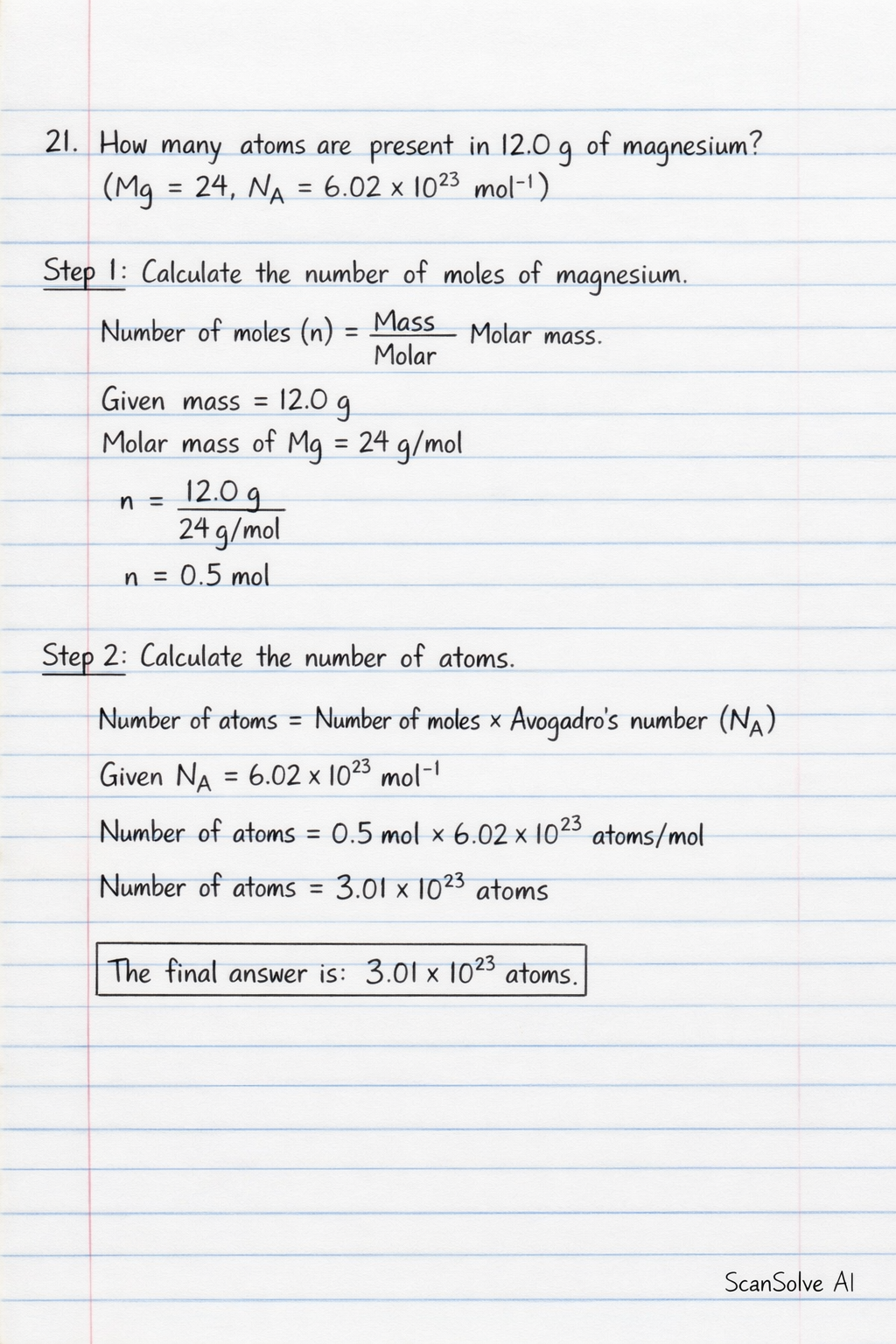
21. How many atoms are present in 12.0 g of magnesium? (Mg = 24, NA = 6.02 x 10²³ mol⁻¹)
Calculate the number of moles of magnesium.
Number of moles () =
Given mass = 12.0 g
Molar mass of Mg = 24 g/molCalculate the number of atoms.
Number of atoms = Number of moles Avogadro's number (NA)
Given NA =The final answer is
22. A gas was collected over water at 25°C and 740 mm Hg. Calculate the volume of the gas at STP if the saturated vapour pressure of water at 25°C is 24 mm Hg. The gas volume collected is 100 cm³.
Calculate the partial pressure of the dry gas.
When a gas is collected over water, the total pressure is the sum of the partial pressure of the dry gas and the vapor pressure of water.
Given and .
Convert initial conditions to standard conditions using the combined gas law.
The combined gas law is .
Initial conditions (1):
Standard Temperature and Pressure (STP) conditions (2):
(standard pressure)
Solve for .
Rounding to one decimal place, .
The final answer is
23. In the reaction , if 500 cm³ of hydrogen reacts with 200 cm³ of oxygen in a sealed tube, what volume of hydrogen would remain unreacted?
Determine the limiting reactant using the volume ratio.
From the balanced equation, 2 volumes of H₂ react with 1 volume of O₂.
Given:
Volume of H₂ = 500 cm³
Volume of O₂ = 200 cm³Calculate how much H₂ is needed to react with 200 cm³ of O₂.
If 1 volume of O₂ reacts with 2 volumes of H₂, then 200 cm³ of O₂ will react with of H₂.
Calculate the volume of H₂ remaining unreacted.
Initial volume of H₂ = 500 cm³
Volume of H₂ reacted = 400 cm³
Volume of H₂ unreacted = Initial volume - Reacted volumeThe final answer is
24. Which of the following phenomena provide evidence for the particulate nature of matter?
The particulate nature of matter refers to the idea that matter is made up of tiny, discrete particles (atoms, molecules, ions) that are in constant motion.- I. Evaporation: Particles gain enough energy to escape from the liquid phase into the gas phase, demonstrating particle movement.
- II. Sublimation: Particles transition directly from solid to gas, also demonstrating particle movement and discrete nature.
- III. Diffusion: Particles spread out from an area of high concentration to low concentration due to their random motion and collisions.
- IV. Brownian motion: The random movement of visible particles suspended in a fluid, caused by collisions with the invisible, rapidly moving fluid particles. This is direct evidence of the constant random motion of particles.
All four phenomena provide evidence for the particulate nature of matter.
The final answer is
25. Elements P and Q have atomic numbers 6 and 8, respectively. What type of bond will they most likely form, and what is the formula of the resulting compound?
Determine the electron configurations and valencies of P and Q.
Element P: Atomic number 6. Electron configuration: . It has 4 valence electrons. It needs 4 electrons to complete its octet.
Element Q: Atomic number 8. Electron configuration: . It has 6 valence electrons. It needs 2 electrons to complete its octet.Determine the type of bond.
Both P (carbon) and Q (oxygen) are non-metals. Non-metals typically form covalent bonds by sharing electrons to achieve a stable octet.
Determine the formula of the compound.
P needs 4 electrons, and Q needs 2 electrons. To satisfy their octets, one atom of P will share electrons with two atoms of Q.
P (valency 4) and Q (valency 2).
The least common multiple of 4 and 2 is 4.
So, 1 atom of P combines with 2 atoms of Q.
The formula will be PQ₂. (For example, carbon dioxide, CO₂).The final answer is
26. An ion M²⁺ has 10 electrons and 12 neutrons. What is the mass number of element M?
Determine the number of protons in element M.
An ion M²⁺ means the element M has lost 2 electrons.
If M²⁺ has 10 electrons, then the neutral atom M must have had electrons.
In a neutral atom, the number of electrons is equal to the number of protons.
So, element M has 12 protons. The atomic number of M is 12.Determine the mass number.
Mass number = Number of protons + Number of neutrons
Given number of neutrons = 12.
Mass number = .The final answer is
27. Which of the following electronic configurations represents an atom in an excited state?
An excited state occurs when an electron moves from a lower energy level to a higher energy level, leaving a vacancy in the lower level. The ground state configuration is the lowest energy arrangement of electrons.- A. : This is the ground state configuration for Neon (atomic number 10). All orbitals are filled according to Aufbau principle.
- B. : This configuration shows an electron from the orbital promoted to the orbital. The orbital is not fully filled before electrons occupy the orbital. This represents an excited state.
- C. : This is the ground state configuration for Magnesium (atomic number 12).
- D. : This is the ground state configuration for Lithium (atomic number 3).
The final answer is
Still stuck on this one?
Ask a follow-up, and the answer starts from this question.
More Chemistry Questions
Handwritten Step-by-Step Solution
Get this as a handwritten image on WhatsApp — like a tutor wrote it for you.
Try on WhatsApp