
We read your photo as:
Describe the materials used in reinforced concrete, their properties, environmental dangers of waste, and mitigation strategies. Also, provide a guide for technical teams on oxygen production via frac
ScanSolve AI Answer
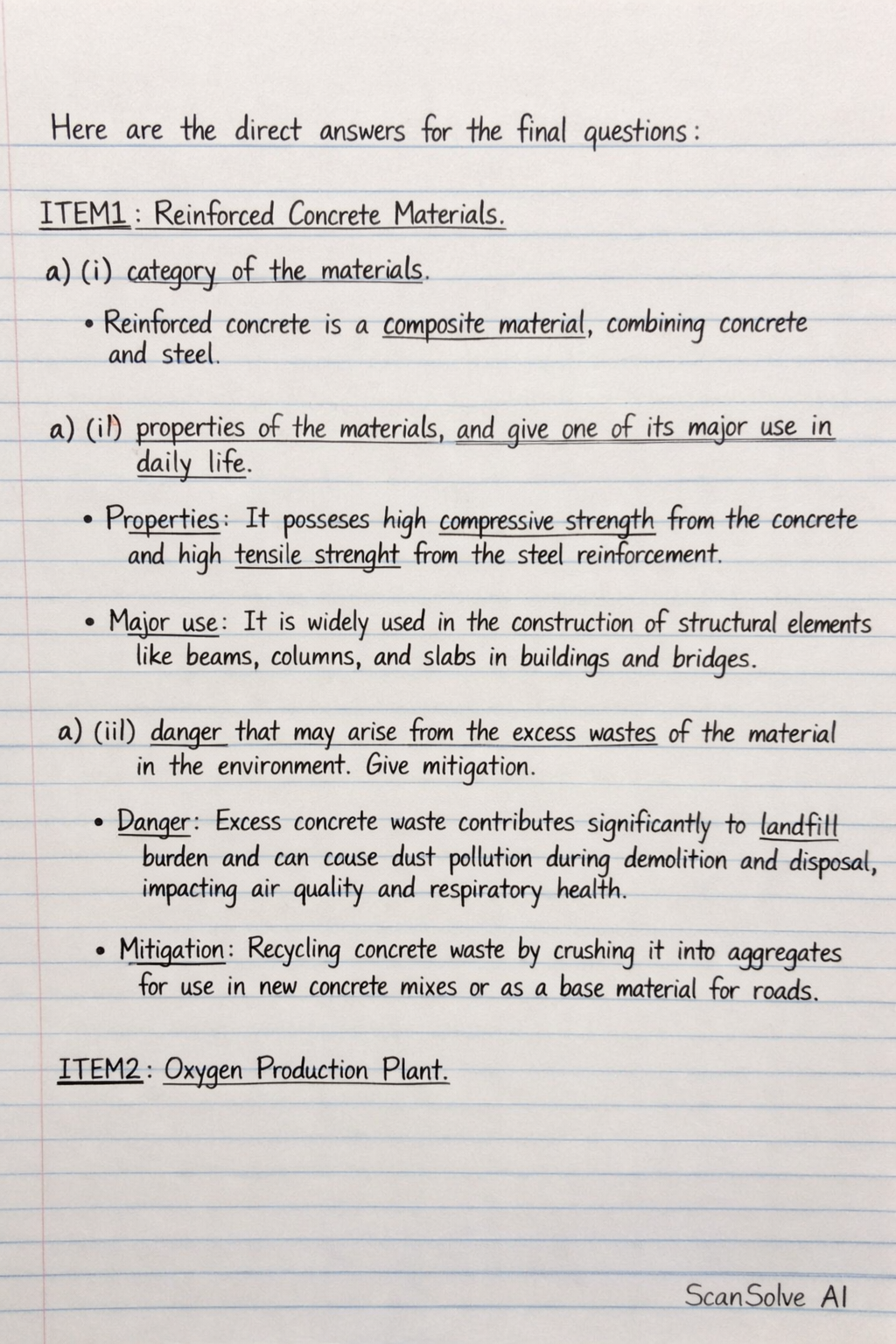
Here are the direct answers for the final questions:
ITEM1: Reinforced Concrete Materials
a) (i) category of the materials.
- Reinforced concrete is a composite material, combining concrete and steel.
a) (ii) properties of the materials, and give one of its major use in daily life.
- Properties: It possesses high compressive strength from the concrete and high tensile strength from the steel reinforcement.
- Major use: It is widely used in the construction of structural elements like beams, columns, and slabs in buildings and bridges.
a) (iii) danger that may arise from the excess wastes of the material in the environment. Give mitigation.
- Danger: Excess concrete waste contributes significantly to landfill burden and can cause dust pollution during demolition and disposal, impacting air quality and respiratory health.
- Mitigation: Recycling concrete waste by crushing it into aggregates for use in new concrete mixes or as a base material for roads.
ITEM2: Oxygen Production Plant
Task: As a chemistry student, make a write up message guiding the technical teams on how the whole production process will be conducted.
"Technical Team,
This guide outlines the process for industrial oxygen production via the fractional distillation of liquid air:
- Air Intake and Purification: Atmospheric air will be drawn in, filtered to remove particulates, then compressed. Crucially, impurities like carbon dioxide and water vapor must be removed (e.g., by adsorption or cooling) to prevent them from solidifying and blocking equipment at low temperatures.
- Cooling and Liquefaction: The purified, compressed air will be progressively cooled using heat exchangers and expansion cycles (Joule-Thomson effect) until it liquefies into a cryogenic liquid.
- Fractional Distillation: The liquid air will then be fed into a distillation column. Due to differences in boiling points, nitrogen (boiling point: ) will vaporize and rise to the top, while oxygen (boiling point: ) will remain as a liquid at the bottom. Gaseous oxygen will be collected from the bottom section of the column.
- Storage and Distribution: The purified oxygen gas will be compressed into cylinders or stored as a cryogenic liquid in insulated tanks, ready for medical or industrial distribution.
Ensure all safety protocols for handling high-pressure gases and cryogenic liquids are strictly followed, and environmental impact is minimized at every stage."
Still stuck on this one?
Ask a follow-up, and the answer starts from this question.
More Chemistry Questions
Handwritten Step-by-Step Solution
Get this as a handwritten image on WhatsApp — like a tutor wrote it for you.
Try on WhatsApp