We read your photo as:

Calculate the molar absorptivity of KMnO4 given its concentration in ppm and absorbance.

Chemistry

ScanSolve AI Answer

Answer

850 L mol−1 cm−1\text{850 L mol}^{-1} \text{ cm}^{-1}

Step-by-step solution

4 steps
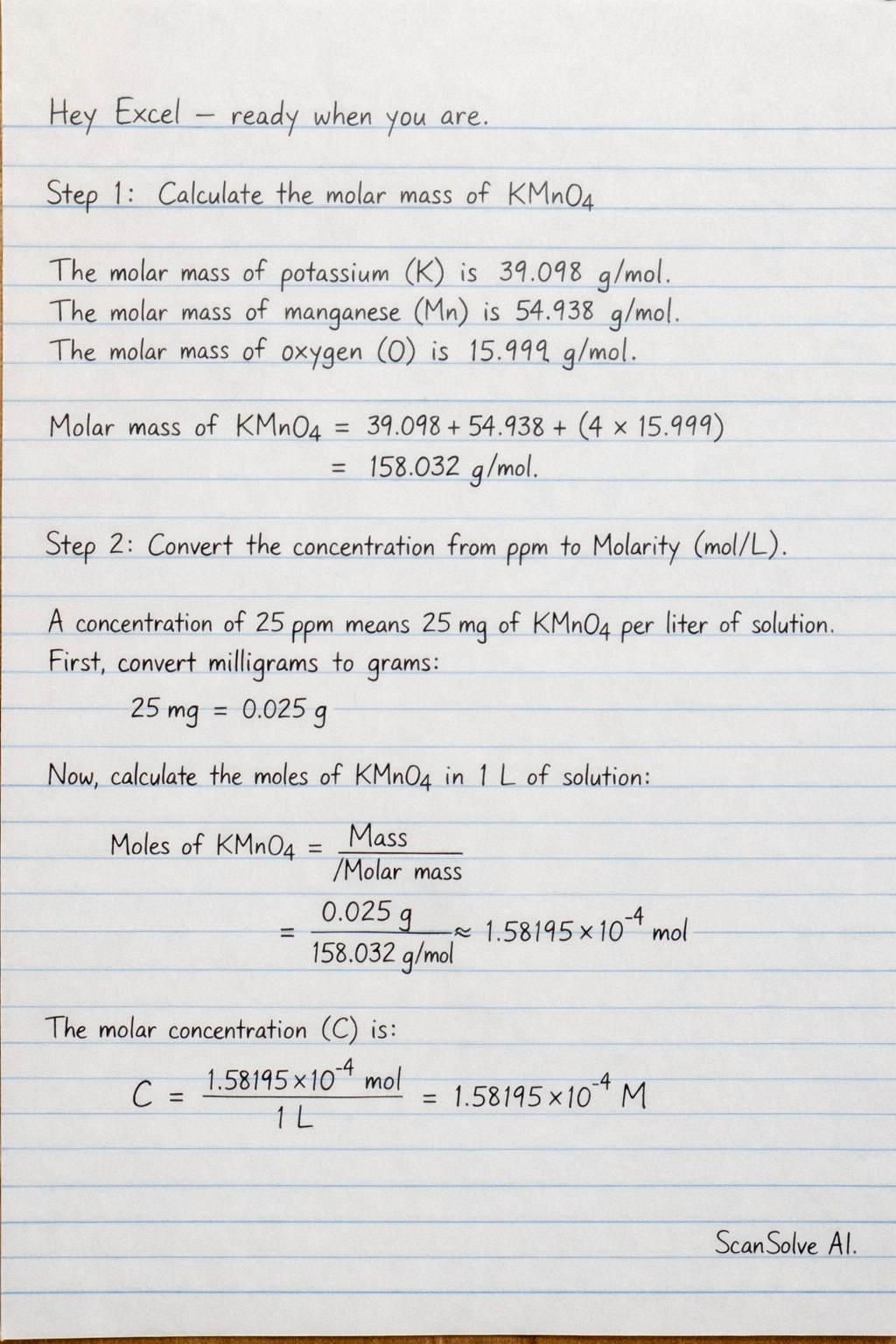
  1. Calculate the molar mass of KMnO4_4.

    The molar mass of potassium (K) is 39.098 g/mol39.098 \text{ g/mol}.
    The molar mass of manganese (Mn) is 54.938 g/mol54.938 \text{ g/mol}.
    The molar mass of oxygen (O) is 15.999 g/mol15.999 \text{ g/mol}.

    Molar mass of KMnO4=39.098+54.938+(4×15.999)=158.032 g/mol\text{Molar mass of KMnO}_4 = 39.098 + 54.938 + (4 \times 15.999) = 158.032 \text{ g/mol}
  2. Convert the concentration from ppm to Molarity (mol/L).

    A concentration of 25 ppm25 \text{ ppm} means 25 mg25 \text{ mg} of KMnO4_4 per liter of solution.
    First, convert milligrams to grams:

    25 mg=0.025 g25 \text{ mg} = 0.025 \text{ g}

    Now, calculate the moles of KMnO4_4 in 1 L1 \text{ L} of solution:

    Moles of KMnO4=MassMolar mass=0.025 g158.032 g/mol≈1.58195×10−4 mol\text{Moles of KMnO}_4 = \frac{\text{Mass}}{\text{Molar mass}} = \frac{0.025 \text{ g}}{158.032 \text{ g/mol}} \approx 1.58195 \times 10^{-4} \text{ mol}

    The molar concentration (CC) is:

    C=1.58195×10⁻⁴ mol1 L=1.58195×10⁻⁴ MC = \frac{1.58195 \times 10^{-4} \text{ mol}}{1 \text{ L}} = 1.58195 \times 10^{-4} \text{ M}
  3. Calculate the molar absorptivity (ϵ\epsilon).

    The Beer-Lambert Law is given by A=ϵCLA = \epsilon C L, where AA is absorbance, ϵ\epsilon is molar absorptivity, CC is molar concentration, and LL is the path length.
    Given:
    A=0.674A = 0.674
    C=1.58195×10⁻⁴ mol/LC = 1.58195 \times 10^{-4} \text{ mol/L}
    L=5 cmL = 5 \text{ cm}
    Rearrange the formula to solve for ϵ\epsilon:

    ϵ=ACL\epsilon = \frac{A}{C L}

    Substitute the values:

    ϵ=0.674(1.58195×10⁻⁴ mol/L)×(5 cm)\epsilon = \frac{0.674}{(1.58195 \times 10^{-4} \text{ mol/L}) \times (5 \text{ cm})} ϵ=0.6747.90975×10−4 mol cm/L\epsilon = \frac{0.674}{7.90975 \times 10^{-4} \text{ mol cm/L}} ϵ≈852.00 L mol−1 cm−1\epsilon \approx 852.00 \text{ L mol}^{-1} \text{ cm}^{-1}

    Rounding to two significant figures (due to 25 ppm25 \text{ ppm}), the molar absorptivity is:

    ϵ≈850 L mol−1 cm−1\epsilon \approx 850 \text{ L mol}^{-1} \text{ cm}^{-1}
  4. Determine the molar absorptivity in a 1 cm1 \text{ cm} cell.

    Molar absorptivity (ϵ\epsilon) is an intrinsic property of the substance at a specific wavelength. It does not depend on the cell path length. Therefore, the molar absorptivity remains the same regardless of the cell length.

    The molar absorptivity of KMnO4_4 at 515 nm515 \text{ nm} is 850 L mol−1 cm−1\boxed{\text{850 L mol}^{-1} \text{ cm}^{-1}}.
    The molar absorptivity in a 1 cm1 \text{ cm} cell will also be 850 L mol−1 cm−1\boxed{\text{850 L mol}^{-1} \text{ cm}^{-1}}.

Was this helpful?

Try one yourself

A new problem that tests the same skill.

Still stuck on this one?

Ask a follow-up, and the answer starts from this question.

Got a different question?Ask your own question
Handwritten step-by-step solution preview

Handwritten Step-by-Step Solution

Get this as a handwritten image on WhatsApp — like a tutor wrote it for you.

Try on WhatsApp