
We read your photo as:
Calculate the molar heat of combustion for ethanol and explain potential errors in the experimental determination.
Chemistry
ScanSolve AI Answer
a) To calculate the molar heat of combustion of ethanol from an experiment, two key pieces of information are required: 1. The total heat evolved during the combustion of ethanol. 2. The mass of ethanol that was completely burned.
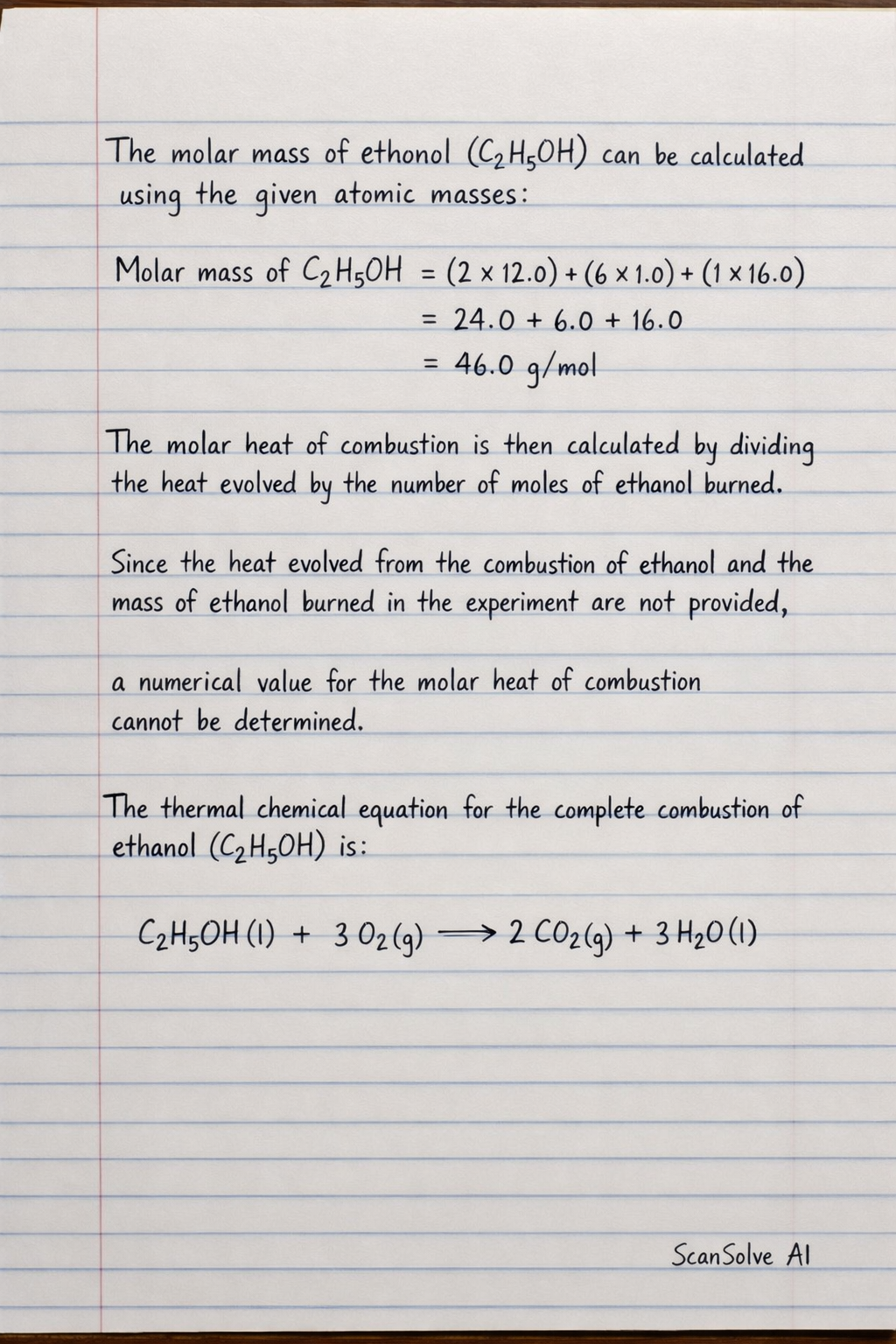
The molar mass of ethanol ($\text{C}_2\text{H}_5\text{OH}$) can be calculated using the given atomic masses:
Molar mass of $\text{C}_2\text{H}_5\text{OH} = (2 \times 12.0) + (6 \times 1.0) + (1 \times 16.0) = 24.0 + 6.0 + 16.0 = 46.0 \text{ g/mol}$.

The molar heat of combustion is then calculated by dividing the heat evolved by the number of moles of ethanol burned.
Since the heat evolved from the combustion of ethanol and the mass of ethanol burned in the experiment are not provided in the current context, a numerical value for the molar heat of combustion cannot be determined.
c) The thermal chemical equation for the complete combustion of ethanol () is:
d) Two sources of error that would cause the experimentally obtained molar heat of combustion to be lower than the theoretical value are:
- Heat loss to the surroundings: The experimental setup (calorimeter) is not perfectly insulated, leading to some heat escaping to the environment instead of being absorbed by the water.
- Incomplete combustion: If the ethanol does not burn completely, it produces less heat than expected and may form products like carbon monoxide or soot (carbon) instead of only carbon dioxide and water
Was this helpful?
Still stuck on this one?
Ask a follow-up, and the answer starts from this question.
Got a different question?Ask your own question
More Chemistry Questions
QDescribe an experiment to determine the heat of combustion of methanol.QCalculate the heat energy released when 1 liter of ethanol is burned.QCalculate the heat energy released when 1 litre of ethanol burns, given its density is 789 g/L and…QWhat do you understand by the Enthalpy of Combustion? In an experiment to determine the Enthalpy of…QState Hess's Law of constant heat summation. ii. From the H enthalpy values, determine the amount of…
Browse by topic:Organic Chemistry
Handwritten Step-by-Step Solution
Get this as a handwritten image on WhatsApp — like a tutor wrote it for you.
Try on WhatsApp