We read your photo as:

Calculate the molar mass of a gas given its volume at STP and mass, and determine the new volume of a gas after a temperature increase at constant pressure.

Chemistry

ScanSolve AI Answer

Step-by-step solution

8 steps

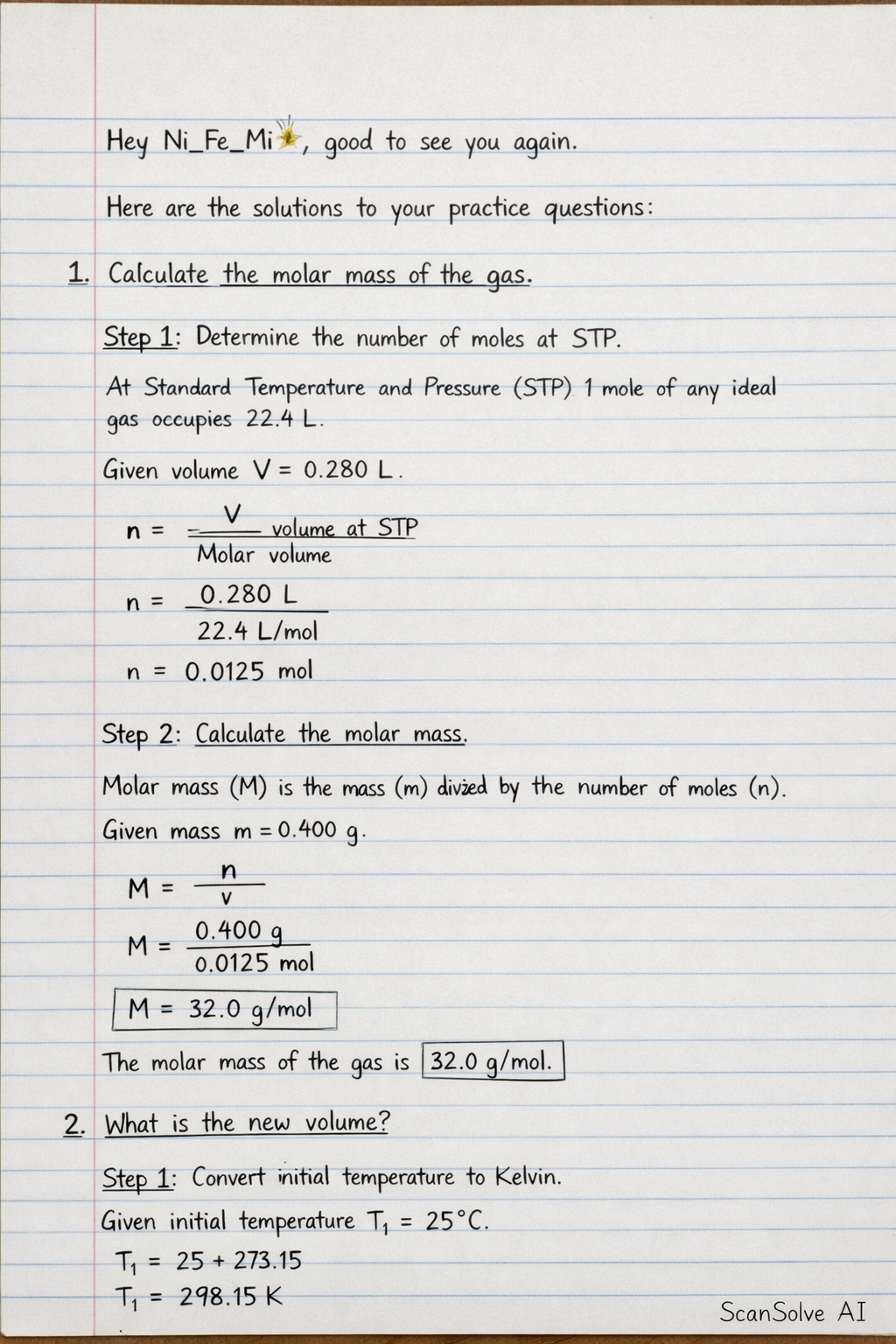
Here are the solutions to your practice questions:

1. Calculate the molar mass of the gas.

  1. Determine the number of moles at STP.

    At Standard Temperature and Pressure (STP), 1 mole of any ideal gas occupies 22.4 L.
    Given volume V=0.280 LV = 0.280 \text{ L}.

    n=VMolar volume at STP=0.280 L22.4 L/moln = \frac{V}{\text{Molar volume at STP}} = \frac{0.280 \text{ L}}{22.4 \text{ L/mol}} n=0.0125 moln = 0.0125 \text{ mol}
  2. Calculate the molar mass.

    Molar mass (MM) is the mass (mm) divided by the number of moles (nn).
    Given mass m=0.400 gm = 0.400 \text{ g}.

    M=mn=0.400 g0.0125 molM = \frac{m}{n} = \frac{0.400 \text{ g}}{0.0125 \text{ mol}} M=32.0 g/molM = 32.0 \text{ g/mol}

    The molar mass of the gas is 32.0 g/mol\boxed{\text{32.0 g/mol}}.

    2. What is the new volume?

  3. Convert initial temperature to Kelvin.

    Given initial temperature T1=25 ∘CT_1 = 25 \,^\circ\text{C}.

    T1=25+273.15=298.15 KT_1 = 25 + 273.15 = 298.15 \text{ K}
  4. Calculate the final temperature in Kelvin.

    The temperature increases by 5 ∘C5 \,^\circ\text{C}.

    T2=(25+5) ∘C=30 ∘CT_2 = (25 + 5) \,^\circ\text{C} = 30 \,^\circ\text{C} T2=30+273.15=303.15 KT_2 = 30 + 273.15 = 303.15 \text{ K}
  5. Apply Charles's Law.

    Since pressure is constant, we use Charles's Law: V1T1=V2T2\frac{V_1}{T_1} = \frac{V_2}{T_2}.
    Given initial volume V1=0.62 LV_1 = 0.62 \text{ L}.

    V2=V1(T2T1)=0.62 L(303.15 K298.15 K)V_2 = V_1 \left(\frac{T_2}{T_1}\right) = 0.62 \text{ L} \left(\frac{303.15 \text{ K}}{298.15 \text{ K}}\right) V2=0.62 L×1.01677V_2 = 0.62 \text{ L} \times 1.01677 V2≈0.63 LV_2 \approx 0.63 \text{ L}

    The new volume is 0.63 L\boxed{\text{0.63 L}}.

    3. Calculate the approximate molar mass of a gas.

  6. Convert temperature to Kelvin.

    Given temperature T=30 ∘CT = 30 \,^\circ\text{C}.

    T=30+273.15=303.15 KT = 30 + 273.15 = 303.15 \text{ K}
  7. Convert pressure to atmospheres.

    Given pressure P=780 torrP = 780 \text{ torr}.

    P=780 torr×1 atm760 torr≈1.0263 atmP = 780 \text{ torr} \times \frac{1 \text{ atm}}{760 \text{ torr}} \approx 1.0263 \text{ atm}
  8. Calculate the molar mass using the ideal gas law in terms of density.

    The ideal gas law can be written as PM=ρRTPM = \rho RT, where MM is molar mass, ρ\rho is density, and RR is the ideal gas constant (0.08206 L⋅atm/(mol⋅K)0.08206 \text{ L}\cdot\text{atm}/(\text{mol}\cdot\text{K})).
    Given density ρ=3.33 g/L\rho = 3.33 \text{ g/L}.

    M=ρRTPM = \frac{\rho RT}{P} M=(3.33 g/L)(0.08206 L⋅atm/(mol⋅K))(303.15 K)1.0263 atmM = \frac{(3.33 \text{ g/L})(0.08206 \text{ L}\cdot\text{atm}/(\text{mol}\cdot\text{K}))(303.15 \text{ K})}{1.0263 \text{ atm}} M=82.91 g⋅atm/mol1.0263 atmM = \frac{82.91 \text{ g}\cdot\text{atm/mol}}{1.0263 \text{ atm}} M≈80.8 g/molM \approx 80.8 \text{ g/mol}

    The approximate molar mass of the gas is 80.8 g/mol\boxed{\text{80.8 g/mol}}.

Was this helpful?

Still stuck on this one?

Ask a follow-up, and the answer starts from this question.

Got a different question?Ask your own question
Handwritten step-by-step solution preview

Handwritten Step-by-Step Solution

Get this as a handwritten image on WhatsApp — like a tutor wrote it for you.

Try on WhatsApp