
We read your photo as:
Calculate the molar mass of an unknown gas using Graham's Law, given its diffusion rate and the diffusion rate of oxygen (32 g/mol).
ScanSolve AI Answer
Step-by-step solution
7 stepsHere are the solutions to your questions:
1)
We will use Graham's Law of Diffusion, which states that the rate of diffusion of a gas is inversely proportional to the square root of its molar mass.
Given:
- Rate of unknown gas () =
- Rate of oxygen () =
- Relative molecular mass of oxygen () = (since oxygen is diatomic, O)
Assumption: The question asks for the relative molecular mass of the unknown gas, as the molecular mass of oxygen is a known constant.
Substitute the given values into Graham's Law.
Square both sides of the equation to remove the square root.
Solve for .
The relative molecular mass of the unknown gas is approximately 52.51 g/mol.
If the question literally meant the relative molecular mass of oxygen, then it is simply . However, this would make the diffusion rates irrelevant.
2)
We will again use Graham's Law of Diffusion.Given:
- Volume of hydrogen (H) =
- Time for hydrogen (H) =
- Molecular mass of hydrogen () =
- Molecular mass of oxygen () =
- Volume of oxygen (O) = (same volume)
- Time for oxygen () = ?
Calculate the rate of diffusion for hydrogen.
Express the rate of oxygen in terms of its unknown time.
Substitute the rates and molecular masses into Graham's Law.
Solve for .
It would take 100 seconds for the same volume of oxygen to diffuse.
The final answers are:
- The relative molecular mass of the unknown gas is .
- The time taken for oxygen to diffuse is .
Still stuck on this one?
Ask a follow-up, and the answer starts from this question.
More Chemistry Questions
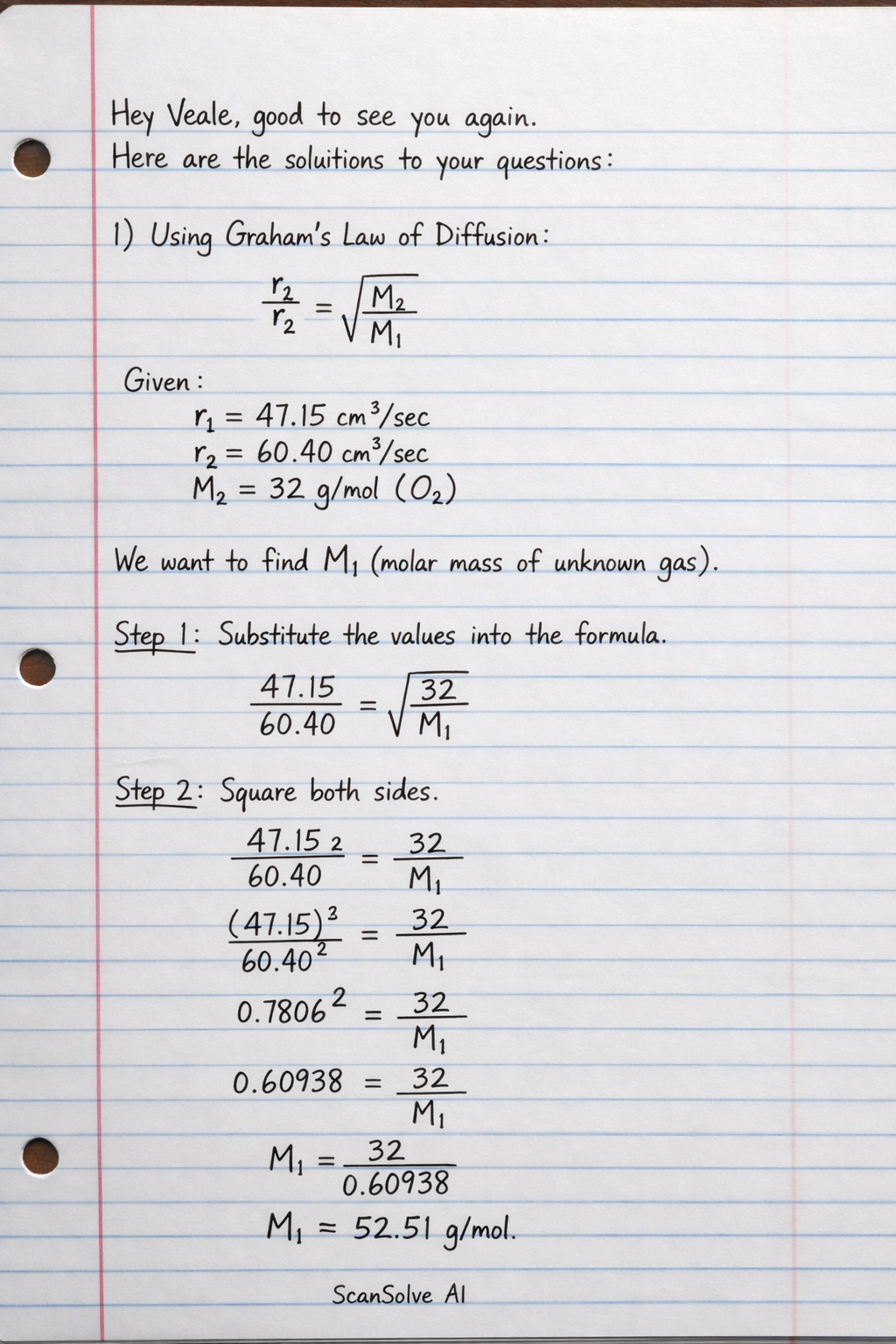
Handwritten Step-by-Step Solution
Get this as a handwritten image on WhatsApp — like a tutor wrote it for you.
Try on WhatsApp