We read your photo as:

Calculate the molarity of HCl and KCl solutions given their mass, volume, and atomic masses.

Chemistry

ScanSolve AI Answer

Step-by-step solution

22 steps

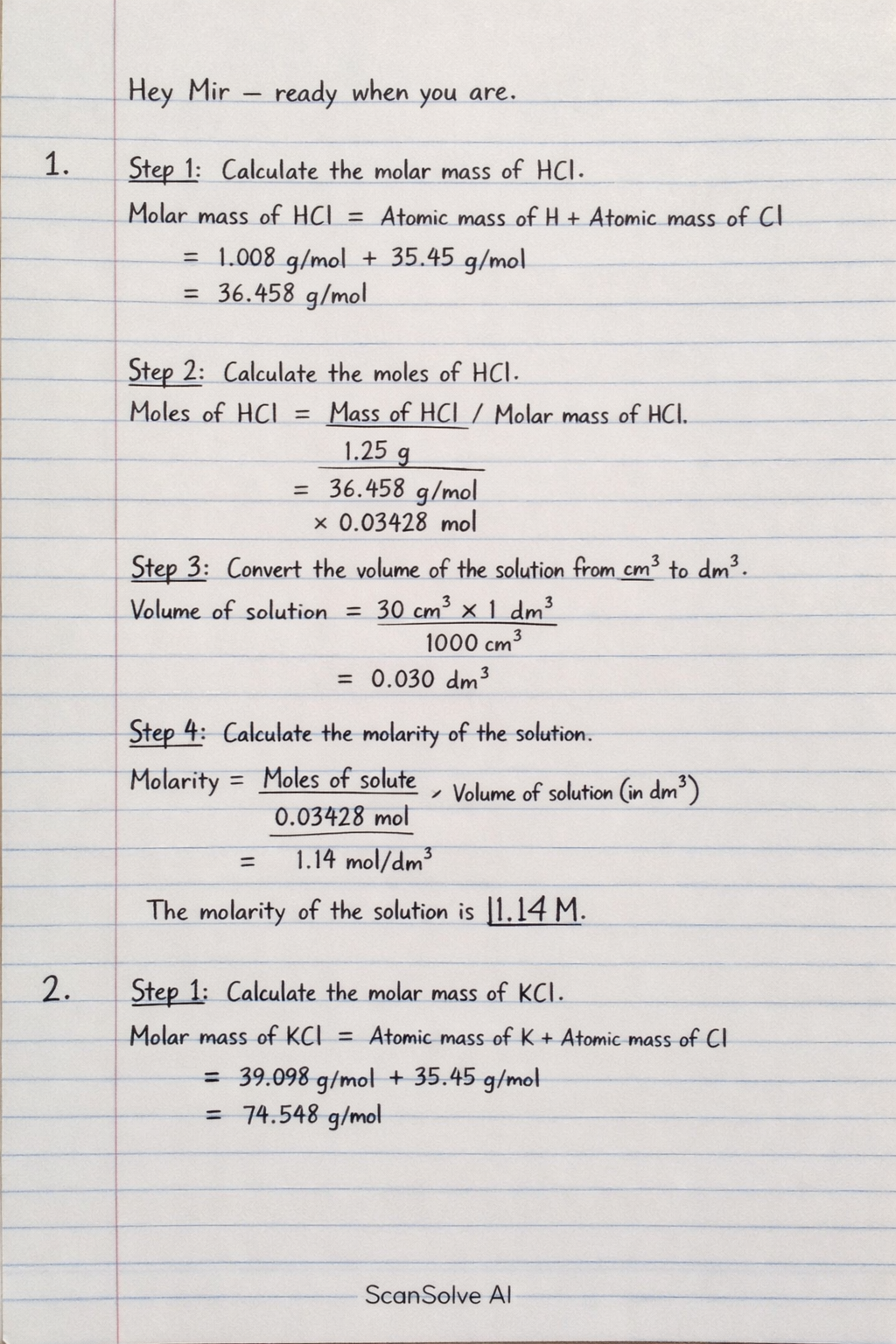
1.

  1. Calculate the molar mass of HCl.

    Molar mass of HCl=Atomic mass of H+Atomic mass of Cl\text{HCl} = \text{Atomic mass of H} + \text{Atomic mass of Cl}

    =1.008 g/mol+35.45 g/mol=36.458 g/mol= 1.008 \text{ g/mol} + 35.45 \text{ g/mol} = 36.458 \text{ g/mol}
  2. Calculate the moles of HCl.

    Moles of HCl=Mass of HClMolar mass of HCl=1.25 g36.458 g/mol=0.03428 mol\text{Moles of HCl} = \frac{\text{Mass of HCl}}{\text{Molar mass of HCl}} = \frac{1.25 \text{ g}}{36.458 \text{ g/mol}} = 0.03428 \text{ mol}
  3. Convert the volume of the solution from cm³ to dm³.

    Volume of solution=30 cm3×1 dm31000 cm3=0.030 dm3\text{Volume of solution} = 30 \text{ cm}^3 \times \frac{1 \text{ dm}^3}{1000 \text{ cm}^3} = 0.030 \text{ dm}^3
  4. Calculate the molarity of the solution.

    Molarity=Moles of soluteVolume of solution (in dm3)=0.03428 mol0.030 dm3=1.14 mol/dm3\text{Molarity} = \frac{\text{Moles of solute}}{\text{Volume of solution (in dm}^3)} = \frac{0.03428 \text{ mol}}{0.030 \text{ dm}^3} = 1.14 \text{ mol/dm}^3

    The molarity of the solution is 1.14 M\boxed{\text{1.14 M}}.

    2.

  5. Calculate the molar mass of KCl.

    Molar mass of KCl=Atomic mass of K+Atomic mass of Cl\text{KCl} = \text{Atomic mass of K} + \text{Atomic mass of Cl}

    =39.098 g/mol+35.45 g/mol=74.548 g/mol= 39.098 \text{ g/mol} + 35.45 \text{ g/mol} = 74.548 \text{ g/mol}
  6. Calculate the moles of KCl.

    Moles of KCl=Mass of KClMolar mass of KCl=2.5 g74.548 g/mol=0.03353 mol\text{Moles of KCl} = \frac{\text{Mass of KCl}}{\text{Molar mass of KCl}} = \frac{2.5 \text{ g}}{74.548 \text{ g/mol}} = 0.03353 \text{ mol}
  7. Convert the volume of the solution from cm³ to dm³.

    Volume of solution=100 cm3×1 dm31000 cm3=0.100 dm3\text{Volume of solution} = 100 \text{ cm}^3 \times \frac{1 \text{ dm}^3}{1000 \text{ cm}^3} = 0.100 \text{ dm}^3
  8. Calculate the concentration of the solution in mol/dm³.

    Concentration=Moles of soluteVolume of solution (in dm3)=0.03353 mol0.100 dm3=0.335 mol/dm3\text{Concentration} = \frac{\text{Moles of solute}}{\text{Volume of solution (in dm}^3)} = \frac{0.03353 \text{ mol}}{0.100 \text{ dm}^3} = 0.335 \text{ mol/dm}^3

    The concentration of the solution is 0.335 mol/dm3\boxed{\text{0.335 mol/dm}^3}.

    3.

  9. Calculate the molar mass of NaOH.

    Molar mass of NaOH=Atomic mass of Na+Atomic mass of O+Atomic mass of H\text{NaOH} = \text{Atomic mass of Na} + \text{Atomic mass of O} + \text{Atomic mass of H}

    =22.99 g/mol+15.999 g/mol+1.008 g/mol=39.997 g/mol= 22.99 \text{ g/mol} + 15.999 \text{ g/mol} + 1.008 \text{ g/mol} = 39.997 \text{ g/mol}
  10. Calculate the moles of NaOH present in 1 dm³ of a 0.25 M solution.

    Moles of NaOH=Molarity×Volume=0.25 mol/dm3×1 dm3=0.25 mol\text{Moles of NaOH} = \text{Molarity} \times \text{Volume} = 0.25 \text{ mol/dm}^3 \times 1 \text{ dm}^3 = 0.25 \text{ mol}
  11. Calculate the mass of NaOH.

    Mass of NaOH=Moles of NaOH×Molar mass of NaOH\text{Mass of NaOH} = \text{Moles of NaOH} \times \text{Molar mass of NaOH} =0.25 mol×39.997 g/mol=9.999 g= 0.25 \text{ mol} \times 39.997 \text{ g/mol} = 9.999 \text{ g}

    The mass of NaOH present per dm³ of solution is 10.0 g\boxed{\text{10.0 g}}.

    4.

  12. Use the neutralization formula MAVA=MBVBM_A V_A = M_B V_B.

    Given:
    Molarity of acid (MAM_A) = 0.5 M
    Volume of acid (VAV_A) = ?
    Molarity of base (MBM_B) = 4 M
    Volume of base (VBV_B) = 200 ml

  13. Substitute the values into the formula and solve for VAV_A.

    0.5 M×VA=4 M×200 ml0.5 \text{ M} \times V_A = 4 \text{ M} \times 200 \text{ ml} VA=4 M×200 ml0.5 MV_A = \frac{4 \text{ M} \times 200 \text{ ml}}{0.5 \text{ M}} VA=800 ml0.5V_A = \frac{800 \text{ ml}}{0.5} VA=1600 mlV_A = 1600 \text{ ml}

    The volume of 0.5 M acid needed is 1600 ml\boxed{\text{1600 ml}}.

    5.

  14. Convert the mass of calcium from mg to g.

    Mass of calcium=28 mg×1 g1000 mg=0.028 g\text{Mass of calcium} = 28 \text{ mg} \times \frac{1 \text{ g}}{1000 \text{ mg}} = 0.028 \text{ g}
  15. Convert the volume of the solution from cm³ to dm³.

    Volume of solution=100 cm3×1 dm31000 cm3=0.100 dm3\text{Volume of solution} = 100 \text{ cm}^3 \times \frac{1 \text{ dm}^3}{1000 \text{ cm}^3} = 0.100 \text{ dm}^3
  16. Calculate the concentration in g/dm³.

    Concentration=Mass of calciumVolume of solution (in dm3)=0.028 g0.100 dm3=0.28 g/dm3\text{Concentration} = \frac{\text{Mass of calcium}}{\text{Volume of solution (in dm}^3)} = \frac{0.028 \text{ g}}{0.100 \text{ dm}^3} = 0.28 \text{ g/dm}^3

    The concentration is 0.28 g/dm3\boxed{\text{0.28 g/dm}^3}.

    6.

  17. Calculate the total volume of the solution.

    Total volume of solution=Volume of alcohol+Volume of water\text{Total volume of solution} = \text{Volume of alcohol} + \text{Volume of water} =20 cm3+80 cm3=100 cm3= 20 \text{ cm}^3 + 80 \text{ cm}^3 = 100 \text{ cm}^3
  18. Calculate the concentration (v/v).

    Concentration (v/v)=Volume of soluteTotal volume of solution×100%\text{Concentration (v/v)} = \frac{\text{Volume of solute}}{\text{Total volume of solution}} \times 100\% =20 cm3100 cm3×100%=20%= \frac{20 \text{ cm}^3}{100 \text{ cm}^3} \times 100\% = 20\%

    The concentration (v/v) of this solution is 20%\boxed{\text{20\%}}.

    7.

  19. Convert the volume of the solution from cm³ to dm³.

    Volume of solution=400 cm3×1 dm31000 cm3=0.400 dm3\text{Volume of solution} = 400 \text{ cm}^3 \times \frac{1 \text{ dm}^3}{1000 \text{ cm}^3} = 0.400 \text{ dm}^3
  20. Calculate the moles of NaOH required.

    Moles of NaOH=Molarity×Volume (in dm3)\text{Moles of NaOH} = \text{Molarity} \times \text{Volume (in dm}^3) =0.3 mol/dm3×0.400 dm3=0.12 mol= 0.3 \text{ mol/dm}^3 \times 0.400 \text{ dm}^3 = 0.12 \text{ mol}
  21. Calculate the molar mass of NaOH.

    Molar mass of NaOH=Atomic mass of Na+Atomic mass of O+Atomic mass of H\text{NaOH} = \text{Atomic mass of Na} + \text{Atomic mass of O} + \text{Atomic mass of H}

    =22.99 g/mol+15.999 g/mol+1.008 g/mol=39.997 g/mol= 22.99 \text{ g/mol} + 15.999 \text{ g/mol} + 1.008 \text{ g/mol} = 39.997 \text{ g/mol}
  22. Calculate the mass of NaOH required.

    Mass of NaOH=Moles of NaOH×Molar mass of NaOH\text{Mass of NaOH} = \text{Moles of NaOH} \times \text{Molar mass of NaOH} =0.12 mol×39.997 g/mol=4.79964 g= 0.12 \text{ mol} \times 39.997 \text{ g/mol} = 4.79964 \text{ g}

    The mass of sodium hydroxide required is 4.80 g\boxed{\text{4.80 g}}.

Was this helpful?

Still stuck on this one?

Ask a follow-up, and the answer starts from this question.

Got a different question?Ask your own question
Handwritten step-by-step solution preview

Handwritten Step-by-Step Solution

Get this as a handwritten image on WhatsApp — like a tutor wrote it for you.

Try on WhatsApp