
We read your photo as:
Determine the moles of CaCO3 used given the volume of CO2 produced in Experiment A and the molar gas volume at 40°C.
ScanSolve AI Answer
Answer
Step-by-step solution
5 stepsDetermine the total volume of CO produced.
From the graph, the reaction for Experiment A stops at a maximum volume of CO gas.
Convert the volume of CO to dm.
Since the molar gas volume is given in dm
^3$$\cdotmol, convert the volume of CO from cm to dm.Step 3: Calculate the moles of CO produced.
Use the given molar gas volume at 40°C, which is 25.7 dm^3$$\cdotmol.Determine the moles of CaCO used.
From the balanced chemical equation:
The mole ratio of CaCO to CO is 1:1.
Therefore, moles of CaCO used = moles of CO produced.Calculate the molar mass of CaCO.
Molar mass of Ca = 40.08 g/mol
Molar mass of C = 12.01 g/mol
Molar mass of O = 16.00 g/molCalculate the mass of CaCO used.
Rounding to two decimal places:
The mass of CaCO(s) used in experiment A is .
Try one yourself
A new problem that tests the same skill.
Still stuck on this one?
Ask a follow-up, and the answer starts from this question.
More Chemistry Questions
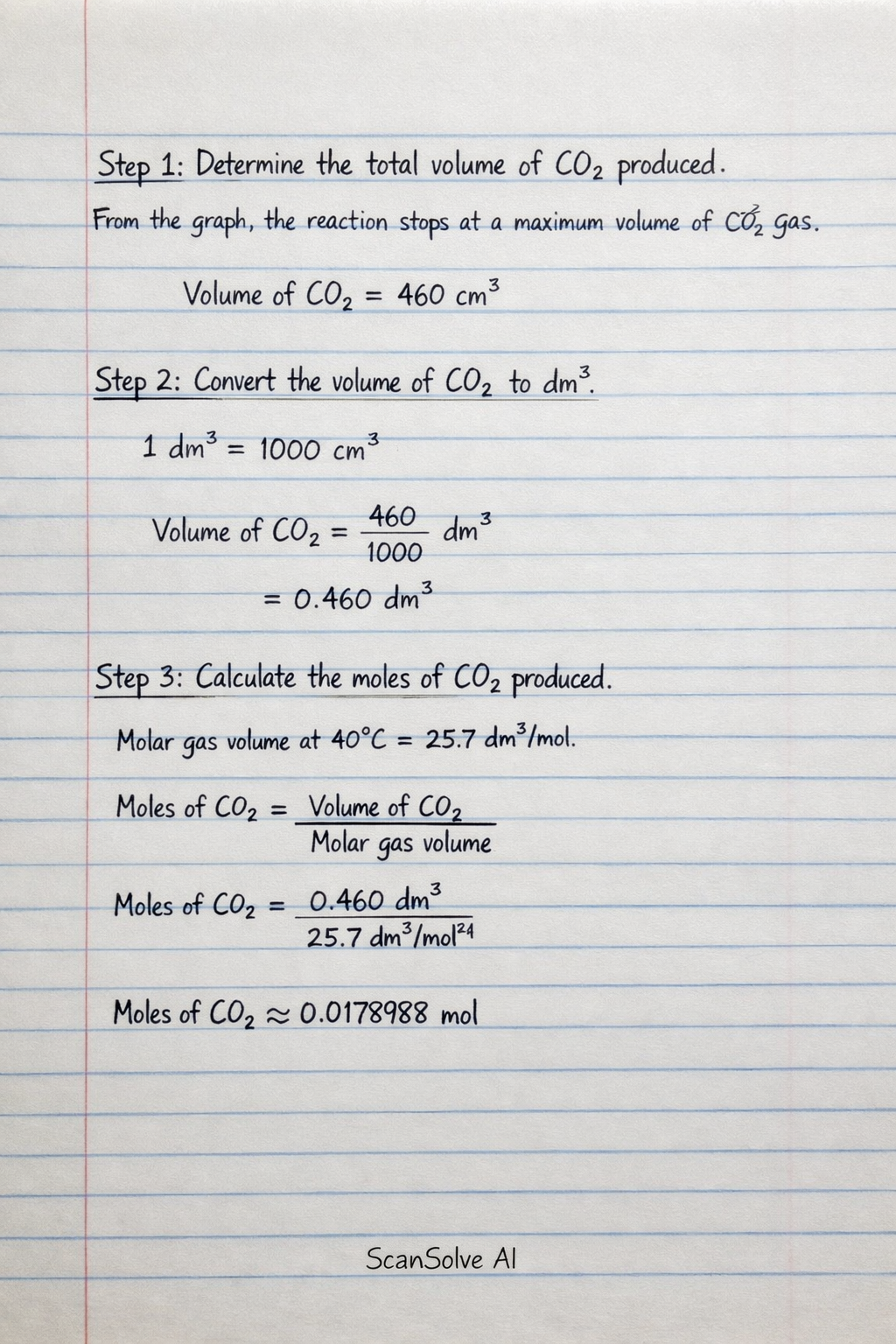
Handwritten Step-by-Step Solution
Get this as a handwritten image on WhatsApp — like a tutor wrote it for you.
Try on WhatsApp