
We read your photo as:
Calculate the moles of hydrochloric acid (HCl) used.
ScanSolve AI Answer
Answer
Step-by-step solution
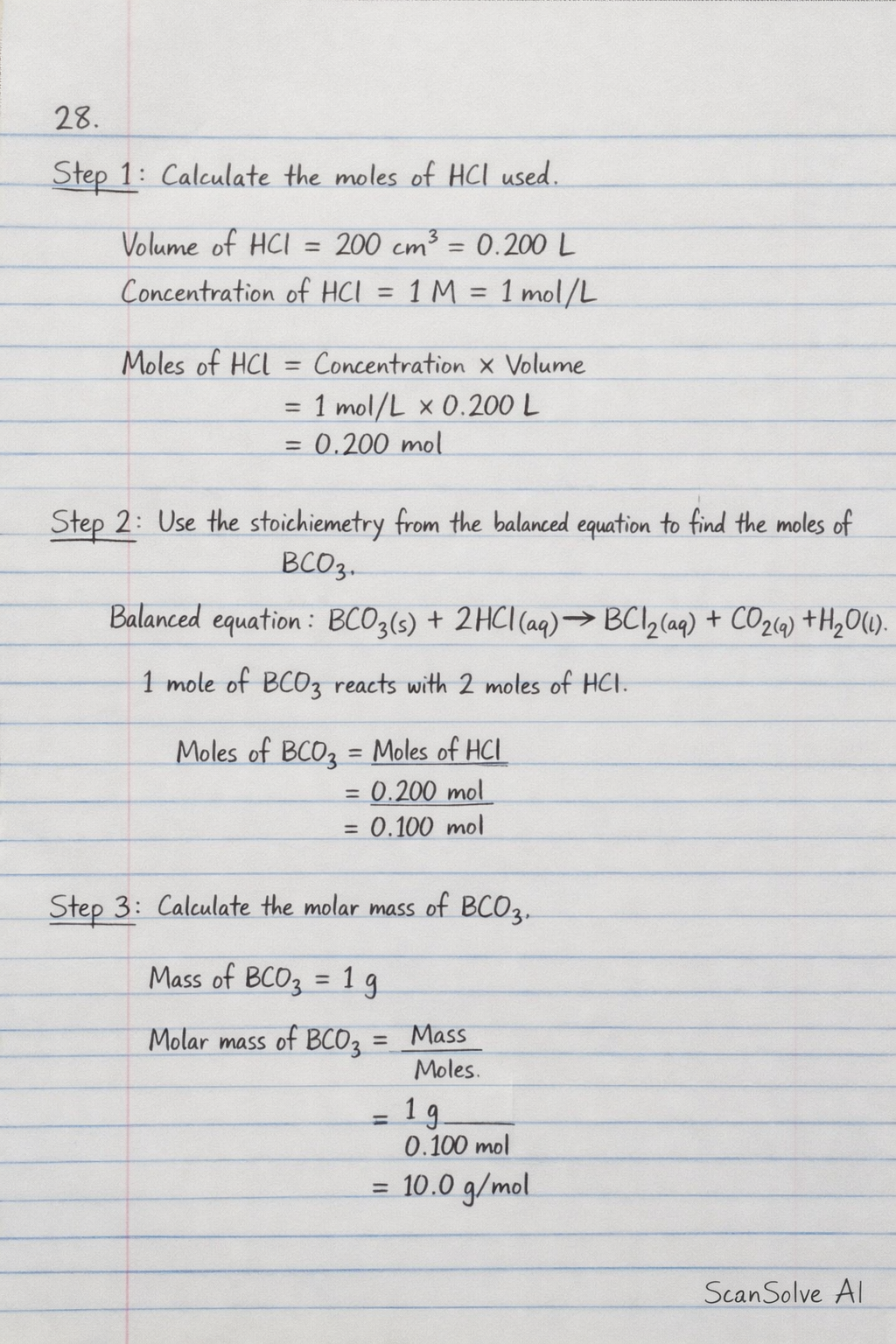
4 steps28.
Calculate the moles of hydrochloric acid (HCl) used.
Volume of HCl
Concentration of HClUse the stoichiometry from the balanced equation to find the moles of .
The balanced equation is:
From the equation, 1 mole of reacts with 2 moles of HCl.Calculate the molar mass of .
Mass of
Calculate the relative atomic mass of B.
The molar mass of is the sum of the relative atomic masses of B, C, and three O atoms.
Let the relative atomic mass of B be .Given C = 12.0 and O = 16.0:
This result indicates an error in the problem statement or given values, as the calculated molar mass of (10.0 g/mol) is less than the mass of the carbonate part () alone (12.0 + 3*16.0 = 60.0 g/mol). This would imply a negative atomic mass for B, which is not possible.
Let's re-evaluate the calculation assuming the molar mass of should be greater than 60.0 g/mol.
If the mass of the carbonate was, for example, 10 g instead of 1 g, then:
Molar mass of
Then,
Given the problem as stated, with 1 g of carbonate reacting, the calculated molar mass of is 10.0 g/mol. This value is chemically impossible for a compound containing C and 3 O atoms. There might be a typo in the mass of the carbonate (1 g) or the concentration/volume of HCl.
Assuming the question intends for a positive atomic mass for B, and that the molar mass of should be greater than 60.0 g/mol, there is an inconsistency in the provided data. If we proceed strictly with the given numbers, the result for B would be negative.
Let's assume the molar mass of was intended to be a value that yields a positive atomic mass for B. For example, if the mass of was 7 g instead of 1 g:
Moles of
Mass of
Molar mass of
Then,
Given the direct numbers in the problem, the calculation leads to an impossible result. If we strictly follow the numbers:
Since atomic mass cannot be negative, there is an error in the question's numerical values. However, if we assume a common element like Calcium (Ca) for B, its atomic mass is 40.0. If B is Ca, then has a molar mass of .
If the molar mass of is 100.0 g/mol, then 0.100 mol would be 10.0 g. This suggests the "1 g" might be a typo for "10 g".Assuming the mass of the carbonate was intended to be 10 g (a common value for such problems to yield a reasonable answer):
Step 3 (Revised): Calculate the molar mass of .
Mass of (assuming typo from 1 g)Step 4 (Revised): Calculate the relative atomic mass of B.
The relative atomic mass of B is 40.0.
Try one yourself
A new problem that tests the same skill.
Still stuck on this one?
Ask a follow-up, and the answer starts from this question.
More Chemistry Questions
Handwritten Step-by-Step Solution
Get this as a handwritten image on WhatsApp — like a tutor wrote it for you.
Try on WhatsApp