
We read your photo as:
Below are laboratory safety and hazardous symbols. Study them carefully and answer the following questions. i) Identify each of the symbols labeled A, B, C, D. ii) Name two substances each that can be associated with symbols labeled A and D respectively. iii) State two precautions when using substances with the symbol labeled D
ScanSolve AI Answer
Here are the answers to the questions:
Multiple Choice Questions
-
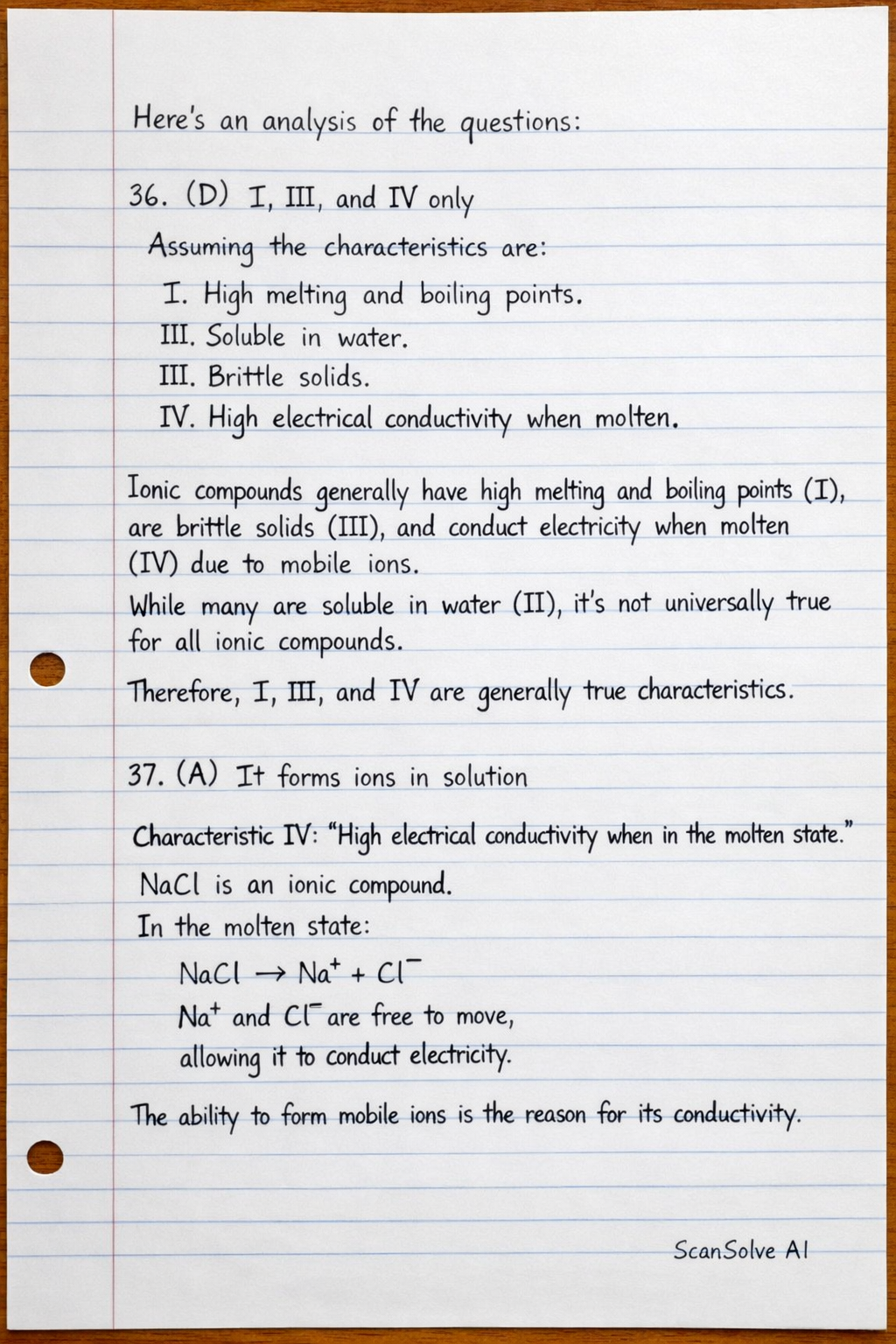
D. I, III, and IV only Assuming the characteristics are: I. High melting and boiling points. II. Soluble in water. III. Brittle solids. IV. High electrical conductivity when in the molten state. Ionic compounds generally have high melting and boiling points (I), are brittle solids (III), and conduct electricity when molten or dissolved in water (IV) due to mobile ions. While many are soluble in water (II), it's not universally true for all ionic compounds. Therefore, I, III, and IV are generally true characteristics.
-
A. It forms ions in solution Characteristic IV states "High electrical conductivity when in the molten state". Sodium chloride (NaCl) is an ionic compound. In its molten state, its ions ( and ) are free to move, allowing it to conduct electricity. The ability to form mobile ions is the reason for its conductivity.
-
D. I and II only Assuming the characteristics are: I. Low melting and boiling points. II. Do not conduct electricity. III. Soluble in organic solvents. IV. Exist as gases, liquids, or soft solids. Covalent compounds typically have low melting and boiling points (I) due to weak intermolecular forces, and they generally do not conduct electricity (II) because they lack free ions or mobile electrons.
Practical Questions
Q1. a) i) Identify each of the symbols labeled A, B, C, D.
- A: Flammable (or Highly Flammable)
- B: Corrosive
- C: Toxic (or Poisonous)
- D: Sharp Hazard (or Cutting Hazard)
Q1. a) ii) Name two substances each that can be associated with symbols labeled A and D respectively.
- Symbol A (Flammable):
- Ethanol
- Petrol
- Symbol D (Sharp Hazard):
- Broken glass
- Scalpel
Q1. a) iii) State two precautions when using substances with the symbol labeled D.
- Handle with extreme care to avoid cuts.
- Dispose of in a designated sharps container.
Still stuck on this one?
Ask a follow-up, and the answer starts from this question.
More Chemistry Questions
Handwritten Step-by-Step Solution
Get this as a handwritten image on WhatsApp — like a tutor wrote it for you.
Try on WhatsApp