
We read your photo as:
Write an equation for the reaction of A and excess oxygen. Explain observations: copper (II) sulfate fading, iron rusting, and identifying aluminium ions.
ScanSolve AI Answer
Step-by-step solution
6 stepsHere are the answers to your questions:
(ix) Write an equation for the reaction of A and excess oxygen. (1mk)
- Explain the following observations:
-
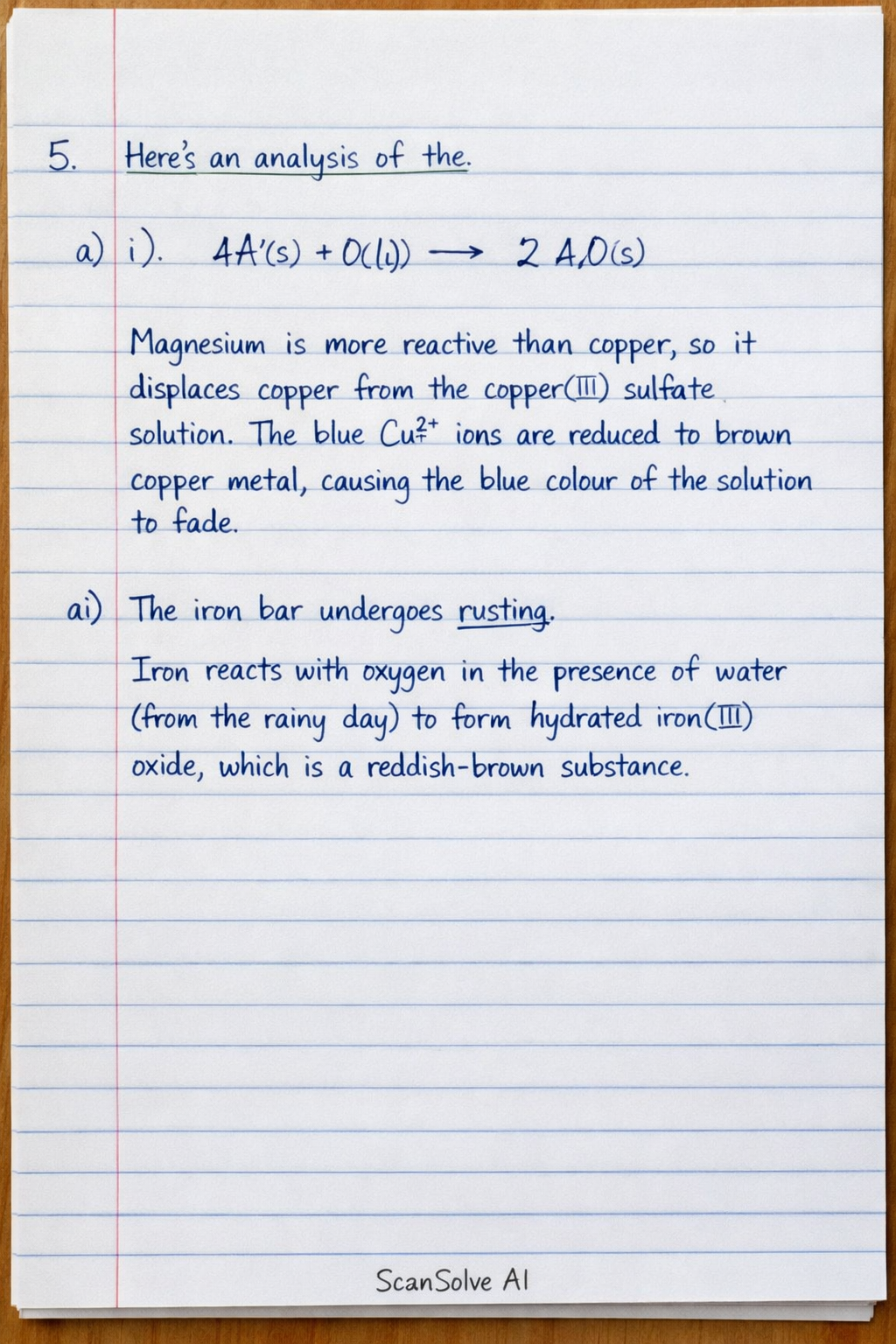
a) i) The colour of aqueous copper (II) sulphate fades when a piece of magnesium metal is dropped into the solution. (2mks) Magnesium is more reactive than copper, so it displaces copper from the copper(II) sulfate solution. The blue ions are reduced to brown copper metal, causing the blue colour of the solution to fade.
-
a) ii) A piece of iron bar is coated with a brown substance when left in the open on a rainy day. (2mks) The iron bar undergoes rusting. Iron reacts with oxygen in the presence of water (from the rainy day) to form hydrated iron(III) oxide, which is a reddish-brown substance.
-
b) A sample of water is suspected to contain aluminium ions (). Describe a laboratory experiment that can be carried out to show that () ions are present in the water sample. (3mks) To a small portion of the water sample, add a few drops of aqueous sodium hydroxide. A white precipitate will form. Continue adding aqueous sodium hydroxide in excess; the white precipitate will dissolve. This confirms the presence of ions. (Alternatively, adding aqueous ammonia would form a white precipitate that is insoluble in excess).
-
c) In an experiment to determine the number of moles of water of crystallization of a hydrated compound , 5g of the compound were heated to constant mass.
- i) Explain how a constant mass was obtained. (2mks) The compound was heated repeatedly, and its mass was measured after each heating. When two consecutive mass readings were the same, it indicated that all the water of crystallization had been driven off, leaving only the anhydrous salt.
- ii) During the experiment, the mass of the residue was found to be 2.205g. Determine the number of moles of water of crystallization in the compound. (3mks) Given: Initial mass of Mass of anhydrous Atomic masses: , , ,
-
Calculate the mass of water lost.
$$ \text{Mass of water} = \text{Initial mass} - \text{Mass of anhydrous salt} $$ $$ \text{Mass of water} = 5.0 \text{ g} - 2.205 \text{ g} = 2.795 \text{ g} $$Calculate the molar mass of anhydrous .
$$ \text{M}_{r}(\text{Na}_{2}\text{SO}_{4}) = (2 \times 23.0) + 32.0 + (4 \times 16.0) $$ $$ \text{M}_{r}(\text{Na}_{2}\text{SO}_{4}) = 46.0 + 32.0 + 64.0 = 142.0 \text{ g/mol} $$Calculate the moles of anhydrous .
$$ \text{Moles of } \text{Na}_{2}\text{SO}_{4} = \frac{\text{Mass}}{\text{Molar mass}} = \frac{2.205 \text{ g}}{142.0 \text{ g/mol}} \approx 0.015528 \text{ mol} $$Calculate the molar mass of water ().
$$ \text{M}_{r}(\text{H}_{2}\text{O}) = (2 \times 1.0) + 16.0 = 18.0 \text{ g/mol} $$Calculate the moles of water lost.
$$ \text{Moles of } \text{H}_{2}\text{O} = \frac{\text{Mass}}{\text{Molar mass}} = \frac{2.795 \text{ g}}{18.0 \text{ g/mol}} \approx 0.155278 \text{ mol} $$Determine the ratio of moles of to moles of to find X.
        $$
        \text{X} = \frac{\text{Moles of } \text{H}_{2}\text{O}}{\text{Moles of } \text{Na}_{2}\text{SO}_{4}} = \frac{0.155278 \text{ mol}}{0.015528 \text{ mol}} \approx 10.0
        $$

        The number of moles of water of crystallization is approximately 10.
        $$
        \boxed{\text{X} = 10}
        $$
Still stuck on this one?
Ask a follow-up, and the answer starts from this question.
More Chemistry Questions
Handwritten Step-by-Step Solution
Get this as a handwritten image on WhatsApp — like a tutor wrote it for you.
Try on WhatsApp