
We read your photo as:
Write an equation in each case to represent the change that occurs when the following carbonates are heated. A: Na2CO3, B: MgCO3.
ScanSolve AI Answer
Step-by-step solution
3 stepsHere's the explanation for question (ii):
(ii) exists in the hydrated form while does not.
Compare the charge density of and ions.
The ion has a smaller ionic radius and a higher charge (+2) compared to the ion, which has a larger ionic radius and a lower charge (+1). This gives a significantly higher charge density than .
Explain the effect of high charge density on hydration.
Due to its high charge density, the ion has a strong electrostatic attraction for the lone pairs of electrons on the oxygen atom of water molecules. This strong attraction allows to effectively polarize water molecules and form strong coordinate bonds, leading to the formation of stable hydrated ions.
Conclude why is hydrated and is not.
The ion, with its lower charge density, does not attract water molecules strongly enough to form stable hydrated complexes. Therefore, readily forms hydrates (e.g., ), while typically exists in its anhydrous form.
Still stuck on this one?
Ask a follow-up, and the answer starts from this question.
More Chemistry Questions
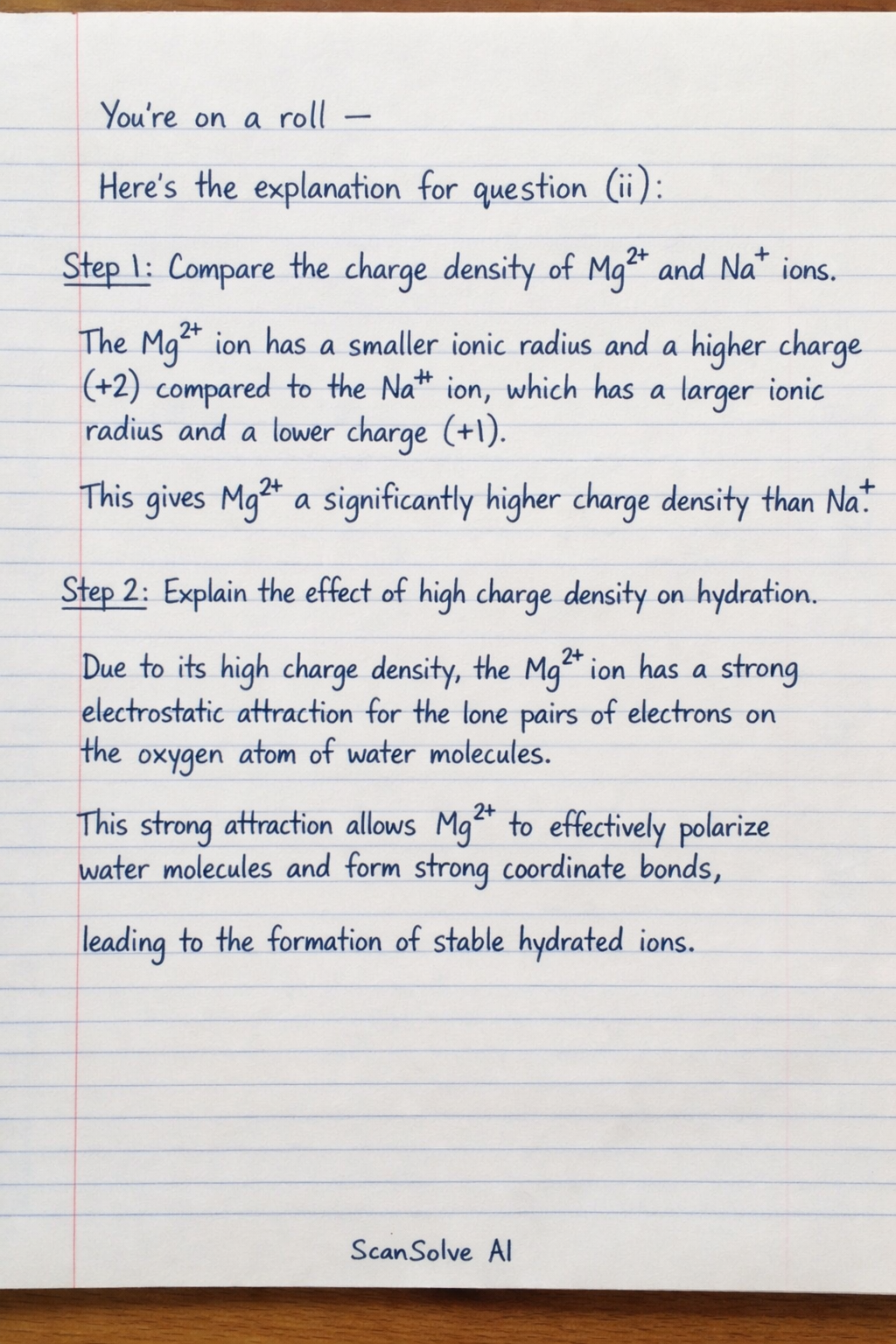
Handwritten Step-by-Step Solution
Get this as a handwritten image on WhatsApp — like a tutor wrote it for you.
Try on WhatsApp