
Notes on phase equilibrium
ScanSolve AI Answer
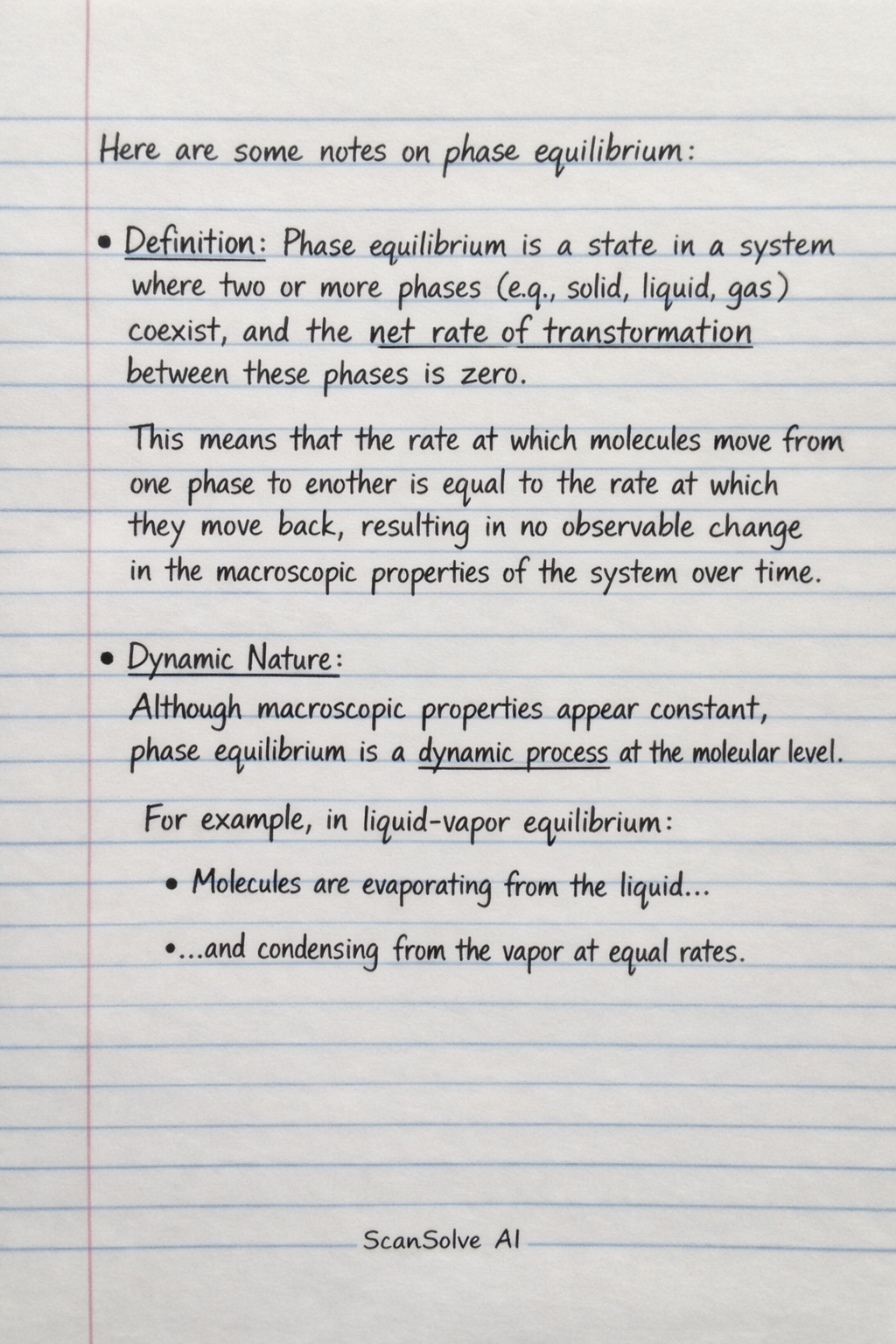
Here are some notes on phase equilibrium:
-
Definition: Phase equilibrium is a state in a system where two or more phases (e.g., solid, liquid, gas) coexist, and the net rate of transformation between these phases is zero. This means that the rate at which molecules move from one phase to another is equal to the rate at which they move back, resulting in no observable change in the macroscopic properties of the system over time.
-
Dynamic Nature: Although macroscopic properties appear constant, phase equilibrium is a dynamic process at the molecular level. For example, in liquid-vapor equilibrium, molecules are continuously evaporating from the liquid and condensing from the vapor at equal rates.
-
Conditions for Equilibrium: For a system to be in phase equilibrium, the following conditions must be met for each component across all coexisting phases:
- Temperature (T): Must be uniform throughout the system.
- Pressure (P): Must be uniform throughout the system.
- Chemical Potential (): The chemical potential of each component must be the same in all phases where it is present. This is the fundamental thermodynamic condition for phase equilibrium.
-
Gibbs Free Energy: At constant temperature and pressure, a system reaches equilibrium when its Gibbs free energy (G) is at a minimum. For phase transitions, the change in Gibbs free energy () is zero at equilibrium.
-
Phase Diagrams: These are graphical representations that show the stable phases of a substance at different temperatures and pressures. They illustrate the conditions under which different phases coexist in equilibrium (e.g., along phase boundaries like the melting curve, boiling curve, and sublimation curve) and the triple point where all three phases coexist.
-
Types of Phase Equilibria: Common examples include:
- Solid-Liquid Equilibrium: Melting/freezing point (e.g., ice and water at and ).
- Liquid-Gas Equilibrium: Boiling/condensation point (e.g., water and steam at and ).
- Solid-Gas Equilibrium: Sublimation/deposition (e.g., dry ice and gas).
Still stuck on this one?
Ask a follow-up, and the answer starts from this question.
More Chemistry Questions
Handwritten Step-by-Step Solution
Get this as a handwritten image on WhatsApp — like a tutor wrote it for you.
Try on WhatsApp