
We read your photo as:
Determine the number of electrons for a neutral Magnesium atom.
ScanSolve AI Answer
Step-by-step solution
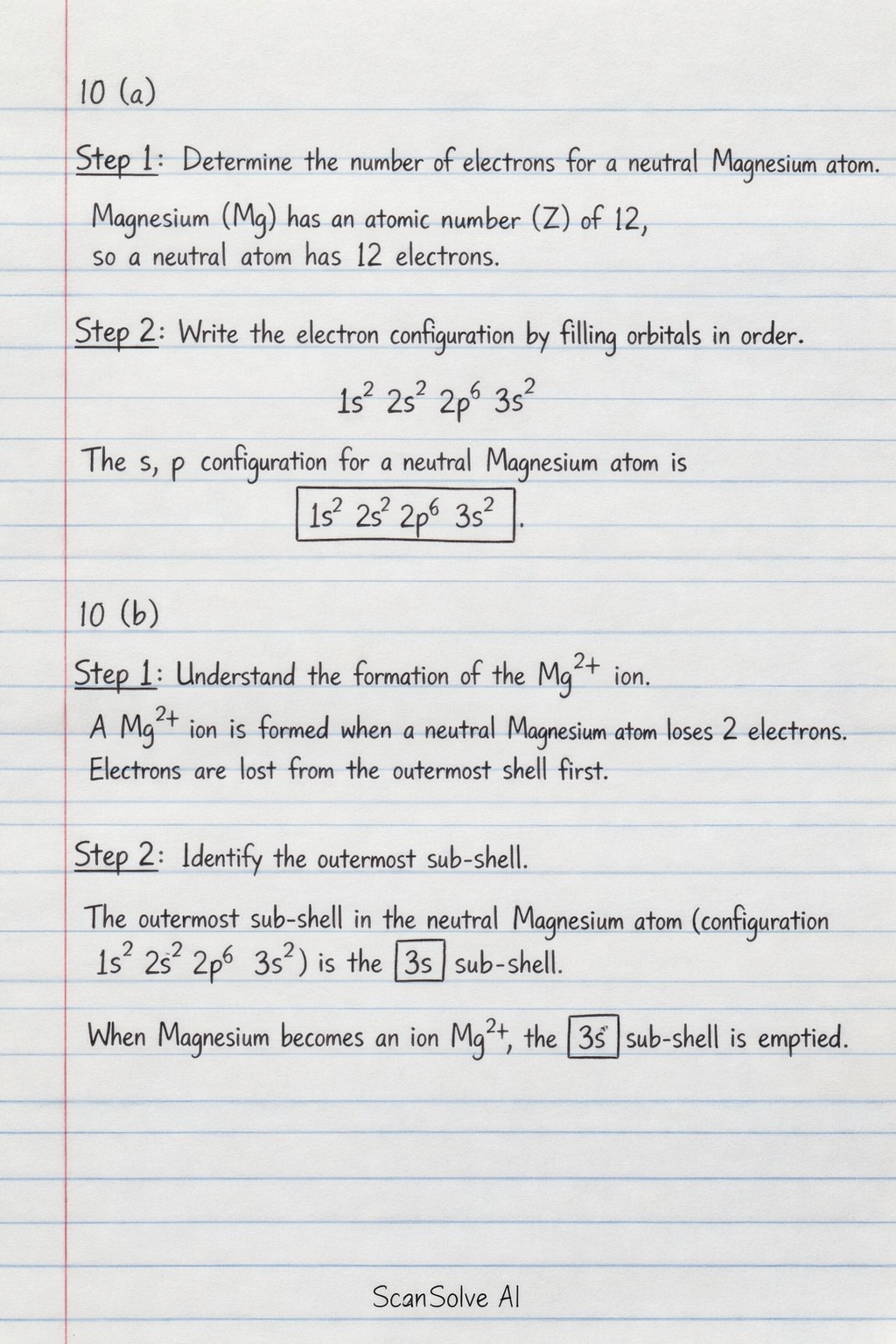
14 steps10 (a)
Determine the number of electrons for a neutral Magnesium atom.
Magnesium (Mg) has an atomic number (Z) of 12, so a neutral atom has 12 electrons.
Write the electron configuration by filling orbitals in order.
The s, p configuration for a neutral Magnesium atom is .
10 (b)
Understand the formation of the ion.
A ion is formed when a neutral Magnesium atom loses 2 electrons. Electrons are lost from the outermost shell first.
Identify the outermost sub-shell.
The outermost sub-shell in the neutral Magnesium atom (configuration ) is the sub-shell.
When Magnesium becomes an ion , the sub-shell is emptied.10 (c)
Start with the neutral Magnesium configuration and remove 2 electrons.
Neutral Mg:
Removing 2 electrons from the sub-shell results in:The resulting configuration of the ion is .
11 (a)
Determine the charge of the Calcium ion in .
Calcium (Ca) is in Group 2, so it forms a ion, meaning its valency is +2.
Determine the valency of the Hypochlorite radical ().
Since the compound is neutral, the total negative charge must balance the +2 charge from Calcium. There are two radicals, so each radical must have a valency of -1.
The valency of the Hypochlorite radical () is .11 (b) (i)
Determine the number of electrons for a neutral Chlorine atom.
Chlorine (Cl) has an atomic number (Z) of 17, so a neutral atom has 17 electrons.
Write the electron configuration for a neutral Chlorine atom.
Determine the number of electrons for a ion.
A ion is formed when a neutral Chlorine atom gains 1 electron. So, it has electrons.
Write the electron configuration for the ion.
The gained electron will fill the sub-shell.
The s, p configuration for the ion is .
11 (b) (ii)
Identify the reactants and product with their chemical formulas and states.
Reactants: Calcium () and Chlorine gas ().
Product: Calcium Chloride ().Write the unbalanced chemical equation.
Balance the equation.
The equation is already balanced with one Ca atom and two Cl atoms on both sides.
The balanced equation with state symbols is:
Still stuck on this one?
Ask a follow-up, and the answer starts from this question.
More Chemistry Questions
Handwritten Step-by-Step Solution
Get this as a handwritten image on WhatsApp — like a tutor wrote it for you.
Try on WhatsApp