

This chemistry question involves key chemical concepts and calculations. The detailed solution below walks through each step, from identifying the reaction type to computing the final answer.
ScanSolve AI Answer
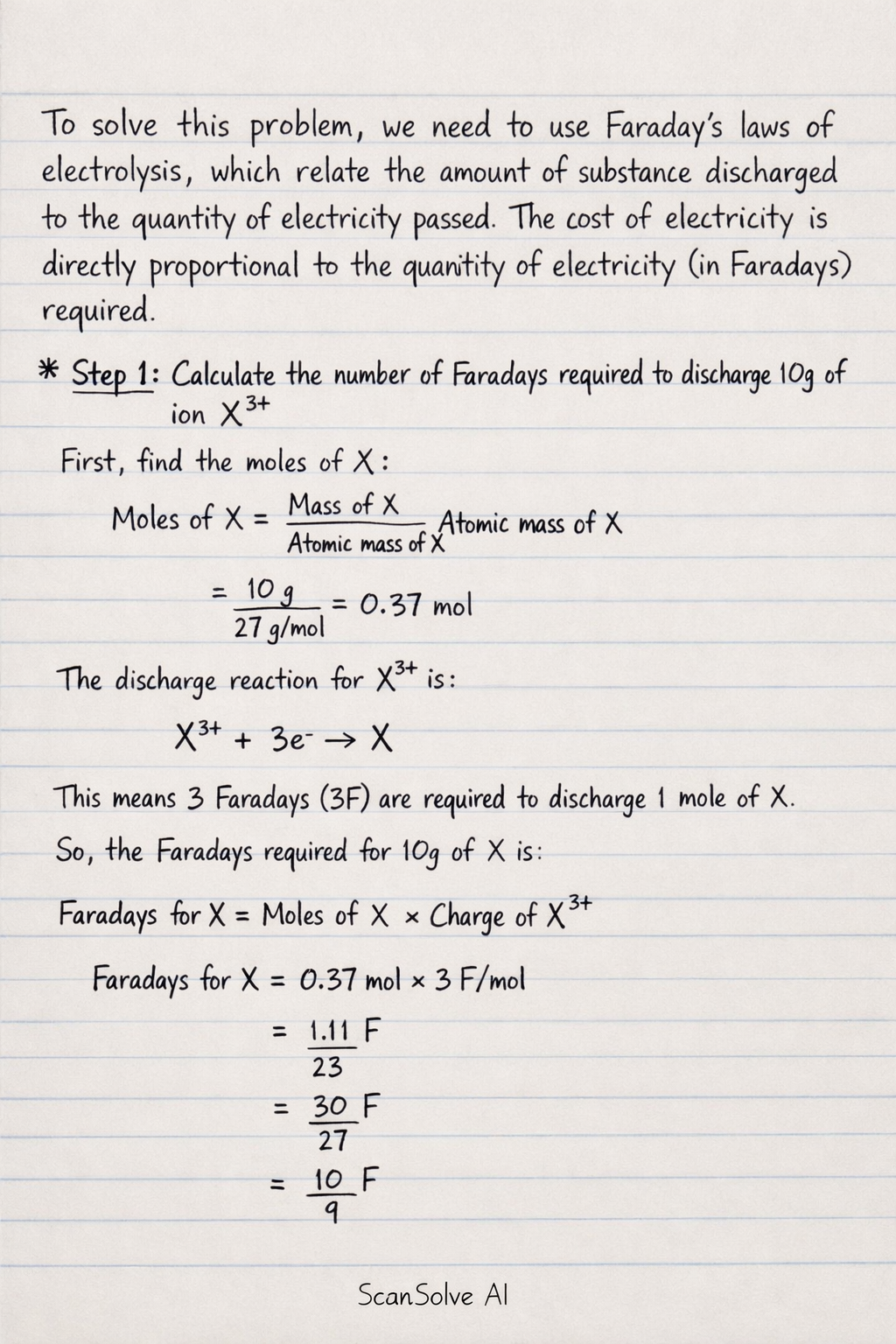
To solve this problem, we need to use Faraday's laws of electrolysis, which relate the amount of substance discharged to the quantity of electricity passed. The cost of electricity is directly proportional to the quantity of electricity (in Faradays) required. Step 1: Calculate the number of Faradays required to discharge 10g of ion X^3+ First, find the moles of X: Moles of X = Mass of XAtomic mass of X = 10 g27 g/mol The discharge reaction for X^3+ is: X^3+ + 3e^- X This means 3 Faradays (3F) are required to discharge 1 mole of X. So, the Faradays required for 10g of X is: Faradays for X = Moles of X × Charge of X^3+ Faradays for X = (10)/(27) mol × 3 F/mol = (30)/(27) F = (10)/(9) F Step 2: Determine the cost per Faraday We are given that the cost to discharge 10g of X^3+ (which is (10)/(9) F) is ₦20.00. Cost per Faraday = Total costTotal Faradays = ₦20.00(10)/(9) F Cost per Faraday = ₦20.00 × (9)/(10) F^-1 = ₦2 × 9 F^-1 = ₦18.00/F Step 3: Calculate the number of Faradays required to discharge 6g of ion Y^2+ First, find the moles of Y: Moles of Y = Mass of YAtomic mass of Y = 6 g24 g/mol = (1)/(4) mol = 0.25 mol The discharge reaction for Y^2+ is: Y^2+ + 2e^- Y This means 2 Faradays (2F) are required to discharge 1 mole of Y. So, the Faradays required for 6g of Y is: Faradays for Y = Moles of Y × Charge of Y^2+ Faradays for Y = (1)/(4) mol × 2 F/mol = (2)/(4) F = (1)/(2) F = 0.5 F Step 4: Calculate the cost to discharge 6g of ion Y^2+ Using the cost per Faraday calculated in Step 2: Cost for Y = Faradays for Y × Cost per Faraday Cost for Y = 0.5 F × ₦18.00/F = ₦9.00 The cost to discharge 6g of ion Y^2+ is ₦9.00. The final answer is ₦9.00.