
We read your photo as:
Which of the following actions cannot be used to control pollution? A. Planting and caring for trees B. Placing liquid and semi-liquid wastes in unlined pits C. Excessive use of agrochemicals D. Colle
ScanSolve AI Answer
Answer
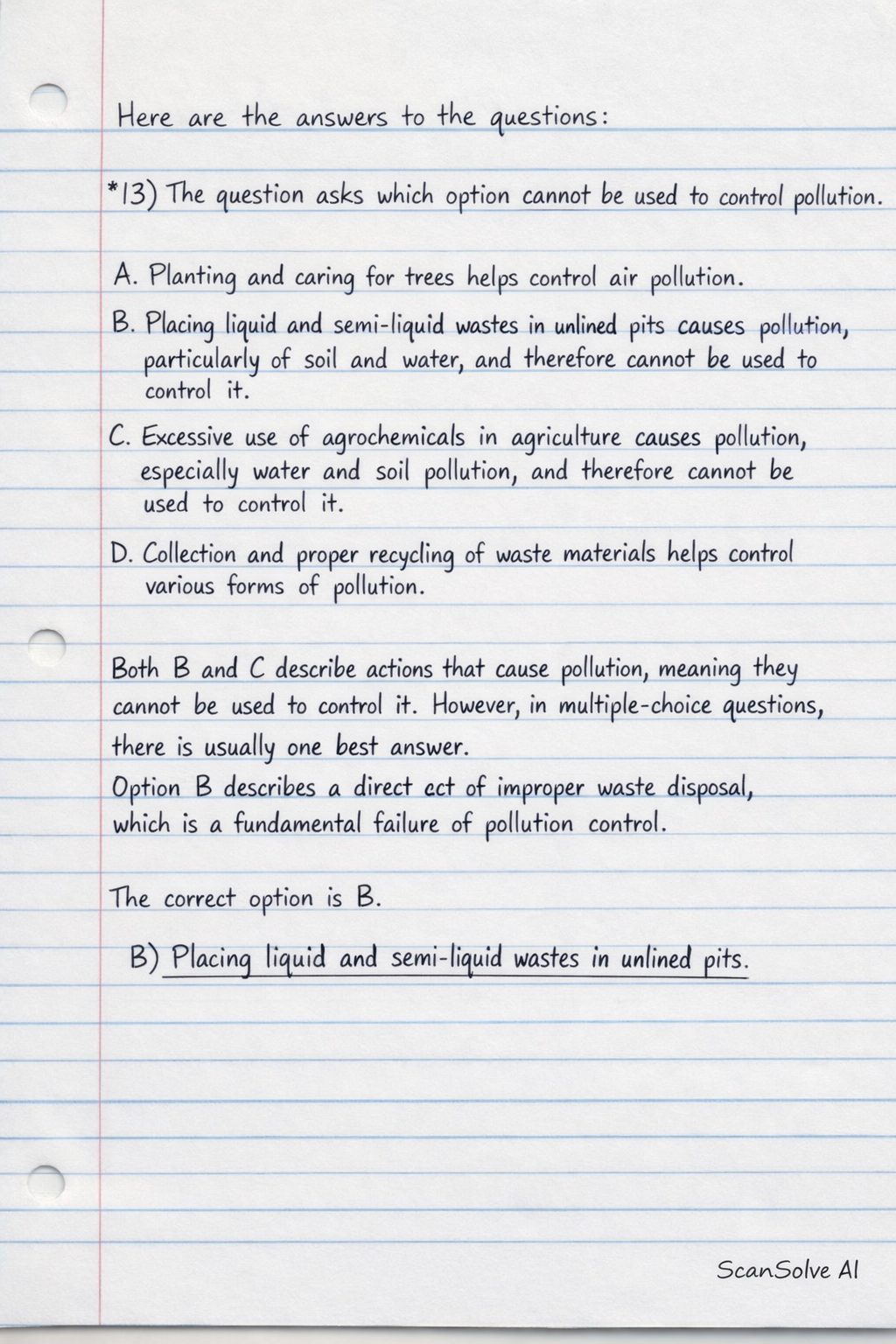
Here are the answers to the questions:
13) The question asks which option cannot be used to control pollution.
A. Planting and caring for trees helps control air pollution.
B. Placing liquid and semi-liquid wastes in unlined pits causes pollution, particularly of soil and water, and therefore cannot be used to control it.
C. Excessive use of agrochemicals in agriculture causes pollution, especially water and soil pollution, and therefore cannot be used to control it.
D. Collection and proper recycling of waste materials helps control various forms of pollution.
Both B and C describe actions that cause pollution, meaning they cannot be used to control it. However, in multiple-choice questions, there is usually one best answer. Option B describes a direct act of improper waste disposal, which is a fundamental failure of pollution control.
The correct option is B.
- B) Placing liquid and semi-liquid wastes in unlined pits
14) Group VIII elements (also known as Group 18 or noble gases) are characterized by their full outer electron shells, which makes them very stable and unreactive.
A. highly reactive (Incorrect)
B. unreactive (Correct)
C. stored under oil (Incorrect, this applies to highly reactive alkali metals)
D. good conductors of heat (Incorrect)
The correct option is B.
- B) unreactive
15) The question asks which option cannot be used to control food poisoning.
A. Good hygienic practices help prevent food poisoning.
B. Improper storage and temperature control causes bacterial growth and spoilage, leading to food poisoning. Therefore, it cannot be used to control food poisoning.
C. Safe water supply prevents waterborne diseases and contamination.
D. Routine inspection and proper regulation ensure food safety standards are met.
The correct option is B.
- B) Improper storage and temperature control
16) When most metals react with acids, they displace hydrogen from the acid, producing a salt and hydrogen gas.
For example:
A. sodium gas (Incorrect)
B. hydrogen gas (Correct)
C. oxygen gas (Incorrect)
D. nitrogen gas (Incorrect)
The correct option is B.
- B) hydrogen gas
17) Food poisoning typically presents with gastrointestinal symptoms and sometimes fever.
A. nausea (A common symptom of food poisoning)
B. vomiting (A common symptom of food poisoning)
C. fever (Can be a symptom of food poisoning)
D. cough (Not typically a symptom of food poisoning)
The correct option is D.
- D) cough
18) The question asks which option does not bring about indigestion.
A. Eating too much acidic foods can irritate the stomach and cause indigestion.
B. Eating at irregular times can disrupt the digestive system and lead to indigestion.
C. Eating enough roughage (fiber) aids digestion and helps prevent indigestion. Therefore, eating enough roughage does not cause indigestion; it helps prevent it.
D. Improper chewing of food makes it harder for the digestive system to break down food, leading to indigestion.
The correct option is C.
- C) Eating enough roughage
19) A metal is an element that is typically shiny, malleable, ductile, and a good conductor of heat and electricity.
A. Chlorine () is a non-metal.
B. Oxygen () is a non-metal.
C. Magnesium () is an alkaline earth metal.
D. Sulphur () is a non-metal.
The correct option is C.
- C) Magnesium
24) Micronutrients are essential nutrients that the body needs in small amounts, such as vitamins and trace minerals. Macronutrients are needed in larger amounts (e.g., carbohydrates, proteins, fats, and major minerals).
A. Nitrogen is a component of proteins (a macronutrient) but not typically classified as a micronutrient itself in human nutrition.
B. Phosphorus is a macromineral, needed in relatively large amounts.
C. Potassium is a macromineral, needed in relatively large amounts.
D. Zinc is a trace mineral, which is a type of micronutrient.
The correct option is D.
- D) Zinc
25) The question asks which option is not a type of tooth.
A. Premolars are a type of tooth used for crushing and grinding.
B. Homodont describes a type of dentition where all teeth are similar in shape and size (e.g., in sharks). Humans have heterodont dentition, meaning we have different types of teeth (incisors, canines, premolars, molars). Homodont is a characteristic of a set of teeth, not an individual tooth type.
C. Incisors are a type of tooth used for cutting.
D. Canines are a type of tooth used for tearing.
The correct option is B.
- B) Homodont
Try one yourself
A new problem that tests the same skill.
Still stuck on this one?
Ask a follow-up, and the answer starts from this question.
More Chemistry Questions
Handwritten Step-by-Step Solution
Get this as a handwritten image on WhatsApp — like a tutor wrote it for you.
Try on WhatsApp