

This chemistry question involves key chemical concepts and calculations. The detailed solution below walks through each step, from identifying the reaction type to computing the final answer.
ScanSolve AI Answer
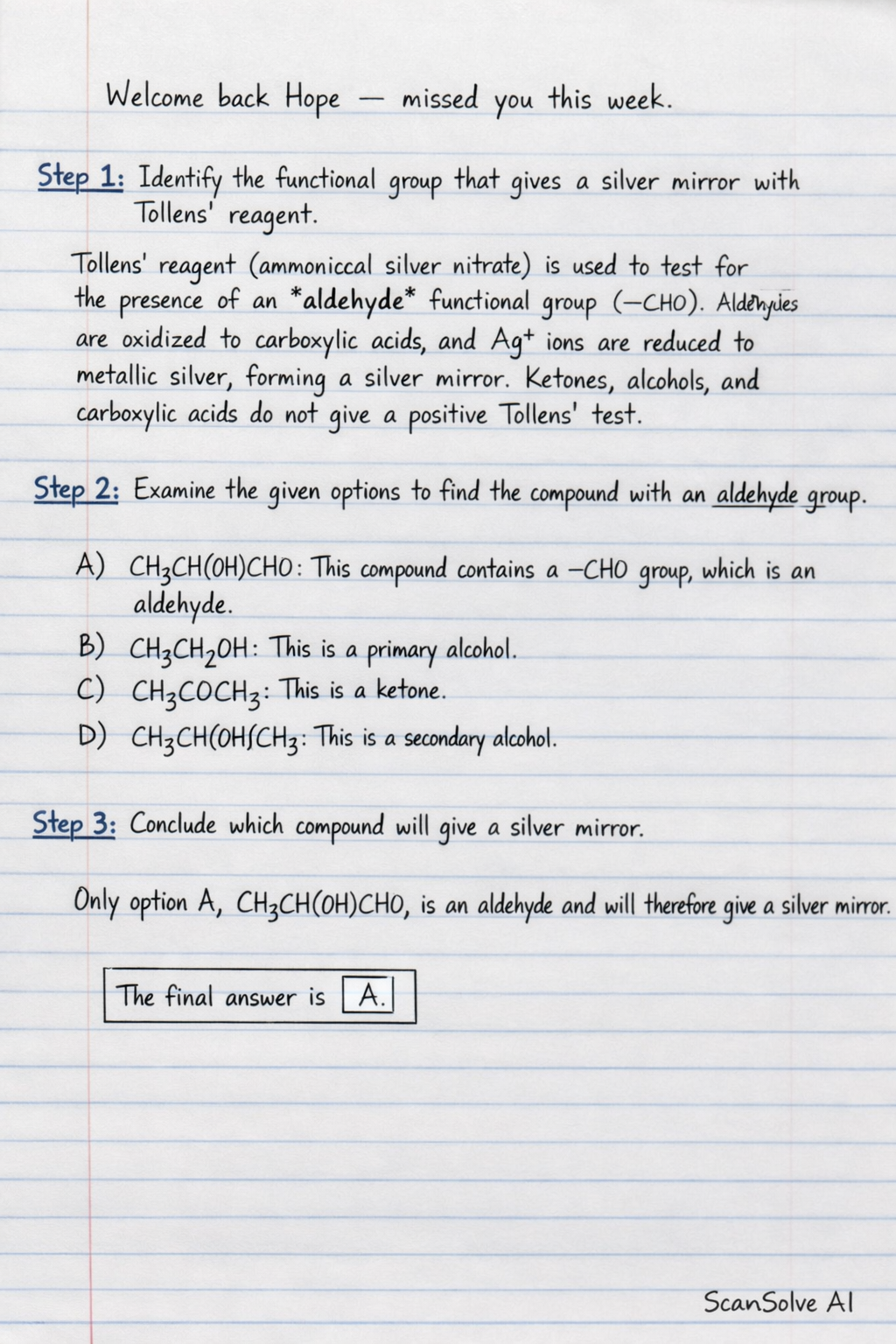
Welcome back Hope — missed you this week. Step 1: Identify the functional group that gives a silver mirror with Tollens' reagent. Tollens' reagent (ammoniacal silver nitrate) is used to test for the presence of an aldehyde functional group (-CHO). Aldehydes are oxidized to carboxylic acids, and Ag^+ ions are reduced to metallic silver, forming a silver mirror. Ketones, alcohols, and carboxylic acids do not give a positive Tollens' test. Step 2: Examine the given options to find the compound with an aldehyde group. A) CH_3CH(OH)CHO: This compound contains a -CHO group, which is an aldehyde. B) CH_3CH_2OH: This is a primary alcohol. C) CH_3COCH_3: This is a ketone. D) CH_3CH(OH)CH_3: This is a secondary alcohol. Step 3: Conclude which compound will give a silver mirror. Only option A, CH_3CH(OH)CHO, is an aldehyde and will therefore give a silver mirror. The final answer is A. --- Step 1: Determine the concentration of hydrogen ions ([H^+]). Sulphuric acid (H_2SO_4) is a strong diprotic acid, meaning it dissociates to release two protons per molecule. For strong acids, we can assume complete dissociation. H_2SO_4 2H^+ + SO_4^2- Given concentration of H_2SO_4 = 0.05 mol dm^-3. Therefore, [H^+] = 2 × 0.05 mol dm^-3 = 0.10 mol dm^-3. Step 2: Calculate the pH using the hydrogen ion concentration. The pH is calculated using the formula: pH = -_10[H^+] Substitute the calculated [H^+]: pH = -_10(0.10) pH = 1 Step 3: Compare the calculated pH with the given options. The calculated pH of 1 matches option A. The final answer is A. --- Step 1: Calculate the number of half-lives that occur in 24 days. Given half-life (t_1/2) = 8 days. Given total time (t) = 24 days. Number of half-lives (n) = Total timeHalf-life n = 24 days8 days = 3 Step 2: Calculate the fraction of the original isotope remaining after 3 half-lives. The fraction remaining after n half-lives is given by the formula: Fraction remaining = ((1)/(2))^n Substitute n=3: Fraction remaining = ((1)/(2))^3 = (1)/(2 × 2 × 2) = (1)/(8) Step 3: Compare the calculated fraction with the given options. The calculated fraction of 1/8 matches option B. The final answer is B. --- Step 1: Calculate the number of moles of the volatile organic liquid. At s.t.p (standard temperature and pressure), 1 mole of any gas occupies 22.4 dm^3. Given volume of gas = 0.112 dm^3. Moles = VolumeMolar volume at s.t.p Moles = 0.112 dm^322.4 dm^3 mol^-1 = 0.005 mol Step 2: Calculate the molar mass of the liquid. Given mass of sample = 0.30 g. Molar mass = MassMoles Molar mass = 0.30 g0.005 mol = 60 g mol^-1 Step 3: Determine the molecular formula by calculating the molar mass for each option. Relative atomic masses (R.A.M): H=1, C=12, O=16. A) CH_3OH: (1 × 12) + (4 × 1) + (1 × 16) = 12 + 4 + 16 = 32 g mol^-1 B) CH_3COCH_3 (Propanone, C_3H_6O): (3 × 12) + (6 × 1) + (1 × 16) = 36 + 6 + 16 = 58 g mol^-1 C) CH_3CHO (Ethanal, C_2H_4O): (2 × 12) + (4 × 1) + (1 × 16) = 24 + 4 + 16 = 44 g mol^-1 D) CH_3CH_2CH_2OH (Propan-1-ol, C_3H_8O): (3 × 12) + (8 × 1) + (1 × 16) = 36 + 8 + 16 = 60 g mol^-1 Step 4: Identify the option with the matching molar mass. The molar mass of CH_3CH_2CH_2OH (or any isomer with formula C_3H_8O) is 60 g mol^-1, which matches the calculated molar mass. The final answer is D. --- Step 1: Understand the conditions for cis-trans (geometric) isomerism. Cis-trans isomerism occurs in molecules with restricted rotation around a bond (typically a carbon-carbon double bond or a ring structure) and where each carbon atom involved in the restricted rotation is bonded to two different groups. Step 2: Analyze each option for the presence of a carbon-carbon double bond and different groups on each carbon. A) $\