
We read your photo as:
Which of the following is primarily composed of calcium phosphate? Which strong base turns red litmus blue? Match the reaction types with their examples.
ScanSolve AI Answer
Step-by-step solution
3 steps-
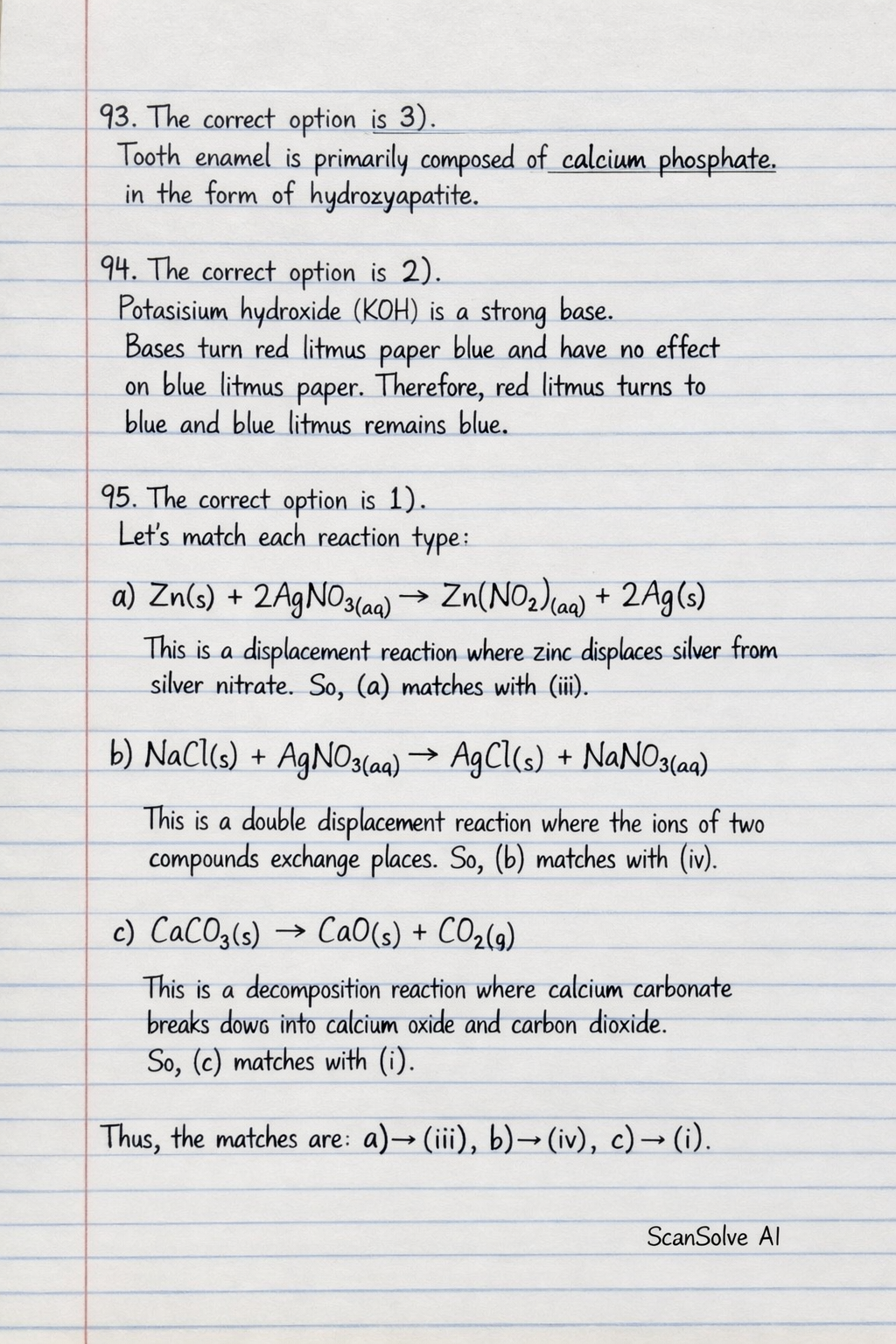
The correct option is 3). Tooth enamel is primarily composed of calcium phosphate in the form of hydroxyapatite.
-
The correct option is 2). Potassium hydroxide () is a strong base. Bases turn red litmus paper blue and have no effect on blue litmus paper. Therefore, red litmus turns to blue and blue litmus remains blue.
-
The correct option is 1). Let's match each reaction type:
- a) This is a displacement reaction where zinc displaces silver from silver nitrate. So, (a) matches with (iii).
- b) This is a double displacement reaction where the ions of two compounds exchange places. So, (b) matches with (iv).
- c) This is a decomposition reaction where a single compound breaks down into two or more simpler substances. So, (c) matches with (i).
- d) This is a combination reaction where two or more reactants combine to form a single product. So, (d) matches with (ii).
Therefore, the correct matching is (a)-(iii), (b)-(iv), (c)-(i), (d)-(ii).
- The correct option is 4). To find the value of x, we need to balance the chemical equation:
Balance Carbon (C) atoms.
There are 3 carbon atoms on the left side (). So, there must be 3 carbon atoms on the right side.
The equation becomes:
Balance Hydrogen (H) atoms.
There are 8 hydrogen atoms on the left side (). So, there must be 8 hydrogen atoms on the right side. Since each water molecule () has 2 hydrogen atoms, we need 4 water molecules.
The equation becomes:
Balance Oxygen (O) atoms.
Count the total oxygen atoms on the right side:
From : oxygen atoms.
From : oxygen atoms.
Total oxygen atoms on the right side = .
On the left side, we have , which means oxygen atoms.The balanced equation is:
The value of x is .
Still stuck on this one?
Ask a follow-up, and the answer starts from this question.
More Chemistry Questions
Handwritten Step-by-Step Solution
Get this as a handwritten image on WhatsApp — like a tutor wrote it for you.
Try on WhatsApp